10 Practical Items You Can Print With a 3D Printer
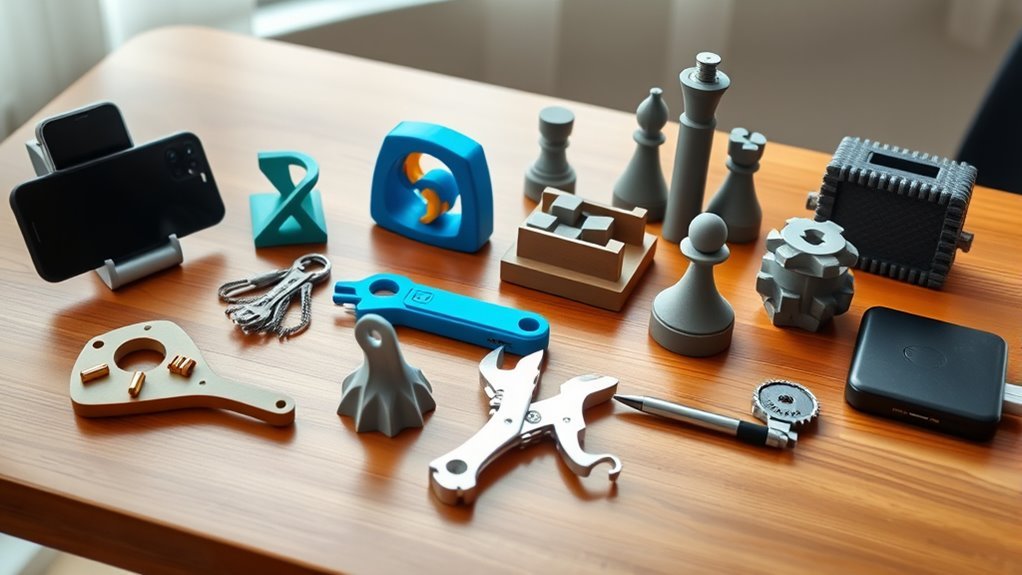
You can print custom cable organizers with clips and spiral holders to tame clutter, or wall-mounted tool holders that snap onto pegboards for easy access.
Replacement knobs and simple hooks help upgrade gear and organize spaces.
Phone stands with cable slots keep devices handy.
Ergonomic grips improve comfort, and small mechanical parts, enclosures, or bag clips add everyday functionality.
Plus, key tags and cord protectors help keep things tidy.
Exploring these ideas reveals even more ways to optimize your setup.
Key Takeaways
- Print custom cable organizers like clips, spiral holders, and TPU ties to keep cords tidy and prevent tangling on desks or behind monitors. These little helpers make a big difference in keeping your workspace neat.
- Create modular wall-mounted tool racks with peg holes and snap-fit compartments for easy organization and accessibility in workshops. It’s super handy to have everything in reach without clutter.
- Design ergonomic replacement knobs with adjustable dimensions and textured grips in durable materials like PETG for enhanced usability. Plus, you can customize them to fit perfectly and feel comfortable.
- Produce simple hooks and wall clips with countersunk screw holes for secure mounting and load support up to 10 kg. They’re great for hanging items without worrying about stability.
- Fabricate functional enclosures and mechanical parts including hinges, snap-fits, and ventilation slots using PETG or nylon with proper clearances. These parts can really improve the durability and functionality of your projects.
Custom Cable Organizers
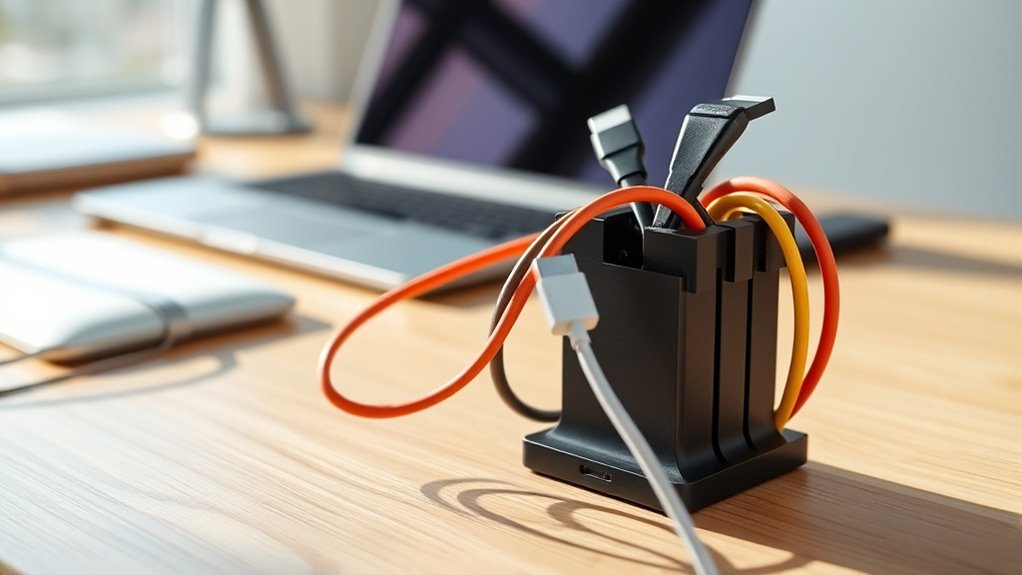
When managing cables, custom 3D-printed organizers let you tailor clip spacing and diameters to fit common sizes like USB-A, USB-C, and power cords perfectly.
Printing custom cable organizers with parametric designs means you can precisely match clips to cable diameters between 4 mm and 12 mm, ensuring a snug fit.
You can create print-in-place spiral holders or snap-on clips in PLA with moderate infill for rigidity, placing 2–3 clips per meter to keep cables tidy.
For bundling, flexible TPU cable ties shine—they’re reusable, stretchable, and tool-free.
Print these at slower speeds with low infill to maintain their elasticity.
Combining these elements, you’ll organize your cables neatly and securely, whether on desks or behind monitors, reducing clutter and preventing tangles efficiently.
Tool Holders
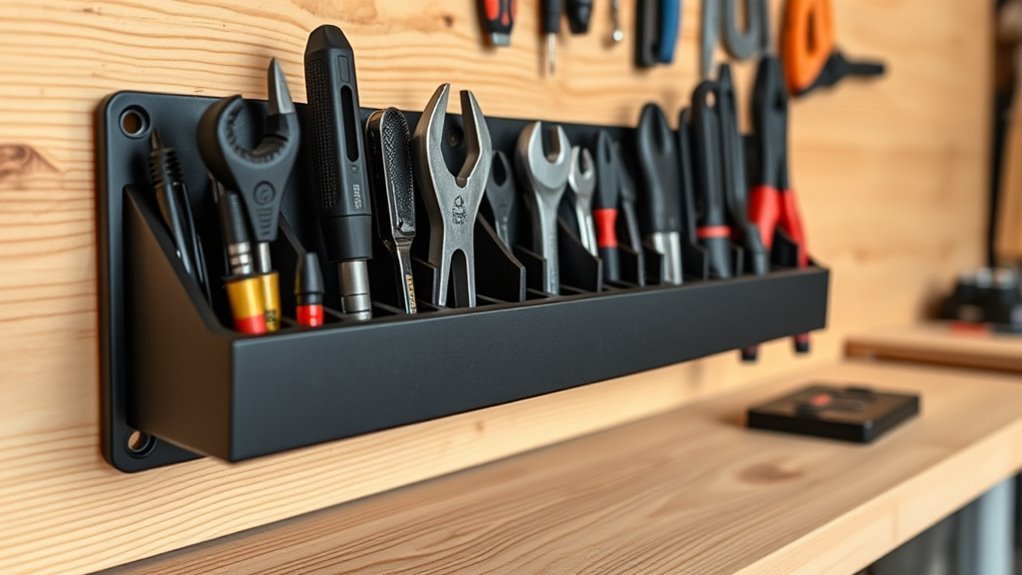
You can keep your workspace tidy by printing wall-mounted organizers that fit your tools perfectly. Modular tool racks let you customize your setup and rearrange tools as needed.
For on-the-go projects, portable tool caddies offer quick access without cluttering your desk. They’re super handy when you need to move around but still want everything within reach.
Wall-Mounted Organizer
With a wall-mounted organizer, you can keep your tools neatly arranged and easily accessible. A wall-mounted tool holder is one of the best 3D printing projects to optimize your workspace.
Print modular pegboard-compatible hooks or custom-shaped slots using PETG or PLA with 20–40% infill and 3–4 top/bottom layers for strength. Design slots about 25–30 mm wide for screwdrivers and 35–45 mm for pliers handles to guarantee a snug fit.
For heavy tools like hammers, print thicker mounting brackets (≥4 mm walls) with filleted stress points. Secure them using M6 screws and nylon anchors instead of adhesives.
Make sure to orient prints so layers run perpendicular to pulling force. Also, add 100% infill ribs or honeycomb for durability.
You might want to add labeled tags or rubberized TPU inserts to protect your tools and reduce slipping. It really helps keep everything in place and easy to find!
Modular Tool Racks
Although modular tool racks might seem complex, they offer a flexible and expandable solution for organizing your workspace. You can print interlocking modules, typically 50–100 mm wide, that snap together without tools to line a wall or pegboard.
Design these modular racks with standard peg holes—like 1/4″ (6 mm)—and include hex sockets or nut pockets to fit common bits and screwdrivers. Print-in-place holders for pliers and wrenches with small flex gaps guarantee a secure grip while maintaining strength.
For heavier tools, use thicker walls and durable materials like PETG or ABS, and for lighter items, PLA with lower infill works well. Adding labeled slots or embossed text helps keep everything clear.
Plus, standard mounting spacings make expanding your rack straightforward and neat. It’s a simple way to keep your tools handy and organized!
Portable Tool Caddies
Portable tool caddies bring your workspace organization to the next level by offering customizable, expandable compartments that keep your tools within easy reach.
You can print modular tool caddies featuring hexagonal honeycomb cells, sized 30–50 mm per side. These are perfect for screwdrivers, pliers, and pens.
Use parametric STL files to adjust internal dividers and wall thickness (2–4 mm) for strength and efficiency.
Don’t forget to include reinforced handles with 3–6 perimeters and 20–30% gyroid or grid infill. This helps support frequent lifting without wear and tear.
Add integrated mounting features like keyhole slots or M4 nut traps, designed around 7.5 mm to fit M4 hex nuts. This way, you can securely attach your caddy to walls or pegboards.
For portability, design snap-fit compartments and add removable TPU inserts or rubber feet. These prevent sliding and absorb vibration during transport, keeping your tools safe on the go.
Replacement Knobs
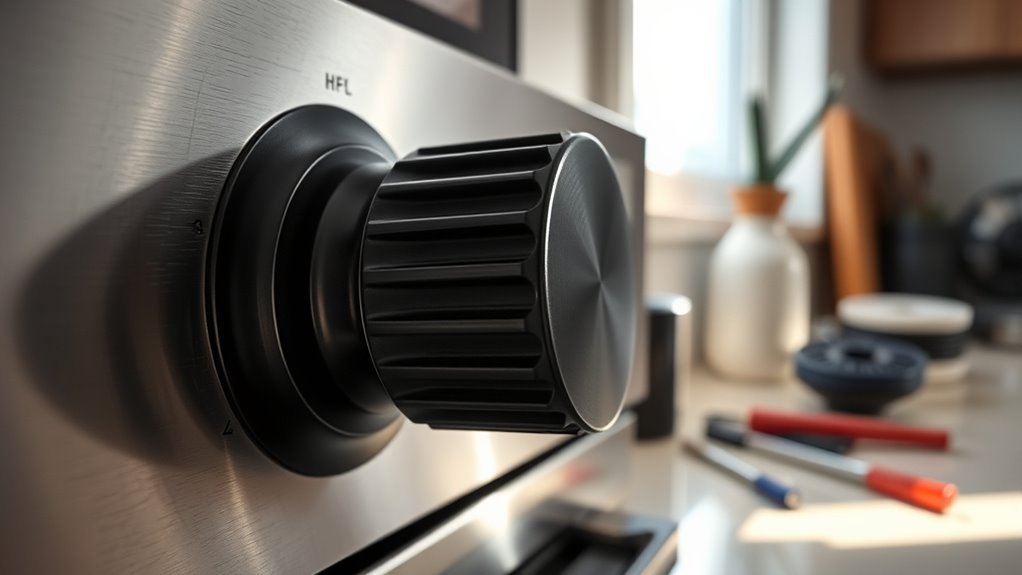
You can easily customize replacement knobs to fit your exact appliance needs by adjusting size and shaft fit with parametric designs. Choosing durable materials like PETG or ASA guarantees your knobs withstand regular use and heat exposure.
With the right settings, you’ll get knobs that feel sturdy and comfortable every time you turn them. It’s all about getting that perfect fit and feel, so your appliance works just like new.
Easy Customization Options
Getting your replacement knobs just right starts with precise measurements—grab calipers to note the original knob’s diameter, shaft size, and depth. This way, your print fits snugly without wobbling.
You can easily customize the knob diameter and height by scaling parametric STL templates in your slicer. It makes tailoring each knob to fit perfectly super simple.
Want a knob that doubles as a bottle opener or integrates a bag clip? Just add those features in your 3D model before printing.
For a secure fit, include a grub-screw hole or a tapered D-flat bore. Textured surfaces like knurling or ribs improve grip and add style.
Customizing knobs this way not only replaces broken parts but also upgrades your everyday items with practical, personalized touches.
Durability and Material Choices
Although customizing your replacement knobs is important, choosing the right material and print settings guarantees they hold up under repeated use.
For knobs facing repeated torque, like on drills or ovens, PETG offers excellent layer adhesion and chemical resistance. ABS tolerates higher heat—just remember ABS needs an enclosure to print well.
If you want flexibility and grip, TPU with shore hardness between 85A–95A provides durable elasticity and shock absorption.
Use 100% infill or at least 50–75% with multiple perimeters and thicker walls to avoid cracking under load. Also, consider incorporating brass or steel heat-set inserts for metal-to-plastic fittings to prevent wear.
Oh, and always check your 3D printing platform’s Terms of Service before printing replacement parts to make sure you’re compliant and safe.
Simple Hooks
Simple hooks can easily be whipped up on a 3D printer using PLA in under an hour, making them perfect for organizing coats or hats. You can print hooks sized 50–100 mm, with 2–3 hooks per item for reliable support.
For loads up to 10 kg, set 3–4 solid walls and 20–30% infill. To mount flush, choose designs with countersunk screw holes or keyhole slots.
Print hooks vertically with shallow overhangs to avoid supports, or horizontally with minimal supports under curves. Kids love customizing hooks with Star Wars or other cool stuff designs, turning practical items into fun decor.
Test strength by printing small samples and reinforcing bases with fillets. These simple hooks bring both function and style to your home organization.
Phone Stands and Mounts
You can print phone stands with adjustable viewing angles for comfortable use during video calls or browsing.
Desk and car mounts keep your phone secure, whether you’re working or driving, with options like magnetic holds or vent clips.
Don’t forget to include cable management features to keep your charging cords organized and out of the way.
Adjustable Viewing Angles
When designing phone stands with adjustable viewing angles, you can print hinged or slotted models that offer common tilts around 15°, 30°, and 45°. These angles are perfect for reading, watching videos, or video calls.
One is probably familiar with the hassle of awkward angles while sipping electric coffee, so a well-designed stand makes the experience even better. Use parametric designs to scale hinge pins and slot clearances, letting you choose rigid PLA for stable positions or flexible TPU for smooth, continuous adjustment without extra hardware.
Add a 10–15 mm lip and slight backward tilt on the cradle to prevent slipping. Also, consider rubberized TPU pads or recessed holes for silicone inserts to boost grip.
These tweaks guarantee your phone stays secure and comfortable at any angle.
Desk and Car Mounts
Adjustable phone mounts for desks and cars combine functionality with ease of use, letting you keep your device accessible and secure throughout the day. You can print a simple desk stand with tilt and a cable slot in 20–40 minutes using 15–20% infill, fitting phones up to 6.8″.
For cars, vent mounts with a 4 mm peg fit most slats and print best in PETG to resist heat—PLA risks deformation above 60°C. Magnetic mounts embed 10×3 mm neodymium magnets in snug pockets, requiring a metal plate on your phone.
Suction mounts pair a printed arm with a commercial suction cup and M4 screw joint for adjustable windshield or dashboard placement. Plus, universal bike or cupholder mounts clamp securely with parametric designs that balance strength and weight.
Cable Management Features
Cable management features take phone stands and mounts to the next level by keeping charging cables neatly routed and reducing wear on connectors. You can print phone stands with integrated cable channels and USB-C or Lightning passthroughs, typically adding a 5–8 mm-wide groove to fit common cables snugly.
Wall- or desk-mounted cable clips printed in PETG or PLA+ secure cables between 3–8 mm in diameter without needing adhesive. For coiled cables, spool-style tidies with flexible TPU grommets protect insulation at entry points.
Adjustable phone mounts often include integrated cable clips and set a 15–20° viewing angle, letting you charge hands-free. You can also design parametric inserts for desks or monitor arms with multiple 3–10 mm channels to separate power, USB, and headphone cables, reducing clutter and interference.
Drawer Dividers and Storage Trays
You can easily create custom-fit drawer dividers and storage trays by measuring your drawer’s internal dimensions to within ±1 mm and printing modular inserts that lock together without glue. Use 3–4 mm thick walls with 20–30% infill for general use, or increase infill to 100% for heavy-duty storage.
Parametric designs let you adjust grid spacing in 5–10 mm increments to fit cutlery, cosmetics, or screws. Print trays with labeling slots or lids, choosing PETG for humid areas and PLA for dry spaces.
For multi-drawer setups, design interlocking tabs or dovetail rails with 2–3 mm tolerance to keep trays stable.
| Feature | Recommendation |
|---|---|
| Wall Thickness | 3–4 mm |
| Infill | 20–30% (general), 100% (heavy) |
| Material | PETG (humid), PLA (dry) |
Ergonomic Grips
How can 3D printing improve your tool handling? By creating ergonomic grips tailored to your hands, you gain comfort and better control. Using flexible filaments like TPU at 20–40% infill cushions your grip and boosts torque transfer.
You can customize grip size by measuring your palm’s widest part and adding 5–8 mm for ease. Textured surfaces, such as hex or waffle patterns, increase friction without bulk.
For power tools, overmold grips combine a rigid PLA core with a soft TPU sleeve, enhancing durability and vibration damping.
- Customize diameter, thumb rests, and finger grooves for a perfect fit.
- Use textured patterns printed at 0.4–0.8 mm height for better grip.
- Print rigid parts in PETG or ASA for heat and chemical resistance.
- Make flexible sleeves replaceable to extend grip lifespan.
Key Tags and Cord Protectors
Looking for simple ways to organize your keys and protect your cords? 3D printing lets you create customized key tags and durable cord protectors that fit your style and needs perfectly.
Print personalized key tags (40–60 mm long) with integrated split-ring holes in PETG or PLA+ for strength. For cables, flexible TPU cord protectors reduce strain by extending bend radius and snap on easily.
You can also print small clips to keep cables neat, mounting them with adhesive or screws.
| Item | Typical Specs |
|---|---|
| Key Tags | 40–60 mm, 3–4 mm thick, ~10–30 min print |
| Cord Protectors | Flexible TPU, shore 85A, zipper or spiral style |
| Cable Clips | 10–25 mm wide, adhesive or screw mount |
Small Mechanical Parts and Enclosures
Although small mechanical parts like gears, bushings, and spacers may seem simple, printing them with the right materials and settings guarantees durability and functionality. Choose PLA or PETG with a 0.1–0.2 mm layer height and 20–40% infill to balance strength and print time.
For functional hinges and snap-fit enclosures, use PETG or nylon with 0.2–0.5 mm clearance to make certain smooth movement and wear resistance. When designing enclosures, add 2–3 mm wall thickness, built-in standoffs, and ventilation slots to protect electronics while maintaining airflow.
Use heat-resistant materials near motors or heat sources. Also, include fillets and ribs to reduce stress and increase strength.
Print threaded inserts or heat-set brass inserts for durable screws. And remember to design precise tolerances for moving parts and snap fits—it really makes a difference!
Bag Clips With Screw Caps
Bag clips with screw caps offer a clever way to seal your snack bags airtight while keeping them easy to open and close. These parametric designs combine a hinged clip body, usually printed in PLA or PETG, with a threaded screw-cap insert to create a reusable, airtight seal.
Typical clips measure 40–60 mm in length with a 6–8 mm throat gap, fitting most snack bags. The screw caps range from 20–30 mm in diameter for effective sealing and quick printing.
Using 0.2 mm layer height, 20–30% infill, and 3–4 perimeter walls guarantees strength and flexibility. Printing with PETG or ASA boosts durability if you flex the clip often.
Plus, you can customize sizes or add branding, making these clips practical, lightweight, and quick to produce. They’re a smart addition to your kitchen gadgets!
Frequently Asked Questions
What Can You Make With a 3D Printer Easily?
You can quickly print useful items like replacement buckles, bag clips, or kitchen tools.
Organizers, phone holders, and simple wearable fixes are easy projects that save time and money.
They enhance daily convenience with minimal effort.
Can You 3D Print Clothes?
Yes, you can 3D print clothes using flexible materials like TPU. But you’ll need precise measurements or scans to get the fit just right.
Also, some post-processing is usually needed to make the clothes comfortable to wear. Keep in mind, full garments might not breathe as well as traditional fabrics.
That said, accessories like jewelry or hats work really well with 3D printing. So, it’s definitely a cool way to create unique pieces!
What Are You Not Allowed to Make With a 3D Printer?
You can’t print illegal items like functioning firearms, counterfeit money, or drug paraphernalia—they’re as forbidden as fire in a dry forest.
You shouldn’t produce unlicensed copyrighted goods or uncertified medical devices, either, to avoid serious legal trouble.
What Can a 3D Printer Print With?
You can print with materials like PLA, PETG, ABS, and TPU, each offering different strengths and flexibilities. Choosing the right filament depends on your project’s needs for durability, flexibility, or food safety.
Each type of filament has its own perks. For example, PLA is great for beginners because it’s easy to use and eco-friendly, while ABS is tougher and better for parts that need to withstand heat.
And if you need something flexible, TPU is your go-to. Plus, PETG strikes a nice balance between strength and ease of printing. So, think about what your project really needs before picking your material!
Conclusion
Imagine reaching for a tangled mess of cables, then effortlessly grabbing a sleek custom organizer you printed yourself. Picture your tools neatly lined up in holders designed just for them, or your phone resting securely in a stand you crafted.
With these practical 3D-printed items, you’re not just creating objects—you’re shaping convenience and order in your daily life. It’s amazing how a few simple prints can transform clutter into neatness.
So grab your printer and start turning simple ideas into handy solutions today! Printing practical items with a 3D printer brings convenience right to your fingertips, making everyday tasks easier and more organized. Whether it’s cable organizers, tool holders, or phone stands, these creations showcase how 3D printing can improve your daily routine with customized, useful items.