How Big Is a Standard Piece of Printer Paper?
A standard piece of printer paper in the U.S. measures 8.5 by 11 inches, known as Letter size. Internationally, A4 paper is a bit different—it’s slightly narrower and taller, measuring 8.27 by 11.69 inches. These sizes are the most common for everyday printing and documents.
Choosing the right paper size really matters because it affects how your documents look and print. Whether you’re printing reports, letters, or school projects, the size can change the layout and overall appearance. If you want to explore other paper sizes and how they impact your printing options, there’s more useful info ahead.
Key Takeaways
- Standard U.S. Letter paper measures 8.5 × 11 inches and is the most common size in North America. It’s what you’ll usually see in offices and schools.
- The international standard A4 paper size is 8.27 × 11.69 inches. This size is widely used outside North America, so it’s pretty much the global standard.
- Legal paper is longer, measuring 8.5 × 14 inches. People often use it for legal documents that need a bit more space.
- Tabloid or Ledger size is 11 × 17 inches. It’s great for larger prints and layouts, like posters or big charts.
- Photo paper commonly comes in sizes like 4 × 6 inches and 5 × 7 inches. These are perfect for printing photographs and small keepsakes.
What Are the Dimensions of Standard Printer Paper?
Measuring 8.5 by 11 inches, Letter size is the standard printer paper in North America. When you print documents, this size is what you’ll most often encounter.
Letter size, measuring 8.5 by 11 inches, is North America’s go-to standard printer paper.
However, if you’re dealing with international papers, ISO A4 is the common standard paper size. It’s slightly narrower and taller at 8.27 by 11.69 inches.
Both sizes serve similar purposes but have distinct dimensions. Besides Letter and ISO A4, other standard paper sizes exist, like Legal at 8.5 by 14 inches, often used for contracts.
And then there’s Tabloid/Ledger at 11 by 17 inches, suitable for posters or spreads. Knowing these dimensions helps you choose the right paper for your projects, whether for printing, copying, or professional presentations.
What’s the Difference Between U.S. Letter and International A4 Paper?
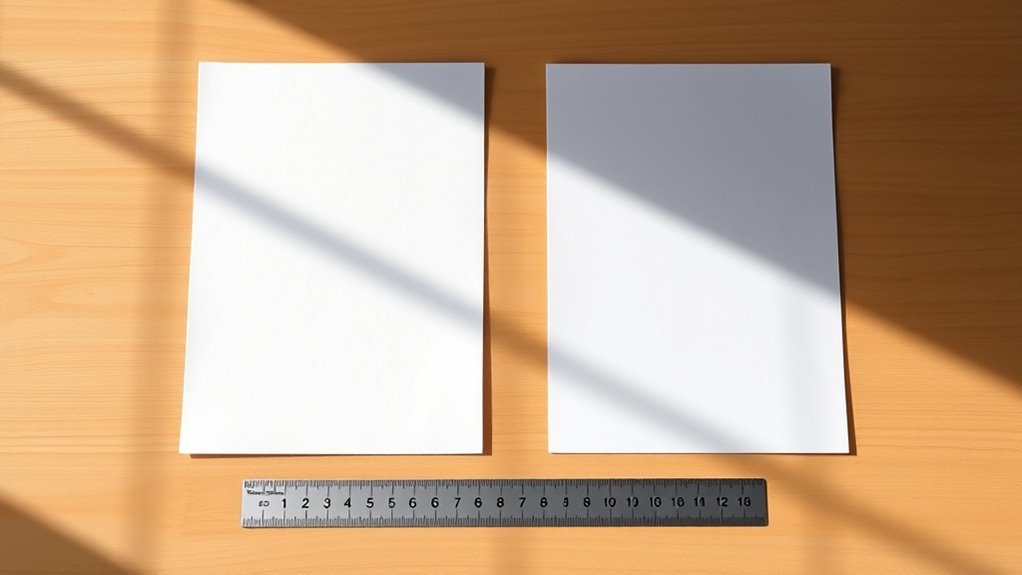
When choosing between U.S. Letter and A4 paper, you’ll notice subtle but important differences. U.S. Letter measures 8.5 × 11 inches, while A4 is slightly narrower at 8.27 inches and taller at 11.69 inches.
This means documents formatted for one size can shift or get clipped when printed on the other. A4 follows the ISO 216 aspect ratio, allowing sheets to be halved or doubled while keeping proportions; U.S. Letter doesn’t.
Also, two A4 pages side-by-side resemble a U.S. Legal sheet more than Letter in area, which can impact layout if you’re working internationally. Many printers support both sizes, but you should always select the correct paper size and adjust margins to avoid misalignment or automatic scaling issues.
Why Does Paper Size Matter for Your Printing and Design?
You need to design with your paper size in mind to keep layouts precise and avoid clipping or awkward reflows. Choosing the right size, like Letter or A4, guarantees your documents look consistent no matter where they’re printed.
This attention to detail helps your work stay professional and compatible worldwide. It’s a simple step that makes a big difference in how your designs come across.
Impact on Layout Precision
Because paper size sets the boundaries for your design, it directly impacts layout precision and how your content fits on the page. When you choose the right size paper, especially following ISO standards like the A-series, you maintain consistent proportions and avoid unexpected resizing issues.
Keep these points in mind:
- Using US Letter (8.5 × 11 inches) versus A4 (8.27 × 11.69 inches) changes text flow, pagination, and image cropping. So, you’ll need to make layout adjustments.
- ISO A-series sizes preserve aspect ratio, which makes scaling between formats easier without distorting your design.
- Nonstandard sizes demand careful setup of printer trays, bleed, and trim areas. This helps prevent misalignment or cutoff.
Ensuring Global Compatibility
Although paper sizes may seem like a minor detail, choosing the right one guarantees your documents print correctly across different regions. If you’re designing for a global audience, using A4 paper secures compatibility since it’s the standard outside North America.
On the other hand, if your primary recipients are in the U.S. or Canada, you’ll want to use Letter size to avoid unwanted scaling or cropping. The ISO A-series, including A4, maintains a consistent 1:√2 aspect ratio, making it easy to scale documents internationally.
Before printing, check your printer’s supported sizes—many handle both A4 and Letter. Picking the correct paper size upfront saves you from reformatting headaches, reduces waste, and secures your designs align perfectly no matter where they’re printed.
What Other Common Printer Paper Sizes Should You Know About?
You’re probably familiar with the standard letter size, but international sizes like A4 and A3 are also important to know, especially if you work globally.
Don’t forget specialty papers like legal, tabloid, and common photo sizes, which serve specific printing needs.
Understanding these options helps you choose the right paper for every project. It really makes a difference when you want your prints to look just right.
International Paper Size Standards
When working with documents outside North America, you’ll encounter the ISO paper size standards, which differ markedly from the familiar Letter and Legal sizes. The most common size is A4, measuring 210 × 297 mm, widely used for letters and documents.
ISO sizes follow a 1:√2 aspect ratio, meaning each size halves or doubles proportionally, making scaling easy. Here are key series to know:
- A-series: Includes A4 and A3 (twice the size of A4), ideal for standard documents and larger prints like posters.
- B-series: Offers intermediate sizes such as B5, often used for books and envelopes.
- C-series: Designed for envelopes like C5, fitting A-series sheets without folding or with a single fold.
Understanding these standards helps you handle international documents effortlessly. It’s really handy once you get the hang of it!
Specialty And Photo Sizes
What printer paper sizes should you know beyond the usual standards? Specialty and photo sizes cover a range of formats designed for specific needs. Common photo sizes include 4 x 6 inches and 5 x 7 inches, perfect for snapshots and framed prints.
You’ll also find larger sizes like A4 (8.3 x 11.7 inches) and Letter (8.5 x 11 inches), ideal for high-resolution images on standard paper. For notecards and invitations, small specialty cards come in 3 x 5, 4 x 5, and 5 x 8 inches.
Photo L (3.5 x 5 inches) and 2L (5 x 7 inches) are popular dedicated photo-paper formats. Don’t forget envelope sizes like DL and C5, which are useful for mailing printed photos and documents.
Knowing these paper sizes helps you choose the right fit every time. It makes printing a breeze and ensures your photos and cards look just right.
How to Check Which Printer Paper Sizes Your Device Supports
Although printer models vary widely, you can quickly determine which paper sizes your device supports by consulting its user manual or spec sheet. Manufacturers typically list standard sizes like Letter, Legal, A4, and A3 there.
Printer manuals and spec sheets usually list supported paper sizes like Letter, Legal, A4, and A3 for easy reference.
To check your printer supported paper sizes:
- Inspect the paper trays and adjustable guides for printed size labels such as Letter, Legal, or A4. Also, check the manual feed slot for custom sizes.
- Open your printer’s control panel or driver settings on your computer to review available paper sizes. See if there are any custom size options it accepts.
- If you’re still unsure, perform a test feed with known paper sizes. Or, check the manufacturer’s website using your model number for exact paper size compatibility.
This way, you’re sure to use the correct paper sizes your printer supports without any guesswork.
How Large Format and Custom Paper Sizes Enhance Printing Options
By choosing large-format or custom paper sizes, you open up new possibilities for your printing projects. Large-format printers handle sizes up to A1 or 13 × 19 inches, which are perfect for posters and banners.
Custom ranges on advanced copiers let you print nonstandard dimensions, bridging gaps between ISO and North American sizes. This flexibility helps you scale designs without losing proportions, especially when using A-series sizes.
Multifunction devices with adjustable trays also support unique media like cardstock and labels. This really expands your creative options.
| Paper Size | Dimensions (inches) | Use Case | Printer Type |
|---|---|---|---|
| A1 | 23.4 × 33.1 | Posters, banners | Large-format printers |
| 13 × 19 | 13 × 19 | Graphics-heavy prints | Large-format printers |
| Custom Range | 5.5 × 8.5 to 12 × 18 | Specialty print jobs | Advanced copiers |
| Up to 20 × 29 | 20 × 29 | Commercial specialty print | High-end digital presses |
Where to Find Standard and Specialty Printer Paper
Finding the right printer paper is easier when you know where to look. For standard sizes like 8.5 x 11 inches, you’ll find plenty of options at office supply stores, supermarkets, and online retailers.
If you need international sizes such as A4, specialty or photo papers, consider these sources:
- Paper suppliers and print shops often carry A4 and other ISO sizes.
- Camera stores and manufacturer catalogs stock photo paper and card stock in various sizes.
- Professional print suppliers and specialty vendors offer large-format and custom sheets.
Always check your printer’s supported sizes and paper weight before purchasing. This guarantees the paper fits perfectly and prints well, whether you’re using the common 8.5 x 11 inches or the slightly different A4 format.
How BDS Can Help You Find the Right Paper and Printing Solutions
When you team up with BDS, you get expert guidance on choosing printers and copiers that handle standard sizes like Letter, Legal, and A4, as well as larger formats for specialized projects. BDS reviews your workflow and paper needs, ensuring your devices support media types from glossy to card stock and custom sizes up to 12 x 18 inches.
They confirm automatic duplexing and verify paper weight compatibility, preventing issues like misfeeds or cropping. If documentation isn’t clear, BDS runs test prints with your specific paper.
Their procurement expertise helps you source the right stocks, including European A-series for commercial printing, while configuring devices for peak quality and durability. With BDS, you get tailored printing solutions that fit your exact requirements.
Frequently Asked Questions
What Is the Size of A6 Paper in Inches?
A6 paper measures about 4.1 inches by 5.8 inches. You’ll find it’s exactly one-quarter the size of A4 paper, keeping the same proportions.
This makes it perfect for postcards and small flyers you might use. It’s a handy size when you want something compact but still readable.
What Are the Sizes of ANSI and Arch Paper?
Think of ANSI and ARCH paper like puzzle pieces—ANSI ranges from 8.5×11 to 34×44 inches for offices, while ARCH sizes, from 9×12 to 36×48 inches, fit architectural plans perfectly.
What Are the Dimensions of an A4 Paper Sheet?
An A4 paper sheet measures 210 mm by 297 mm, or about 8.27 inches by 11.69 inches.
You’ll find it’s perfect for letters, reports, and most office documents outside North America. It’s pretty much the standard size used almost everywhere else.
Is Normal Printer Paper A4 or A5?
Normal printer paper is usually A4 if you’re outside North America. You’ll find A5 used for smaller tasks like flyers or notebooks, but A4 remains the standard choice for most everyday printing needs worldwide.
Conclusion
Choosing the right printer paper size is like picking the perfect frame for your artwork—it highlights your work and guarantees everything fits just right. Whether you’re using U.S. Letter or A4, knowing the dimensions helps you avoid printing mishaps and design frustrations.
By understanding your printer’s supported sizes and exploring specialty options, you’re setting yourself up for smooth, professional results every time. Don’t let the wrong paper size ruin your project!
Let BDS guide you to the best paper and solutions for your needs. With the right printer paper size knowledge, you’ll always get crisp, clean prints that look just as you imagined. Trust BDS to help you find the perfect fit for your printing needs, whether it’s standard printer paper or a specialty size.