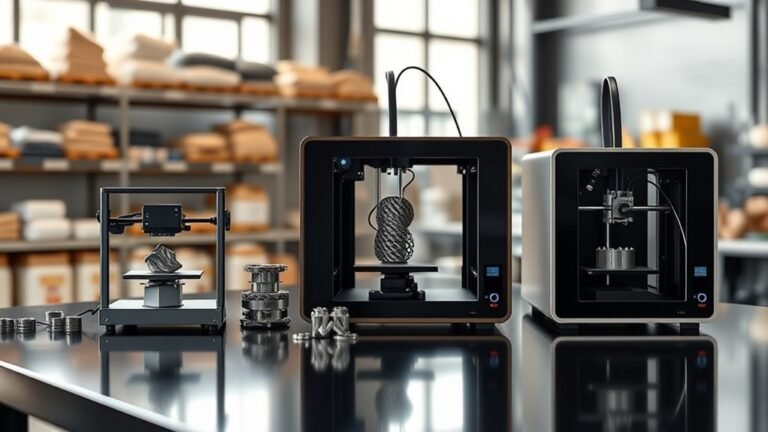
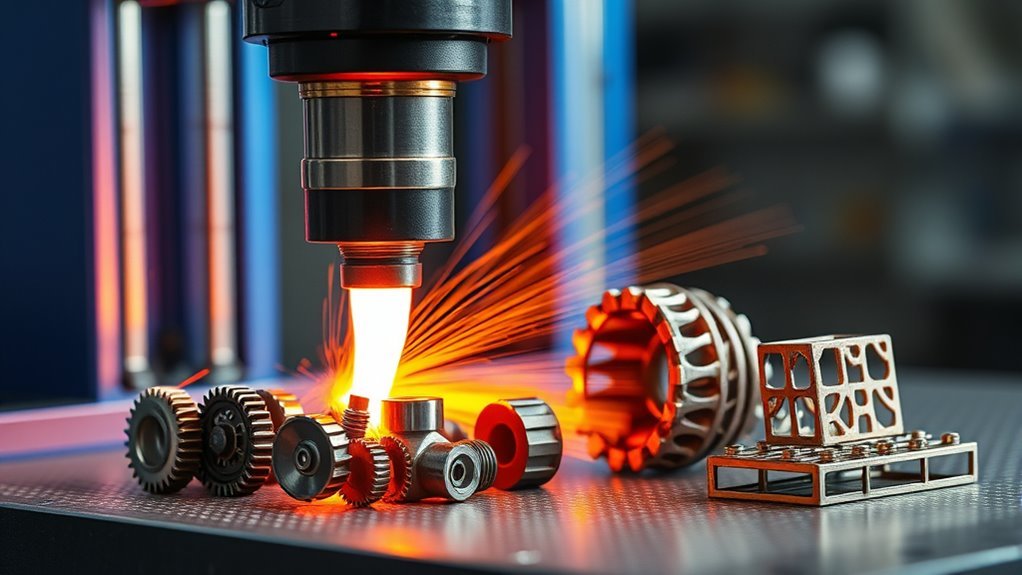
What Can a 3D Printer Print in Metal?
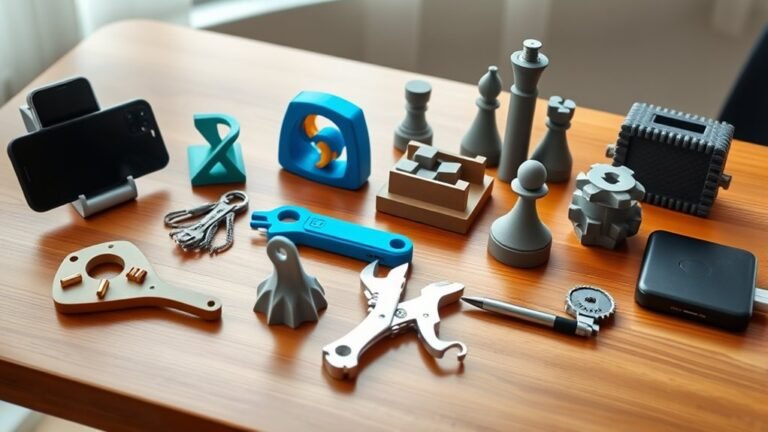
You can 3D print a wide range of metal parts, from functional components like brackets and gripper jaws to aerospace turbine blades and patient-specific implants. Metal 3D printing is incredibly versatile, allowing you to create everything from durable consumer items to complex, consolidated assemblies.
Whether you need tooling inserts or high-performance aerospace parts, metal printing has you covered.
Different methods suit different needs. For example, high-strength powder-bed fusion is perfect for performance alloys, while more affordable options like Filamet™ work well for low-volume projects.
If you’re curious about how to design parts, choose the right alloys, or handle post-processing, there’s a lot more to explore in the world of metal 3D printing. It’s an exciting field with plenty of opportunities to customize and optimize your metal parts.
Key Takeaways
– 3D printers can produce functional metal parts like gripper jaws, actuator housings, and aerospace components such as turbine blades and implants.
They’re great for making complex items that need to be strong and precise.
– Consolidated metal assemblies reduce fasteners and welds, enabling complex multi-part replacements in a single print.
This means fewer steps and less chance for errors during assembly.
– Metal 3D printing supports tooling, injection mold inserts with conformal cooling, and durable consumer items like gears and jewelry patterns.
So, it’s not just for industrial use — you can get creative with it too!
– Common printable metal alloys include stainless steel, titanium (Ti-6Al-4V), Inconel 718, and cobalt-chrome for specialized industrial and medical uses.
These materials cover a wide range of strength and durability needs.
– Printing methods vary from powder-bed fusion for high-strength, detailed parts to metal filament FDM for affordable hobbyist projects requiring post-sintering.
Basically, there’s an option for every budget and level of complexity.
What Metal Parts Can You 3D Print?
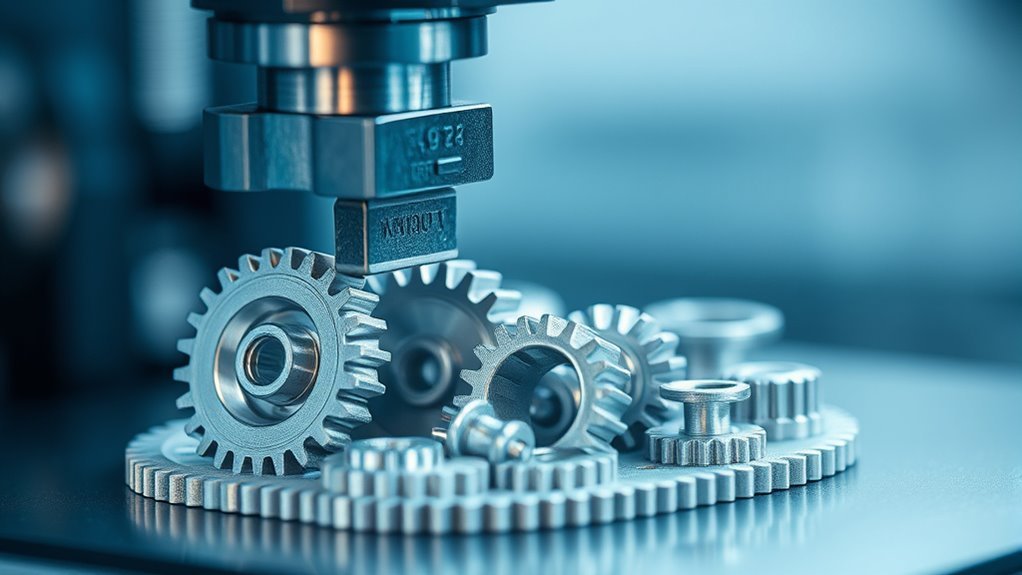
You can 3D print a wide range of metal parts, from functional end-use components like gripper jaws and actuator housings to complex, consolidated assemblies with internal channels and lattice structures. Metal additive manufacturing lets you create parts in alloys such as 17-4 PH and 316L stainless steel, offering abrasion and corrosion resistance.
Whether you need tooling inserts or lightweight aerospace brackets, metal additive techniques like DMLS deliver high-strength, durable results. Even consumer items like phone stands or durable gears become practical with careful design and post-processing.
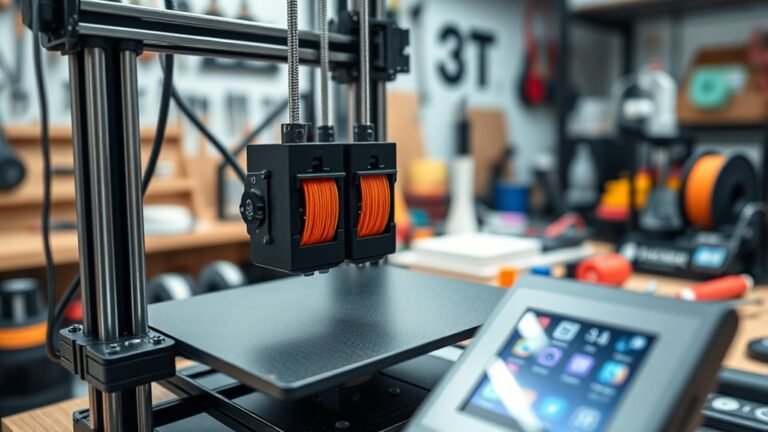
For hobbyists, desktop FDM metal-filled filaments enable printing small stainless steel or bronze parts after debinding and sintering. Metal additive printing opens the door to components that are both functional and optimized for performance, reducing assembly steps and expanding material options.
How Does Metal 3D Printing Unlock Complex Designs?
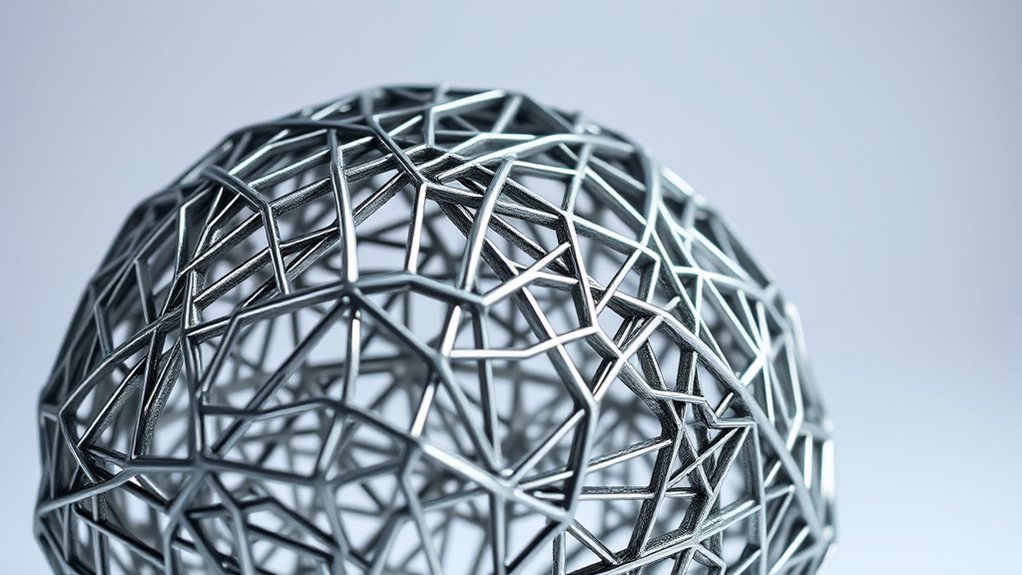
Metal 3D printing opens complex designs by building parts layer-by-layer, allowing you to create internal channels, conformal cooling systems, and intricate lattice structures that traditional subtractive methods can’t achieve without excessive cost or effort.
Metal 3D printing enables complex internal channels and lattices beyond traditional manufacturing limits.
With additive manufacturing, you can produce near-fully dense metal parts featuring wrapped cooling passages or embedded channels, ideal for turbine blades and injection-mold tooling.
You’ll also benefit from topology optimization and lattice infill, which reduce weight by 30–70% while maintaining strength.
Additive consolidation lets you replace multi-part assemblies with single components, eliminating fasteners and welded seams. That means cutting assembly time and reducing failure points.
Plus, you can print hard-to-machine alloys and integrate features like threaded inserts and customized surface textures—all without added tooling. This really frees up your design possibilities like never before.
Which Metal Alloys Are Best for 3D Printing?
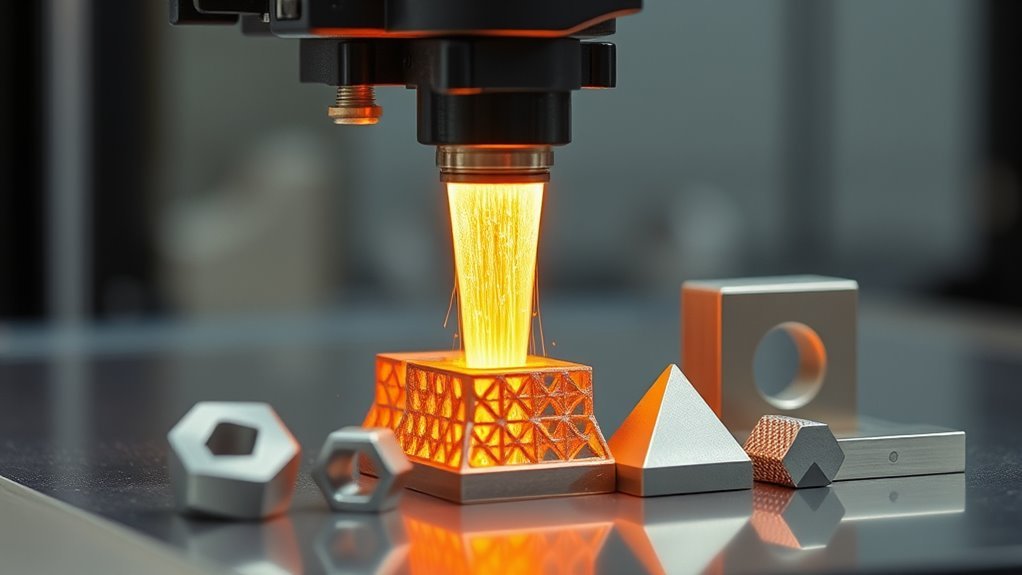
Choosing the right alloy can make all the difference in your 3D printing project’s success. In metal 3D printing, alloys like 17-4 PH stand out for their high strength and hardness, especially after heat treatments like H900 aging.
If you need corrosion resistance with good ductility, 316L stainless steel is a solid choice, though it offers lower ultimate strength. For lightweight, high-strength parts, titanium Ti-6Al-4V is common, especially in aerospace and medical fields, thanks to its excellent strength-to-weight ratio.
Inconel 718 suits high-temperature applications, while AlSi10Mg and cobalt-chrome fit aerospace and medical uses respectively. Your alloy choice should align with your project’s demands for strength, corrosion resistance, temperature tolerance, and post-processing options to maximize performance and durability.
How Do Metal Filaments Like Filamet™ Work?
Although 3D printing with metal powders traditionally involves complex processes, Filamet™ filaments simplify this by blending high percentages of metal powder with a polymer binder. You print a “green” composite that’s mostly metal powder held together by the polymer.
After printing, you remove the binder through debinding, leaving a fragile “brown” metal part. Then, sintering fuses the metal powder into a solid piece with some shrinkage.
To get good results, you’ll need to use hardened nozzles and print slowly. Also, make certain your design has uniform wall thickness.
Don’t forget to scale your model to offset shrinkage. Debind carefully to avoid damage.
Finally, sinter with refractory supports to maintain shape. This process turns your printed composite into functional metal parts with precision.
How to Design Functional Metal 3D Printed Parts
Start by scaling your CAD models to offset the typical 15–20% shrinkage that happens during sintering with metal-filled filaments like Filamet™. When you’re designing functional metal 3D printed parts, try to keep the wall thickness uniform and add fillets at the joints. This helps reduce warping and stress during debinding and sintering.
Also, design access channels for solvent flow and leave space for refractory packing. This is key to preserving fine features. Since additive manufacturing gives you a lot of geometric freedom, you can consolidate multi-part assemblies into a single piece. Just remember, you’ll likely need some post-process machining or polishing to get those tight tolerances right.
Use slicer profiles that the community has already validated, and print at slow speeds with a hardened nozzle to ensure good quality. It’s a good idea to print test coupons and tweak your sintering profiles. This way, you can check dimensional accuracy and mechanical properties before you commit to your final parts. Following this approach will help your metal additive parts perform reliably every time.
Key Post-Processing Steps for Metal 3D Prints
Once your metal 3D print is complete, you’ll need to focus on some important post-processing steps. These include solvent debinding and kiln sintering to remove binders and fuse the metal powder into a dense part.
For DMLS/SLM prints, this usually means stress-relief treatments or HIP. These help reduce residual stress and porosity, which improves the yield strength of your part.
You’ll also want to carefully remove any supports. After that, performing fixture-based heat treatments is key to preventing distortion during further processing.
Surface finishing is next. Techniques like bead blasting or polishing help refine surface roughness and ensure you meet dimensional tolerances.
And don’t forget to keep in mind the predictable shrinkage during sintering. Using refractory packing can help maintain the geometry of your part throughout the process.
- Solvent debinding and kiln sintering (1,100–1,400°C)
- Stress-relief or HIP for DMLS/SLM prints
- Support removal and heat treatments
- Surface finishing: bead blasting, tumbling, polishing
- Dimensional compensation and refractory packing
Which Industries Use Metal 3D Printing Today?
Metal 3D printing frequently transforms how industries tackle complex manufacturing challenges by enabling lightweight, customized, and high-performance parts. In aerospace, you’ll find metal parts like Inconel turbine components and Ti6Al4V brackets optimized for weight and strength.
The medical field leverages biocompatible metals to create patient-specific implants and surgical guides. Automotive and motorsports use metal AM for prototypes, custom brackets, and tooling with stainless steel and aluminum alloys.
Oil, gas, and power sectors benefit from corrosion- and heat-resistant metal parts, producing spare components on demand to reduce downtime. Even jewelry and consumer goods industries print custom metal pieces or casting patterns, reducing waste.
Across these diverse fields, metal 3D printing reshapes traditional manufacturing, offering precision and flexibility you can’t achieve with conventional methods. It’s pretty amazing how this technology is changing the game!
How to Choose the Right Metal 3D Printing Method
You’ll want to start by matching your project’s metal printing techniques to the alloys you need and the part’s intended use.
Think about how production volume affects cost and turnaround time. Some methods work better for prototyping, while others shine with larger runs.
Metal Printing Techniques
Choosing the right metal 3D printing method depends on your part’s size, complexity, material requirements, and desired finish. You want printed parts with optimal tensile strength and surface quality, so each technique offers unique trade-offs.
Powder-bed fusion (DMLS/SLM) delivers near-fully dense parts with excellent tensile strength and fine details. Directed energy deposition (DED) suits large parts or repairs but yields coarser finishes.
Binder-jetting offers fast builds and low support costs but needs sintering to boost density. Metal filament FDM prints green parts affordable for hobbyists, requiring debinding and sintering afterward.
Wire-arc additive manufacturing (WAAM) builds large structural pieces economically but at lower resolution and higher porosity risk. Match your project’s needs to these techniques for the best balance of strength, detail, and cost.
Material Compatibility Factors
The best 3D printing method depends heavily on the metal you plan to use. High-performance alloys like Ti6Al4V and Inconel 718 work well with DMLS/DMLM. This method offers parts without compromising strength, especially when using 17-4 PH stainless steel with proper heat treatment.
For hobbyist or desktop projects, metal-filled FDM suits stainless, bronze, and copper. However, it does require debinding and sintering to get the best results.
Atmosphere control also matters a lot. Reactive metals need an inert gas environment, while less reactive ones can use nitrogen or simplified methods.
| Metal Type | Recommended Method | Atmosphere |
|---|---|---|
| Ti6Al4V, Inconel | DMLS/DMLM | Argon/Inert |
| Stainless, Bronze | Filamet™/FDM | Nitrogen/Furnace |
| 17-4 PH | DMLS + Heat Treat | Vacuum/Argon |
Production Volume Considerations
When deciding on a metal 3D printing method, consider how many parts you need to produce. Different manufacturing processes suit different production volumes.
Using metal binder-jetting or powder bed fusion works well for prototyping and low- to mid-volume runs. They offer fast turnaround without tooling costs, which is a big plus.
For mid-volume production, powder bed processes with heat treatments deliver consistent mechanical properties. This makes them perfect for aerospace or medical parts.
Very low volumes or one-offs benefit from Filamet™ or lost-resin casting. These balance cost and quality nicely.
High-volume runs usually favor traditional manufacturing due to cost efficiency.
- Dozens of prototype parts
- Hundreds of end-use aerospace components
- Thousands of industrial parts
- One-off custom pieces
- Long-tail or legacy parts
Choose based on cost, volume, and required part performance. It’s all about finding the right fit for your needs.
Frequently Asked Questions
Are There 3D Printers That Print Metal?
Yes, you can get 3D printers that print metal using technologies like powder-bed fusion or metal-filled filaments. They vary in cost, complexity, and post-processing needs.
But the cool part is, they let you create strong, functional metal parts. So, whether you’re making prototypes or end-use items, these printers can handle it.
Is Anything Illegal to 3D Print?
Of course, you’re free to print a unicorn or a spaceship. But try making unlicensed guns or patented stuff—suddenly, you’re a criminal mastermind.
What Are Some Applications of 3D Printing?
You can use 3D printing for aerospace parts, medical implants, custom dental tools, factory fixtures, and rapid prototyping. It’s perfect for low-volume production and repairs.
Plus, it’s great for jewelry and creating complex, durable metal components quickly and cost-effectively. So, whether you need something unique or just want to save time, 3D printing has got you covered!
What Is the Cheapest Metal to 3D Print?
The cheapest metal you can 3D print is bronze or copper using Filamet™ filaments. They work on standard FDM printers and only need debinding and sintering, making them affordable for hobbyists compared to other metal printing methods.
It’s pretty cool because you don’t need fancy, expensive machines. Just your regular 3D printer can handle it, which makes metal printing way more accessible. Plus, the process is simpler, so it’s easier on your wallet and your time.
Conclusion
If you’re exploring metal 3D printing, you’ll be amazed at its potential—over 60% of manufacturers say it’s key for producing complex, lightweight parts that traditional methods can’t match. By choosing the right metal and design, you can create strong, functional components tailored to your needs.
With proper post-processing, your prints will meet industry standards. This makes metal 3D printing a game-changer for innovation and customization in many fields.
In short, metal 3D printing opens doors to creating parts that are not only durable but also precisely engineered for specific applications. Whether it’s aerospace, automotive, or medical industries, this technology is revolutionizing how manufacturers approach design and production. Embracing metal 3D printing means embracing flexibility, efficiency, and the future of manufacturing.