What Is the Size of Printer Paper in Inches?
You’ll find that the most common printer paper size in the U.S. is Letter, measuring 8.5 by 11 inches, perfect for everyday documents.
Legal paper is longer at 8.5 by 14 inches, often used for contracts.
For larger layouts, Tabloid or Ledger size is 11 by 17 inches.
Internationally, A-series sizes like A4 (8.27 by 11.69) are standard.
Understanding these sizes helps you pick the right paper for your project and avoid printing issues. Explore more to find what fits your needs best.
Key Takeaways
- Common U.S. printer paper sizes include Letter (8.5×11 inches), Legal (8.5×14 inches), and Tabloid (11×17 inches).
- The international A-series uses sizes like A4 (8.27×11.69 inches) and A3 (11.7×16.5 inches) for standardized printing.
- Large-format paper sizes include A2 (16.5×23.4 inches), A1 (23.4×33.1 inches), and A0 (33.1×46.8 inches) for posters and technical drawings.
- Specialty papers include photo sizes (8×10 inches) and envelopes like US #10 (4.125×9.5 inches) for business correspondence.
- Knowing exact paper dimensions helps prevent printing errors, layout shifts, and ensures compatibility with printer trays and projects.
Common Printer Paper Sizes in the United States
When you print in the United States, you’ll most often use one of several standard paper sizes. The most common is the US Letter size, measuring 8.5 × 11 inches, perfect for everyday documents and office printing.
Legal paper, slightly longer at 8.5 × 14 inches, is typical for contracts and legal forms. If you need bigger layouts or small posters, Tabloid or Ledger size at 11 × 17 inches works well.
There are also specialty sizes like 8 × 10 inches for photos. Beyond these, the US uses ANSI sizes for larger formats—ANSI A matches Letter, while ANSI B through E increase progressively up to 34 × 44 inches.
These paper sizes cover most printing needs in the United States. So, whatever you’re printing, there’s probably a standard size that fits just right.
Dimensions of International A-Series Paper Sizes
You’ll find that the international A-series paper sizes follow precise measurements, with A0 starting at 33.1 by 46.8 inches and each subsequent size halving the previous one.
These dimensions make A-series papers ideal for everything from large posters to everyday printing tasks. Understanding their sizes helps you choose the right paper for your specific needs.
Standard A-Series Measurements
Although the A-series paper sizes are standardized internationally, you might be surprised to learn how their dimensions scale consistently. Each size halves the area of the previous one while maintaining the same aspect ratio.
The A4 paper, the most common standard paper size, measures 8.3 by 11.7 inches. This scaling makes it easy to choose the right size for your needs.
| Paper Size | Dimensions (inches) | Dimensions (mm) |
|---|---|---|
| A0 | 33.1 × 46.8 | 841 × 1189 |
| A2 | 16.5 × 23.4 | 420 × 594 |
| A4 | 8.3 × 11.7 | 210 × 297 |
Knowing these measurements helps you understand the standard paper sizes better. It’s pretty handy to know when you’re picking paper for printing or design projects.
Common A-Series Applications
Understanding the exact dimensions of A-series paper sizes helps you pick the right sheet for your project. A4 paper size, measuring 8.27 × 11.69 inches, is commonly used for letters, reports, and office documents.
If you need something larger, A3 at 11.69 × 16.54 inches works well for drawings, magazines, and posters. For smaller prints like flyers or notebooks, A5 (5.83 × 8.27 inches) is ideal.
When you require large-format prints, A2 and A1 paper sizes come into play. A2 (16.54 × 23.39 inches) suits wall calendars and flipcharts, while A1 (23.39 × 33.11 inches) is perfect for technical drawings and large advertisements.
Knowing these common A-series paper sizes guarantees you select the best fit for your printing needs. It really makes the whole process easier and more efficient.
Differences Between Letter, Legal, and Tabloid Paper
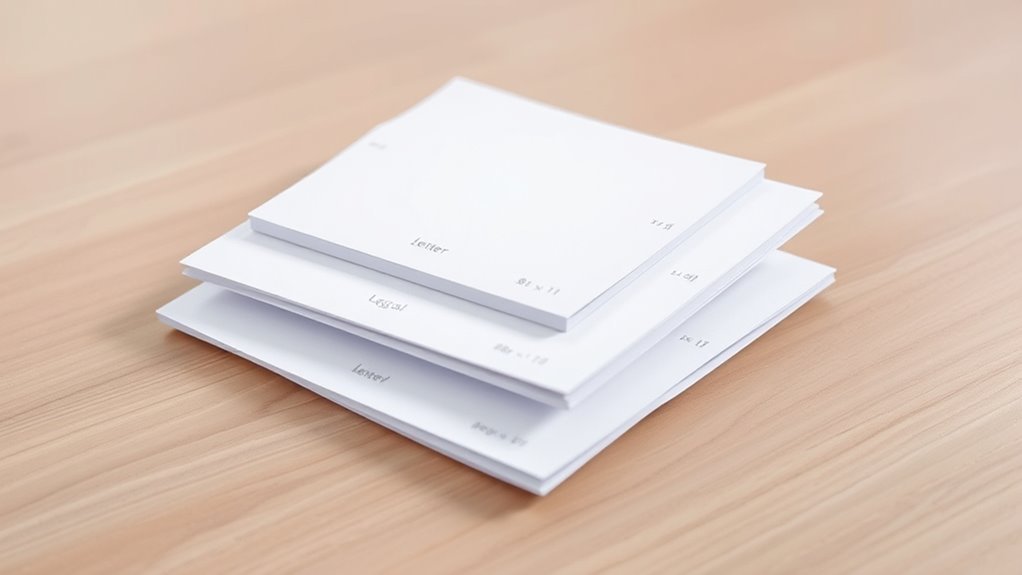
When choosing between Letter, Legal, and Tabloid paper, you’ll notice differences in their dimensions and typical uses. Letter is your go-to for everyday documents, while Legal gives you extra length for contracts.
Tabloid is larger, perfect for posters or newsletters, and each size also reflects regional preferences you should keep in mind. It’s good to pick the right one depending on what you’re printing!
Dimensions Comparison
Since you often work with different paper types, knowing their exact dimensions helps you choose the right size for your project.
Letter paper, the standard paper size in North America, measures 8.5 × 11 inches. It’s perfect for everyday printing.
Legal paper is longer at 8.5 × 14 inches, ideal for contracts and legal documents.
Tabloid paper is the largest, measuring 11 × 17 inches. It’s often used for posters or brochures.
| Paper Type | Width (inches) | Height (inches) |
|---|---|---|
| Letter | 8.5 | 11 |
| Legal | 8.5 | 14 |
| Tabloid | 11 | 17 |
Understanding these sizes helps you pick the right paper for your specific needs.
Common Usage Scenarios
Choosing the right paper size can make a big difference in how your documents look and function. Understanding the common usage scenarios for Letter, Legal, and Tabloid paper helps you select the best fit for your needs.
Here’s a quick guide: Letter (8.5 × 11 inches) suits everyday documents like letters, reports, and schoolwork. Legal (8.5 × 14 inches) offers extra length for contracts, legal forms, and extended entries.
Tabloid (11 × 17 inches) works well for larger layouts such as newsletters, brochures, and posters. Setting the correct paper size in your printer prevents misalignment or cropping during printing.
Regional Preferences
Although paper sizes vary globally, North America chiefly uses Letter, Legal, and Tabloid formats for different printing needs. Letter paper, measuring 8.5 × 11 inches, serves as the standard paper size for everyday documents and office printing.
When you handle contracts or legal forms in North America, you’ll often use Legal paper, which is 8.5 × 14 inches—offering extra length for detailed information. For larger prints like newsletters or small posters, Tabloid paper (11 × 17 inches) is your go-to, often printed landscape as Ledger.
Outside North America, the ISO A4 size dominates, but if you’re printing locally, understanding these North American paper sizes helps you select the right tray and avoid scaling issues. That way, your documents come out perfectly every time.
Large Format Paper Sizes and Their Uses
When you need to create visuals that stand out from a distance, large format paper sizes like A2, A1, and A0 offer the perfect canvas.
A2 paper is typically used for close-up viewing items like wall calendars and flipcharts, while large-format printers can handle A1 and A0 sizes for bigger projects. Each size suits different purposes:
A2 suits close-up items like calendars, while A1 and A0 handle larger projects with big-format printers.
- A2 (16.5 × 23.4 inches): posters, photo prints, flipcharts
- A1 (23.4 × 33.1 inches): technical drawings, maps, medium-distance posters
- A0 (33.1 × 46.8 inches): large exhibition graphics, engineering drawings
Large-format printers support thick media for high-quality presentation graphics. So, choosing the right size really depends on how far your audience will be and the level of detail you need to preserve.
How to Identify Paper Size in Your Copy Machine
If you want to guarantee your copies come out perfectly sized, start by checking your copier’s paper trays and adjustable guides—they’re usually labeled with standard sizes like Letter (8.5 × 11 inches), Legal (8.5 × 14 inches), and A4 (8.27 × 11.69 inches).
To find the paper size your machine supports, open the control panel or settings menu to see which trays correspond to each size. If you’re unsure, consult the user manual or manufacturer’s specs for the full range of supported sizes.
Running a test copy using known sizes can also help you confirm the machine’s settings. When irregular sizes come up, use the manual feed slot or contact your dealer to find the paper size options available for custom or specialty media.
Why Knowing Paper Sizes Matters for Printing Projects
Knowing how to identify the paper size in your copy machine sets you up for success, but understanding why those sizes matter can save you from costly mistakes in your printing projects.
When you choose the right paper, you make certain your content prints exactly as intended without unwanted scaling or cropping. Matching your printer’s paper size also prevents jams and misfeeds.
Plus, using the standard paper size in your region keeps layouts consistent, especially when sharing documents internationally. Keep these in mind:
- Prevent layout shifts by choosing the right paper size (Letter, A4, Legal, etc.)
- Avoid printer jams by matching paper size to tray settings
- Accommodate larger graphics with multi-page sizes like Tabloid or A3
- Make sure accurate proofs by knowing exact dimensions for specialty projects
Choosing the correct paper size streamlines your printing workflow effectively. It’s a small step that can make a big difference in your results.
Specialty and Envelope Paper Sizes Explained
Although standard paper sizes cover most printing needs, specialty and envelope paper sizes play a crucial role in professional and personal correspondence. When sending mail, choosing the appropriate paper size guarantees your documents fit perfectly.
For example, the US #10 business envelope measures 4.125 × 9.5 inches, ideal for standard letters, while Monarch envelopes at 3.9 × 7.5 inches suit personal stationery. You’ll also find small common envelopes like the European C6 (4.5 × 6.4 inches) and the US postcard-style envelope (about 4 × 6 inches) convenient for invitations or notes.
Beyond envelopes, specialty sizes like 8 × 10 inches photos or 12 × 18 inches posters cater to specific printing needs. Knowing these sizes helps you pick the right paper for your projects.
Choosing the Right Paper Size for Your Printing Needs
Selecting the right paper size guarantees your printed documents look professional and fit their intended purpose. When choosing size paper, consider the document type and where it will be used to help with your printing.
For instance, Letter size (8.5 × 11 inches) suits everyday U.S. documents, while A4 is standard internationally. Remember to check your printer’s supported tray sizes and page setup to avoid cropping.
- Use Legal (8.5 × 14 inches) for contracts or longer forms
- Opt for Tabloid/Ledger (11 × 17 inches) for posters or spreads
- Select A3 (11.7 × 16.5 inches) for large international prints
- Match specialty sizes for photos or brochures with your printer’s capabilities
Frequently Asked Questions
What Are the Dimensions of A8 Paper?
A8 paper measures about 2.0 by 2.9 inches. You’ll find it’s small, perfect for tickets, labels, or business-card-sized prints.
It keeps the same aspect ratio as larger A-series sheets, just much smaller. So, even though it’s tiny, it still fits right in with the rest of the A paper sizes.
What Is the Size of a B5 Paper?
B5 paper boasts balanced breadth and breadth, measuring about 6.9 inches wide by 9.8 inches tall for ISO standards.
Just be aware that Japanese B5 is a bit bigger, at roughly 7.2 by 10.1 inches.
What Is the Size of A6 Paper in Inches?
You’ll find A6 paper measures 4.13 by 5.83 inches. It’s perfect for postcards or small flyers.
It’s exactly one quarter the size of A4 and half of A5 in the ISO A-series. Pretty handy if you’re working with those paper sizes!
What Is the Difference Between a Series and B Series Paper Sizes?
Think of A series as your classic, reliable friend, always consistent with a √2 ratio.
B series, however, is the adventurous sibling, offering in-between sizes and slightly different proportions for posters or envelopes.
You’ll pick based on need.
Conclusion
Now that you know the ins and outs of printer paper sizes, you’re ready to tackle any printing project with confidence—like a seasoned artist choosing the perfect canvas. Whether you’re printing a simple letter or a large poster, understanding these sizes guarantees your work fits just right.
So next time you load your paper tray, remember: the right size isn’t just a detail, it’s the first step toward masterpiece-worthy prints. Knowing the size of printer paper in inches helps you avoid misprints and wasted materials. It ensures your documents and images come out looking exactly as you envision.
By mastering printer paper dimensions, you’re setting yourself up for success in every project. Whether it’s standard letter size or something larger, having this knowledge means smoother printing and better results every time.