4 Best Budget Beginner 3D Printers for 2027
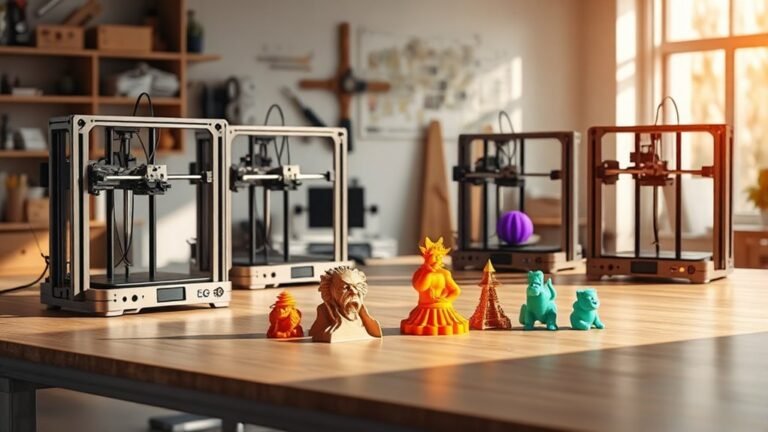
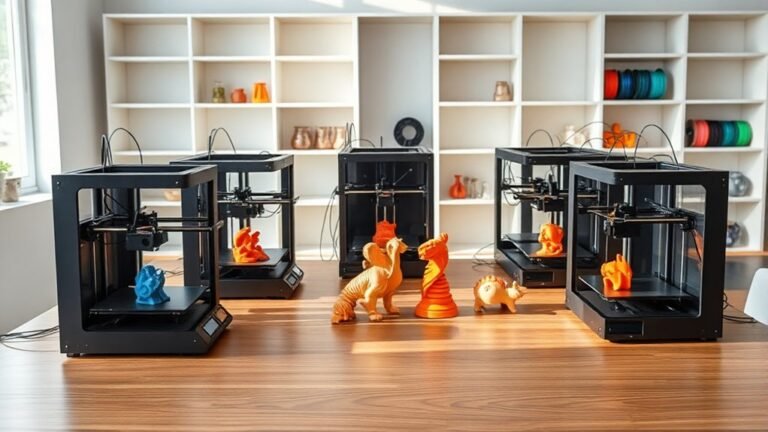
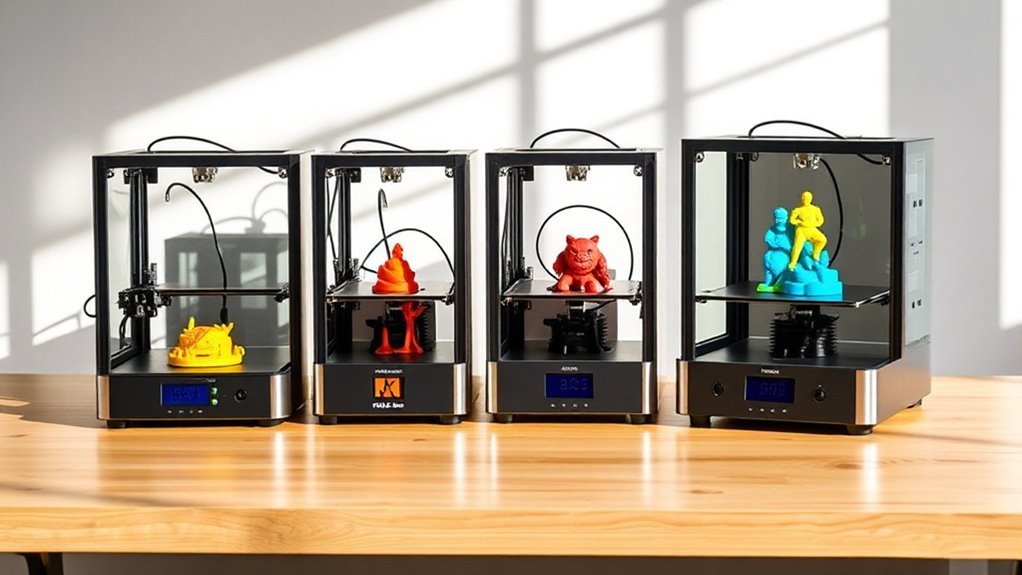
For 2027, you’ll want these budget beginner 3D printers that combine ease, quality, and affordability. Whether you’re just starting out or looking to upgrade, these models make 3D printing accessible without breaking the bank.
The Entina Tina2 Plus offers ready-to-print ease with WiFi and helpful tutorials. It’s perfect if you want to jump right into printing without a steep learning curve.
Creality Ender 3 V3 SE brings auto leveling and quiet precision, making your printing experience smooth and hassle-free.
Anycubic Kobra X stands out for multicolor one-click printing and AI monitoring, giving you more creative freedom and smart features.
Finally, the Portable Compact FDM is ideal for saving space and guided learning, great if you’re short on room but big on ambition.
Each printer balances user-friendly features with reliable quality. Stick around to discover which model fits your specific needs best.
| Image | Name | Editor's Rating | Price |
|---|---|---|---|

|
|
||

|
|
||

|
|
||

|
|
Entina Tina2 Plus Fast WiFi 3D Printer
- 【Start Printing in Minutes – Beginner Friendly】No setup required. Tina2 Plus 3d printer comes fully assembled and ready to use out of the box. With included TF card...
- 【Fast 250mm/s Printing Performance】This Tina2 Plus high speed 3D printer print speeds up to 250 mm/s help reduce waiting time and support fast project turnaround...
- 【WiFi App Control & STEM Model Library】Powered by the Poloprint Cloud app, this WiFi-enabled 3D printer gives access to 3,500+ printable models and 25+ creative DIY...
- 【40-Second Fast Heat Ceramic Hotend】High-efficiency ceramic hotend heats up in just 40 seconds for faster start-up and less downtime. The quick-swap nozzle design...
- 【Compact 3D Printer for Home & Classroom】Designed with a space-saving footprint while maintaining practical print capacity, this compact 3D printer fits easily on...
The Entina Tina2 Plus Fast WiFi 3D Printer offers a seamless entry into the world of 3D printing. Its fully assembled design eliminates setup hassles, allowing you to start printing immediately with preloaded models on the included TF card. This makes it perfect for beginners and those new to 3D printing.
Designed for ease of use, this printer’s intuitive interface and WiFi connectivity simplify control through a mobile app. You can access a wide range of printable models, reducing the need for complex design work. This setup supports creative projects for kids, educators, and first-time users without the frustration of complicated calibration.
Maintenance is straightforward with its compact build and reliable components. Its size suits smaller projects and school assignments, although larger prints may be limited by the build volume. Because it is a newer model releasing in 2026, long-term feedback is still emerging.
The Entina Tina2 Plus is ideal for supervised environments, ensuring safe and guided printing experiences. It helps users build confidence and skills with minimal barriers, making it an excellent choice for educational settings and home use.
Best for: Beginners, students, and educators looking for an easy-to-use, ready-to-print 3D printer for learning and small-scale projects.
What We Like:
- Fully assembled for immediate use with preloaded model files
- WiFi-enabled with app control for convenient printing
- Beginner-friendly design suited for supervised learning
- Compact footprint fits classroom or home workspaces
Specification:
| Feature | Details |
|---|---|
| Manufacturer | Entina |
| Dimensions | Compact (exact size not provided) |
| Weight | Not specified |
| Material | Not specified |
| Color Options | Not specified |
| Connectivity | WiFi with mobile app control |
| Included Storage | TF card with preloaded models |
| Release Year | 2026 |
Creality Ender 3 V3 SE Beginner-Friendly 3D Printer with Auto Leveling
- 250mm/s High-Speed Printing: Print at speeds of up to 250mm/s with 2500mm/s² acceleration, helping you complete prototypes, functional parts, and everyday projects...
- Easy Setup with Auto Leveling: Designed for a fast and straightforward setup, the Ender 3 V3 SE can be assembled in just a few simple steps. CR Touch Auto Leveling and...
- Proven Sprite Direct Drive Extruder: The upgraded Sprite Direct Drive Extruder provides smooth and consistent filament feeding for PLA, PETG, and TPU. Its proven design...
- Stable Motion System for Consistent Results: Dual synchronized Z-axis lead screws and precision Y-axis linear shafts work together to help reduce vibration and Z...
- Quiet Operation with Easy Print Removal: A 32-bit silent mainboard helps reduce operating noise for a more comfortable printing experience, while the flexible PC spring...
The Creality Ender 3 V3 SE transforms 3D printing into a hassle-free experience. Its CR Touch auto leveling automatically adjusts the bed, eliminating tedious manual calibration. This ensures a solid first layer, which is crucial for successful prints.
Designed with beginners in mind, the printer’s Sprite Direct Drive Extruder handles common filaments like PLA, PETG, and TPU smoothly. The auto filament loading feature further simplifies setup, letting you start printing quickly.
Maintenance is straightforward thanks to the dual Z-axis lead screws and precision Y-axis shafts, which reduce vibration and Z wobble. These design features contribute to consistent print quality and less frequent adjustments.
With speeds up to 250 mm/s and a 32-bit silent mainboard, the Ender 3 V3 SE balances performance and quiet operation. The flexible spring steel build plate makes removing finished models easy, reducing damage risk.
Best for: Beginners and hobbyists seeking a reliable, easy-to-use 3D printer with auto leveling and versatile filament compatibility.
What We Like:
- CR Touch auto leveling and Z-offset calibration for consistent first layers
- Smooth printing with PLA, PETG, and TPU using the upgraded direct drive extruder
- Dual Z-axis lead screws and precision shafts minimize vibration and wobble
- Quiet operation with a 32-bit silent mainboard
- Flexible spring steel build plate simplifies model removal
Specification:
| Feature | Details |
|---|---|
| Manufacturer | Creality |
| Dimensions | Not specified |
| Weight | ~20 lb (9 kg) |
| Material | Metal frame, spring steel build plate |
| Color Options | Not specified |
Anycubic Kobra X Multicolor 3D Printer, Easy One-Click Printing
- 【Vivid 19-Color and Versatile Materials】Unleash creativity beyond limits. The Kobra X supports 4-color standard and expands up to 19 colors with 4 ACE 2 Pro for...
- 【600mm/s High Speed Performance】Don't let slow speeds limit your creativity. This high-speed FDM 3D printer reaches up to 600mm/s, completing tasks significantly...
- 【True Plug & Play Experience】Start your first project in as little as 15 minutes. The Kobra X arrives with a user-friendly setup and LeviQ 3.0 automatic bed leveling...
- 【LeviQ 3.0 Perfect First Layer】Forget the frustration of manual bed leveling that plagues beginner machines. The LeviQ 3.0 system utilizes 49-point full-auto leveling...
- 【Quiet & Reliable for Home】The ultra-quiet ≤48 dB operation ensures the living or learning space remains peaceful. Combined with power loss recovery and filament...
The Anycubic Kobra X Multicolor 3D printer simplifies complex multicolor printing with its easy one-click setup. It handles up to four colors out of the box and can expand to 19 colors with additional modules, allowing you to create detailed, vivid prints without complicated adjustments. This versatility solves the challenge of producing multicolor projects efficiently.
Maintaining smooth material transitions is effortless thanks to the adaptive extrusion force compensator. It supports a variety of filaments like TPU, PLA, PETG, PVA, and ASA, broadening your creative options. The hardened steel nozzle heats up to 300°C, accommodating most common printing materials while requiring minimal upkeep.
The printer’s 260 mm build volume fits most standard projects, balancing size with precision. Features like LeviQ 3.0 automatic bed leveling and a filament run-out sensor reduce print failures and maintenance time. Real-time 720p camera monitoring and AI-powered error detection add layers of reliability and convenience.
Quiet operation and a robust design make this machine suitable for home, classroom, or hobbyist environments. While the build volume and nozzle temperature limit very large or high-temp prints, the modular color expansion supports evolving needs.
Best for: Hobbyists and educators seeking an easy-to-use multicolor 3D printer with advanced features for smooth, reliable, and versatile printing.
What We Like:
- Supports up to 4 colors standard, expandable to 19 with modules
- AI-powered error detection and 720p camera for real-time monitoring
- LeviQ 3.0 automatic bed leveling simplifies setup
- Quiet operation suitable for shared spaces
- Adaptive extrusion force compensator ensures smooth color changes
Specification:
| Feature | Details |
|---|---|
| Manufacturer | Anycubic |
| Build Volume | 260 × 260 × 260 mm |
| Nozzle Material | Hardened Steel |
| Max Nozzle Temperature | 300°C |
| Supported Filaments | TPU, PLA, PETG, PVA, ASA |
| Color Options | Up to 4 colors standard, expandable to 19 |
Portable Compact FDM 3D Printer with Removable Plate
- Foolproof Setup with Video Guides – Never get stuck! We provide a crystal-clear Quick Start Guide and step-by-step video tutorials. Watch them online to get started.
- Simple Assembly with Video Guide – Requires quick modular setup (watch our step-by-step video). Comes with 10m PLA filament, TF card, tools, and 12V Type-C power...
- Versatile Filament Compatibility – Unleash your creativity with both PLA and flexible TPU (1.75mm). The reliable 0.4mm nozzle and precise 0.05-0.3mm layer thickness...
- Reliable Performance & Compact Design – Features stable FDM technology and a removable build plate for easy model removal. The perfect 100x100x100mm build volume is...
- Complete Package – No Hidden Costs – Includes printer, 10m PLA filament, 8GB TF card + reader, tools, illustrated manual, and 12V Type-C power adapter. Plus free...
Experience the ease of 3D printing with this portable compact FDM 3D printer designed for quick setup and seamless operation. Its removable build plate simplifies model removal, reducing the risk of damage and speeding up your workflow. You can focus more on creating and less on fiddling with your prints.
This printer offers precise results thanks to a 0.4 mm nozzle and adjustable layer thickness from 0.05 to 0.3 mm. Its build volume of 100 x 100 x 100 mm fits small projects perfectly, making it ideal for detailed models or prototypes. The compact design also saves space in any learning or hobby environment.
Maintenance is straightforward with easy access to the build plate and common filaments like PLA and TPU. Including a 10 m PLA filament and an 8 GB TF card with tutorials, it supports beginners through every step. This makes it a practical tool for STEM education and creative exploration.
While the limited build volume may restrict larger prints, the printer’s portability and user-friendly features deliver excellent value for small-scale projects. The package encourages hands-on learning without overwhelming new users with complexity.
Best for: Beginners, students, and hobbyists seeking a simple, compact 3D printer tailored for STEM learning and small creative tasks.
What We Like:
- Portable and space-saving design with a removable build plate for easy print removal
- Includes an 8 GB TF card with tutorials and a quick start guide for smooth onboarding
- Supports PLA and TPU filaments for varied project needs
- Precise printing with adjustable layer thickness from 0.05 to 0.3 mm
Specification:
| Feature | Details |
|---|---|
| Manufacturer | Not specified |
| Build Volume | 100 x 100 x 100 mm |
| Nozzle Diameter | 0.4 mm |
| Layer Thickness | 0.05–0.3 mm |
| Filament Types | PLA, TPU |
| Included Filament | 10 m PLA |
| Storage Media | 8 GB TF card |
| Dimensions | Compact (specific size not provided) |
| Weight | Not specified |
Factors to Consider When Choosing a Budget Beginner 3D Printer
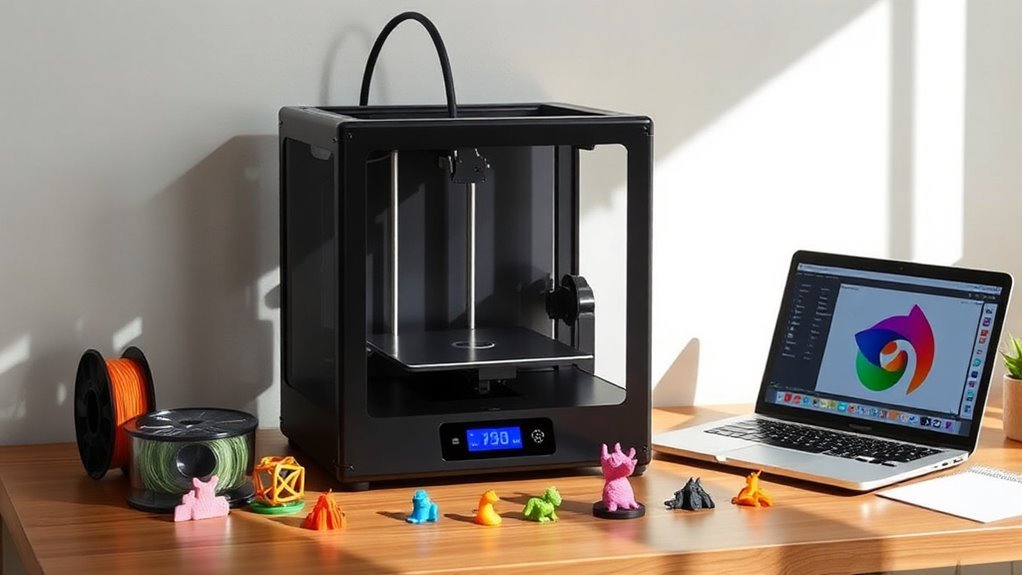
When choosing a budget beginner 3D printer, you’ll want to focus on ease of setup and how quickly it prints without sacrificing quality. Material compatibility and connectivity options also play a big role in what you can create and how smoothly the process goes.
Don’t forget to check for safety features to keep your workspace secure while you’re learning. It’s all about finding the right balance between functionality and user-friendliness.
Ease Of Setup
Although 3D printing might seem complex at first, choosing a beginner-friendly printer can make setup quick and straightforward. Look for models that arrive fully assembled or require minimal assembly, so you can start printing in 15–30 minutes.
Printers with preloaded models on removable storage and clear Quick Start guides or video tutorials help you achieve your first successful print right away. Automatic or assisted bed leveling systems reduce the hassle of manual adjustments, while built-in filament loading aids simplify filament insertion and prevent jams.
Also, check for common connection options like USB, Wi-Fi, or SD card and easy-to-use slicing apps. This way, you can prepare and send print jobs without struggling with complicated software. These features guarantee a smooth start to your 3D printing journey.
Print Speed And Quality
Since print speed and quality directly impact your 3D printing experience, you’ll want to find a balance that fits your needs as a beginner. While higher speeds (200–600 mm/s) can cut job times, they often require sturdier frames and finely tuned motion systems to prevent ringing and detail loss.
Most beginner printers offer 0.05–0.3 mm layer heights with a 0.4 mm nozzle. Lower layers mean finer detail but longer prints.
Key factors like stable dual-axis motion, controlled acceleration, and reliable extrusion help maintain accuracy and quality at moderate speeds. For beginners, aiming for around 200–250 mm/s with good first-layer adhesion, auto-leveling, and a flexible build plate usually gives you the best mix of print speed and consistent results.
Material Compatibility
What materials do you want to print with your 3D printer? Start by checking which filaments a printer supports—PLA is easiest for beginners, PETG offers more strength, and TPU adds flexibility.
Verify the hotend and heated bed temperatures; you’ll need around 240–260°C and a bed that reaches 60–100°C for materials beyond PLA. Confirm filament diameter compatibility, usually 1.75 mm, and consider extruder type—direct drive handles flexible filaments like TPU better than Bowden.
Look for features like hardened nozzles for abrasive filaments, reliable feeding, and build surfaces like PEI-coated beds to improve adhesion. Also, choose printers with open-source firmware and upgrade options, so you can expand material compatibility as your skills grow and printing needs evolve.
Connectivity Options
When choosing a budget beginner 3D printer, you’ll want to weigh connectivity options carefully, as they affect how easily you can send print jobs and manage your projects.
Wi‑Fi lets you start prints wirelessly and use cloud slicing or mobile apps. Just make sure the printer supports stable local connections and secure firmware updates.
USB and SD/TF card slots are reliable offline options. They’re essential as backups or for simpler setups.
USB tethering offers real-time control and monitoring via slicer software. This is handy for troubleshooting but needs a dedicated PC during printing.
Ethernet, though less common in budget models, provides the most stable remote access and faster transfers for large files.
Look for open connectivity plus cross-platform software support to maximize flexibility across your devices. It just makes life easier no matter what device you use.
Safety Features
How can you make sure your 3D printing experience stays safe, especially as a beginner? Start by choosing a printer with enclosed or partially enclosed frames to keep you from touching hot parts and to contain fumes.
Look for thermal protections like rapid-heating cutoffs, thermal runaway safeguards, and temperature sensors to prevent overheating. Filament run-out detection and power-loss recovery help avoid failed prints that could cause jams or excess heat.
Select models with stable mechanics—dual Z support or sturdy gantries—and secure wiring to reduce vibrations and electrical risks. If kids are around, prioritize child-safe features such as rounded edges, covered belts, and easy-to-access emergency stops.
These safety features will help you print confidently and protect both you and your surroundings.
Frequently Asked Questions
What Types of Filaments Are Best for Beginners?
You’ll find PLA and PETG filaments best for beginners since they’re easy to print, have low warping, and require minimal bed heating. They’re forgiving and produce good-quality prints, helping you learn without frustration or wasted material.
Honestly, these filaments make the whole printing process way smoother. So, if you’re just starting out, sticking with PLA or PETG is definitely the way to go.
How Do I Maintain and Clean a 3D Printer?
Think of your 3D printer as a garden—keep it thriving by regularly cleaning the nozzle, wiping the bed, and lubricating moving parts.
Doing this will prevent clogs and guarantee smooth prints. It’s the best way to let your creativity blossom effortlessly.
Can I Upgrade My Budget 3D Printer Later?
Yes, you can upgrade your budget 3D printer later. You’ll often swap parts like the nozzle, print bed, or add upgrades like better extruders and firmware.
Just check compatibility before buying upgrades to avoid issues. It’s always a good idea to do a little research first so everything works smoothly.
What Safety Precautions Should Beginners Follow?
Think of safety like your 3D printer’s guardian angel—always wear gloves, keep the area ventilated, and never leave it unattended.
Also, avoid touching hot parts. These simple steps keep sparks of creativity, not accidents, flying.
Are There Any Recommended Free 3D Modeling Software Options?
Yes, you can use free 3D modeling software like Tinkercad, Fusion 360 (free for personal use), and Blender. They’re beginner-friendly, powerful, and great for creating designs without spending a dime.
Give them a try! You might find one that fits your style perfectly.
Conclusion
Choosing your first 3D printer is like planting a seed in a garden—you want the right soil, sunlight, and care to watch your creativity bloom. The Entina Tina2 Plus, Creality Ender 3 V3 SE, Anycubic Kobra X, and the Portable Compact FDM each offer the perfect foundation for your ideas to grow.
Pick one that fits your needs, and soon, you’ll be crafting masterpieces from thin air. These budget beginner 3D printers are designed to be user-friendly and reliable, making them great choices for anyone just starting out.
Whether you want to explore hobby projects or prototype new inventions, these affordable 3D printers provide the tools to bring your imagination to life. Your creative journey starts now with one of the best budget beginner 3D printers for 2027!