7 Best Conductive 3D Printer Filaments for 2027
You’ll want to check out Protopasta’s Conductive Black PLA for strong, low-current circuits. It’s perfect if you need reliable conductivity without fuss.
AMOLEN’s conductive PLA is another solid pick, especially with its wide temperature range that handles various printing conditions well.
For tougher, heat-resistant parts, the 1kg Conductive ABS shines. It’s great for ESD and EMI shielding but keep in mind it requires a hardened steel nozzle and an enclosure.
Flexible projects benefit from TPU filaments like Reprapper’s graphene-carbon blend, which adds a nice stretch to conductive prints.
Polymaker’s Fiberon PETG-ESD offers static dissipation with reliable conductivity. It’s a dependable choice if you need consistent performance across your prints.
Explore these top options, and you’ll find the right match for your specific applications and printer setup.
| Image | Name | Editor's Rating | Price |
|---|---|---|---|

|
|
||

|
|
||

|
|
||

|
|
||

|
|
Protopasta Conductive Black PLA 3D Printer Filament
- Ideal for Electronic Prototyping & Smart Devices: Design and test functional electronics with ease using this electronic prototyping filament. Perfect for IoT device...
- Functional Performance with Stable Resistivity: This filament maintains a volume resistivity of less than 10ohm-cm for reliable conductivity across printed parts. As a...
- Engineered Conductivity with Composite PLA: Crafted with a precise polymer composite, this electrically conductive 3D printer filament creates robust, low-resistance...
- Premium 3D Printing Material for Precision and Performance: Offered in a convenient 500g spool, this 1.75mm conductive filament boasts smooth, reliable flow at...
- Black Finish & Durable Build for Display and Use: With its sleek black appearance and consistent flow, this black conductive 3d printing material is great for both...
Protopasta Conductive Black PLA filament is designed for creators who need reliable conductivity in their 3D printed electronics. It solves the challenge of integrating conductive pathways directly into prototypes, enabling smooth development of touch sensors, LED circuits, and smart devices. This filament delivers consistent electrical performance, helping you build functional electronics with confidence.
With a volume resistivity below 10 ohm-cm, it ensures dependable conductivity across printed layers. The composite PLA base provides strength and durability while resisting warping during printing. Its sleek black finish adds a professional look to your projects without compromising performance.
Compatible with most standard FDM printers, it prints smoothly at temperatures between 210 and 230°C. Maintenance is straightforward since the filament flows consistently and produces minimal printing defects. This makes it suitable for educational environments and rugged IoT or wearable prototypes.
While ideal for low-current applications, it is not designed for high-power electronics. Also, the filament is available only in 500 g spools, which may require multiple purchases for larger projects. The black color may limit design options for some users but enhances the overall durability and conductivity.
Best for: Engineers, makers, and DIY electronics enthusiasts prototyping functional, low-current electronic devices and wearable technology.
What We Like:
- Low volume resistivity under 10 ohm-cm ensures reliable conductivity
- Strong composite PLA resists warping and enhances durability
- Smooth printing on standard FDM printers at 210–230°C
- Professional black finish ideal for functional prototypes
Specification:
| Attribute | Details |
|---|---|
| Manufacturer | Protopasta |
| Material | Conductive Black PLA |
| Weight | 500 g spool |
| Color | Black |
| Printing Temperature | 210–230°C |
| Volume Resistivity | Under 10 ohm-cm |
Conductive ABS Filament 1KG 1.75mm 3D Engineering Grade Filament
- What Conductive ABS Really Does? ABS conductive filament is designed to provide external protection for internal conductive systems. It creates a low-resistance...
- Reliable Conductivity for ESD Protection: With a stable volume resistivity of 20,000 Ω·cm, YXPOLYER ABS Conductive filament is optimized for ESD-safe applications...
- Stronger than PLA: Compared to conductive PLA, conductive ABS offers lower resistivity, higher strength, better heat resistance, and improved durability, making it the...
- Easy to Print with Conductive Fillers: Made with conductive particles like carbon nanotubes or metal powder. Prints well at 220–260 °C on most standard FDM printers...
- Strong Bonding and Toughness: This conductive ABS sticks well between layers and is stronger than PLA. It doesn’t crack or break easily, even in large or detailed...

Conductive ABS Filament offers a perfect balance of conductivity and durability for demanding engineering projects. It solves the problem of static buildup by providing stable low resistivity, making it ideal for ESD-safe applications such as flexible circuits and EMI shielding components.
This filament stands out with its superior strength and heat resistance compared to conductive PLA. These qualities reduce cracking and improve longevity in complex, functional prints. You can rely on it to maintain structural integrity under stress.
To achieve consistent results, print with a hardened steel nozzle at 220–260°C on an enclosed FDM printer equipped with a heated bed. Proper maintenance is essential: dry the filament at 65–75°C for 6–8 hours and store it in a moisture-controlled environment to preserve its conductivity and extrusion stability.
While it is not designed for carrying electrical current, this filament excels at static discharge and shielding applications. The abrasive conductive fillers require specialized nozzles, so ensure your printer setup is compatible.
Best for: Engineers and makers needing a durable, low-resistivity filament for ESD-safe functional parts like sensors, flexible circuits, and EMI shielding.
What We Like:
- Stable low resistivity (20,000 Ω·cm) for effective static dissipation
- Superior strength and heat resistance reduce print failures
- Compatible with hardened steel nozzles and enclosed FDM printers
- Requires proper drying and moisture-controlled storage for optimal performance
Specification:
| Attribute | Details |
|---|---|
| Material | Conductive ABS |
| Diameter | 1.75 mm |
| Weight | 1 kg |
| Resistivity | 20,000 Ω·cm |
| Recommended Temp. | 220–260°C |
| Nozzle Type | Hardened steel |
Protopasta Conductive Black PLA 3D Printer Filament
- Ideal for Electronic Prototyping & Smart Devices: Design and test functional electronics with ease using this electronic prototyping filament. Perfect for IoT device...
- Functional Performance with Stable Resistivity: This filament maintains a volume resistivity of less than 10ohm-cm for reliable conductivity across printed parts. As a...
- Engineered Conductivity with Composite PLA: Crafted with a precise polymer composite, this electrically conductive 3D printer filament creates robust, low-resistance...
- Premium 3D Printing Material for Precision and Performance: Offered in a convenient 1kg spool, this 1.75mm conductive filament boasts smooth, reliable flow at...
- Black Finish & Durable Build for Display and Use: With its sleek black appearance and consistent flow, this black conductive 3d printing material is great for both...
Protopasta Conductive Black PLA offers an innovative solution for makers and engineers tackling electronics projects. Its low volume resistivity ensures your prints maintain consistent electrical conductivity, reducing troubleshooting time and improving device reliability.
Designed for FDM printers, this filament flows smoothly and resists warping, making it easier to produce precise, functional parts at temperatures between 210 and 230°C. The sleek black finish not only looks professional but also suits applications like touch sensors and wearable tech.
Maintenance is straightforward—print settings may need slight adjustment to account for its conductive properties, but overall it behaves similarly to standard PLA. Its packaging on a recyclable 1 kg spool supports sustainable practices and keeps filament tidy during use.
This conductive filament is ideal for low current circuits and prototyping IoT devices, offering a practical option for STEM education and electronics development. However, it is not suitable for high-power applications and comes only in 1.75 mm diameter, which may limit printer compatibility.
Best for: makers, educators, and engineers seeking an easy-to-print conductive filament for functional electronic prototypes and wearables.
What We Like:
- Consistent electrical conductivity with low volume resistivity
- Smooth flow and low warp for reliable FDM printing
- Professional black finish for both functional and aesthetic needs
- Recyclable 1 kg spool supports sustainability
Specification:
| Feature | Details |
|---|---|
| Manufacturer | Protopasta |
| Material | Conductive Black PLA |
| Diameter | 1.75 mm |
| Recommended Temp | 210–230°C |
| Spool Weight | 1 kg |
| Color | Black |
AMOLEN Conductive Black PLA 3D Printer Filament
- 【ELECTRICALLY CONDUCTIVE 】- Special Electrically conductive PLA filament, with a solid dark black color that lasts throughout each batch,Our Filament with...
- 【HIGH COMPATIBILITY 】- Perfectly compatible with most FDM 3D printers, constant filament diameter of 1.75 mm, dimensional accuracy of +/- 0.03 mm,Our AMOLEN...
- 【Quality PLA Filament】Ensuring durability and excellent performance. Good shaping, strong toughness, no bubble, no jamming, no warping, melt well, feed smoothly and...
- 【Why Choose AMOLEN PLA Filament】User's mind and keeping innovation. Transparent spool shows more color of the 1.75mm pla filament. Sealed Vacuum Bags to keep the 3d...
- 【After-sales Service】AMOLEN is focused on innovative and better quality 3d printing filaments. We stand behind the quality and performance of our 3D printer filament...
AMOLEN Conductive Black PLA filament offers a dependable solution for creators working on electrically conductive projects. Its solid black finish not only looks professional but also ensures consistent conductivity throughout your prints. The filament’s precise 1.75 mm diameter with tight tolerance minimizes extrusion issues, helping you avoid jams and bubbles.
This filament melts cleanly between 230℃ and 280℃, accommodating a wide range of 3D printers. Maintaining the recommended bed temperature of 80℃ to 100℃ enhances adhesion and print quality. The vacuum-sealed packaging preserves filament freshness by keeping it dry and free from dust, which reduces maintenance needs and prolongs its usability.
Ideal for practical electronics, circuit boards, wiring, and artistic 3D printing, this filament balances performance with convenience. While the 200 g spool size may require more frequent changes during large projects, its consistent quality supports reliable, precise printing. Keep in mind, the slight variance in diameter might affect ultra-precision tasks, and some low-temp printers may not reach the necessary extrusion temperatures.
Best for: makers and engineers needing reliable, electrically conductive black PLA filament for functional and creative 3D printing applications.
What We Like:
- Precise 1.75 mm diameter ensures smooth, jam-free extrusion
- Wide temperature range (230℃–280℃) suits varied printers
- Vacuum-sealed packaging keeps filament dry and dust-free
- Solid black, conductive finish ideal for electronics and art
Specification:
| Manufacturer | AMOLEN |
|---|---|
| Diameter | 1.75 mm |
| Weight | 200 g |
| Material | Conductive Black PLA |
| Color | Black |
| Printing Temp | 230℃ – 280℃ |
| Bed Temp | 80℃ – 100℃ |
Polymaker Fiberon PETG-ESD 3D Printer Filament, Black, 1.75mm, 0.5kg
- STATIC-DISSIPATIVE PETG: Carbon nanotube-compounded PETG developed for electronics housings, PCB assembly jigs, component trays, storage fixtures, production tools, and...
- CONTROLLED ELECTROSTATIC DISSIPATION: Engineered to dissipate accumulated static charge rather than function as a current-carrying conductor. Surface resistivity may vary...
- TOUGH FUNCTIONAL PARTS: Combines static-dissipative properties with the toughness and durability of PETG, making it suitable for reusable jigs, fixtures, enclosures...
- PRINTING REQUIREMENTS: Print at 250–290°C with a 70–80°C build plate and the cooling fan turned off. Use an all-metal hotend capable of at least 250°C and a...
- MOISTURE AND PART CARE: Store the filament sealed and dry. If stringing, bubbles, rough surfaces, or inconsistent extrusion occur, dry at 65°C for 3 hours. Keep finished...
Polymaker Fiberon PETG-ESD is designed to keep your electronics safe from damaging static buildup. This black PETG filament contains carbon nanotubes that effectively dissipate static without conducting electricity. It’s perfect for printing durable housings, jigs, and trays where electrostatic discharge protection is critical.
This filament prints smoothly at 250–290°C on an all-metal hotend, with no annealing or heated chamber needed. Its toughness and static-dissipative properties combine to create functional parts that withstand everyday use. After printing, checking the surface resistivity ensures your components meet ESD requirements.
Proper storage is essential. Keep the filament sealed and dry to maintain print quality. If moisture absorption occurs, drying at 65°C will prevent defects like stringing or bubbles. Using a wear-resistant nozzle is recommended for consistent results.
Polymaker Fiberon PETG-ESD offers a reliable solution for static-safe 3D printing, balancing mechanical strength with electrostatic control for electronics applications.
Best for: Professionals and hobbyists needing static-dissipative, durable filament for electronics-related functional parts.
What We Like:
- Combines PETG toughness with effective static dissipation
- Prints without annealing and works within a broad temperature range
- Controls static buildup without conducting current
- Requires simple drying to maintain optimal print quality
- Suitable for functional electronics housings, jigs, and trays
Specification:
| Attribute | Details |
|---|---|
| Manufacturer | Polymaker |
| Material | PETG with carbon nanotubes |
| Color | Black |
| Diameter | 1.75 mm |
| Spool Weight | 0.5 kg |
| Recommended Print Temp | 250–290°C |
| Hotend Type | All-metal |
3D Printer Conductive TPU Filament 1.75mm Black

- 【Conductivity & flexible】– Conductive TPU filament based on 95A TPU filament, enbodied with conductive carbon and graphene, as a result has both conductivity...
- 【High tier & innovative application】– With 95A TPU conductive filament’s property, it can be used for several high tier & innovative application. For example...
- 【Consistent quality】– we have strictly process control of 3d printer conductive filament TPU with 1.75mm +/- 0.02mm diameter and its conductivity etc quality point...
- 【Good compatibility】–Yousu conductive TPU 3d filament has good compatibility. It can be used for most FDM 3d printer like bambu lab X1, P1P, A1 series 3d printer...
- 【Professional】– Conductive TPU 3d filament is more professional material, the target customer are these people who really wants its conductive functional or ESD...
Experience the versatility of conductive TPU filament designed to bring flexibility and electrical functionality to your 3D prints. This black, 1.75mm diameter filament combines soft, durable TPU with conductive carbon and graphene additives. It enables the creation of flexible parts that conduct electricity, ideal for specialized projects where traditional rigid filaments fall short.
This filament is perfect for applications requiring electrostatic discharge (ESD) protection or soft electronics components. Its conductivity, while not as high as metals like copper, supports innovation in research and maker projects. Print settings greatly influence conductivity, so measuring with an ohmmeter is recommended for optimal results.
Proper maintenance ensures consistent performance. The filament absorbs moisture easily, so it must be dried before printing to avoid defects. It requires more printing skill than standard PLA, especially when managing overhangs and fine-tuning parameters for conductivity.
Compatible with many popular FDM printers, including Bambu Lab and Creality Ender 3, this filament offers a reliable diameter tolerance for smooth feeding and quality prints. It uniquely merges softness with electrical functionality, expanding the possibilities for flexible, conductive 3D-printed components.
Best for: makers, researchers, and hobbyists creating flexible, conductive parts for ESD applications or soft electronics projects.
What We Like:
- Flexible prints with integrated electrical conductivity
- Compatible with a wide range of FDM 3D printers
- Consistent diameter tolerance for reliable printing
- Suitable for specialized applications requiring ESD protection
- Enables innovative soft electronics and maker projects
Specification:
| Feature | Details |
|---|---|
| Manufacturer | Not specified |
| Diameter | 1.75 mm |
| Weight | 1 kg |
| Material | TPU (95A) with carbon and graphene additives |
| Color Options | Black |
Reprapper Conductive TPU Filament 1.75mm Black
- 【Electrically Conductive and Flexible】— This 3d printer filament is included with conductive graphene and carbon, so it has conductivity properties. It does have...
- 【Professional High Innovative application 】 — This conductive filament is a resistor for LEDs and interacts with touch capacitive devices plus supports ESD...
- 【Laser Diameter Control and Automatic Winding System】— We've taken care of the details so you can focus on creating. Our 3d printer filament is meticulously...
- 【 Professional-Grade Packed and Perfect Customer Service 】— Our 1.75 filament undergoes rigorous CCD checks and comes with a guarantee, compatible with almost all...
- 【Functional Filament Printing Tips】– This 3d filament absorbs moisture, so the user needs to dry the filament before printing and needs more 3d printing skills. For...
Discover the power of flexible, electro-conductive 3D printing with the Reprapper Conductive TPU Filament 1.75mm Black. This filament is designed to bring your electronic projects to life by combining durability with conductivity. It solves common challenges in creating flexible circuits and touch-sensitive parts without compromising material strength.
Made from a 95A TPU blend infused with graphene and carbon, it delivers reliable electrical pathways for resistors, sensors, switches, and ESD protection. While not as conductive as copper, it offers an innovative solution for printed circuit applications where flexibility and elasticity matter most.
Maintenance is straightforward. The filament comes vacuum-sealed to avoid moisture absorption, which can cause printing issues. Simply dry it before use to ensure smooth extrusion and consistent results. Its tightly controlled 1.75mm diameter guarantees precise layering on most FDM printers.
Printing requires moderate skill and speeds under 100mm/s. This balance helps maintain print quality and conductivity, although complex geometries may require extra care. Its compatibility with a wide range of printers makes it accessible for both makers and engineers.
Best for: Makers and engineers needing flexible, electro-conductive filament for advanced 3D printed electronic circuits, sensors, switches, and ESD applications.
What We Like:
- Flexible TPU infused with graphene and carbon for dependable conductivity
- Vacuum-sealed packaging prevents moisture issues
- Precise 1.75mm diameter ensures smooth printing
- Compatible with most FDM 3D printers
- Suitable for various electronic and ESD projects
Specification:
| Feature | Details |
|---|---|
| Manufacturer | Reprapper |
| Diameter | 1.75 mm |
| Material | TPU (95A) with graphene and carbon |
| Color | Black |
| Compatibility | Most FDM 3D printers |
Factors to Consider When Choosing Conductive 3D Printer Filament
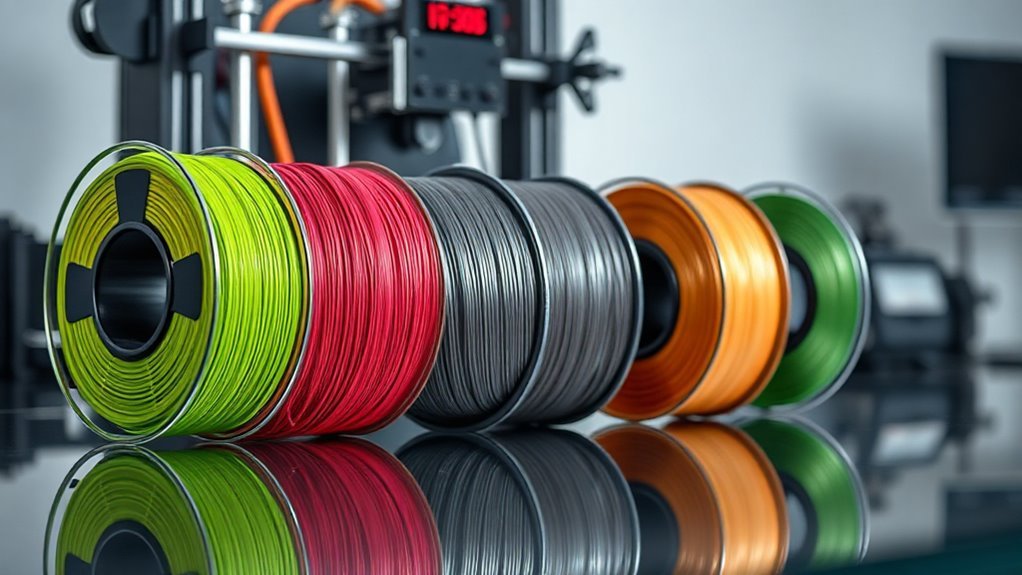
When choosing conductive 3D printer filament, you’ll want to check its electrical conductivity levels and how well it matches your printer’s material compatibility and durability needs.
Make sure to account for printing temperature requirements and how you’ll handle and store the filament to keep it in good shape.
Finally, think about your specific application to pick a filament that performs exactly where and how you need it.
Electrical Conductivity Levels
Electrical conductivity often plays a pivotal role in selecting conductive 3D printer filaments, so understanding how it’s measured and what affects it is essential. Conductivity is usually expressed as volume resistivity, where values below 10 Ω·cm indicate strong conductivity for low-current paths.
Keep in mind, some filaments focus on ESD or static dissipation with much higher resistivity, around 20,000 Ω·cm. The actual resistance you get depends on your print’s geometry—length, cross-sectional area, and infill all matter.
Conductivity isn’t just about a single strand; it must maintain consistent performance across layers. Also, print parameters can impact how conductive fillers behave, so always verify electrical performance with a meter if your project demands precise conductivity levels.
Material Compatibility And Durability
Since your project demands both conductivity and durability, you’ll want to carefully align the filament material with the mechanical environment it’ll face. Conductive PLA is easier to print but less tough, making it suitable for less demanding applications.
If you need strength and heat resistance, conductive ABS is your best bet. It’s an engineering-grade option designed for toughness and stable resistivity around 20,000 Ω·cm. Just remember, ABS requires an enclosed printer, heated bed, and a hardened steel nozzle because of its abrasive fillers.
For flexible parts, conductive TPU offers elastic durability, but its conductivity can vary with print geometry and infill. Also, keep in mind filament care: ABS needs drying and proper storage, TPU requires moisture control, and maintaining consistent extrusion with composite filaments is key to reliable durability and performance.
Printing Temperature Requirements
Although choosing the right conductive filament is essential, you also need to pay close attention to printing temperature requirements to ensure excellent performance. Check the manufacturer’s recommended nozzle temperature, as it varies—for example, conductive PLA usually prints around 210–230°C. But some variants may require 230–280°C.
Conductive ABS demands higher temperatures, typically 220–260°C, plus a heated bed at 80–100°C to ensure stability and good layer bonding. If you’re using conductive TPU, expect higher temperatures and handle it carefully. It often needs drying to avoid extrusion issues.
Also, make sure your printer’s all-metal hotend and nozzle can reach and maintain these temperatures reliably. This is especially important since abrasive conductive fillers can cause clogs or inconsistent flow if the setup isn’t right.
Filament Handling And Storage
Maintaining the right printing temperature is only part of the equation when working with conductive filaments—you also need to handle and store them properly to keep their performance consistent. Store your filament in a dry box or sealed container after opening to prevent moisture issues. Moisture can cause poor extrusion and inconsistent conductivity.
If you notice stringing, bubbles, or rough surfaces, dry the filament. Typically, this means heating it at 65–75°C for 6–8 hours or around 65°C for about 3 hours, depending on the material. Conductive composites, especially TPU and PETG, absorb moisture more easily, so drying is essential.
Make sure to use moisture-protective packaging and keep caps closed between prints. After drying, only load what you’ll use soon, then reseal the rest promptly. This helps maintain stable printing and reliable conductive properties.
Application Specific Use Cases
When choosing conductive 3D printer filament, you need to ensure the specific application to provide the best performance. For low-current electronics like touch sensors or LED circuits, pick filaments with volume resistivity under 10 Ω·cm for reliable conductivity across layers.
If you want ESD control for housings or trays, static-dissipative filaments with resistivity around 20,000 Ω·cm work best—they prevent short circuits while dissipating charge. For EMI shielding or tougher parts, conductive ABS offers durability but requires drying and enclosed printing.
Flexible, wearable components benefit from conductive TPU, where conductivity depends on infill and geometry. Firstly, for heat- and stress-resistant parts, choose filaments stronger than conductive PLA to ensure both conductivity and durability in practical builds.
Frequently Asked Questions
How Do Conductive Filaments Affect Print Speed and Quality?
Conductive filaments usually slow your print speed because of their unique material properties. They can also affect quality by causing rougher surfaces or clogging.
You’ll need to adjust settings for a best balance between speed and finish. It’s all about finding that sweet spot where your print looks good without taking forever.
Can Conductive Filaments Be Used With Any 3D Printer?
You can use conductive filaments with most 3D printers, but you’ll need a printer that handles specialty materials well.
Make sure your nozzle and bed can manage the filament’s properties to avoid clogs or poor adhesion.
It’s all about getting the right settings and equipment to make your prints turn out great. Just a little extra care goes a long way!
What Safety Precautions Are Needed When Printing With Conductive Filaments?
You might think conductive filaments are totally safe, but you should still wear gloves and a mask to avoid inhaling fumes or skin contact.
Make sure your printer’s well-ventilated and avoid overheating the filament during printing. It’s better to be safe than sorry!
How Do Conductive Filaments Compare in Cost to Standard Filaments?
You’ll find conductive filaments generally cost more than standard ones due to their specialized materials. However, prices have been dropping, so you can expect to pay a bit extra but still get good value for your projects.
It’s kind of like paying a little more for high-quality gear — totally worth it if your project needs that extra conductivity. Plus, as more people use them, costs are likely to keep going down.
Are There Post-Processing Techniques to Improve Conductivity?
You know what they say, “slow and steady wins the race.” You can improve conductivity by sanding, applying conductive inks, or adding metal coatings after printing.
These post-processing steps boost electrical performance effectively. It’s a simple way to get better results without changing the whole printing process.
Conclusion
Choosing the right conductive 3D printer filament isn’t just about conductivity—it’s about blending flexibility, durability, and precision. You want a filament that sparks innovation without short-circuiting your creativity.
Whether it’s Protopasta’s reliable PLA or the versatile TPU options, the perfect filament can turn your bold ideas into functional reality. After all, in the world of 3D printing, the filament you pick is the thread that weaves your future creations.
When selecting conductive filaments for 3D printing, consider not only electrical performance but also mechanical properties like flexibility and strength. The best conductive 3D printer filaments combine these qualities to help you craft prototypes and finished products that truly stand out. So, keep these factors in mind to choose a filament that balances conductivity, durability, and precision—making your innovative projects come to life with ease.