7 Best 3D Printers for Students in 2027 (Top Picks)
If you’re a student looking for a reliable 3D printer, you’ve got some great options to consider. The Bambu Lab A1 and P1S stand out with their fast, easy setups and multi-color printing capabilities. These printers make it simple to bring your creative ideas to life without a complicated start.
On the other hand, the Anycubic Kobra X supports native 4-color printing, which is perfect for those creative projects needing vibrant and varied colors. If you want something more compact and beginner-friendly, the Entina Tina2C Mini and TINA2S kits are excellent choices.
Plus, the ELEGOO Centauri 2 shines when it comes to multicolor ease and monitoring features. These models all balance speed, quietness, and usability, making them ideal for classroom or home learning environments. Take a closer look at their features, and you’ll find the perfect 3D printer to fit your needs.
| Image | Name | Editor's Rating | Price |
|---|---|---|---|

|
|
||

|
|
||

|
|
||

|
|
||
|
|
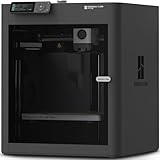
Bambu Lab A1 3D Printer, Ready-to-Use FDM 3D Printer for Beginners and Kids
- High-Speed Precision: Experience unparalleled speed and precision with the Bambu Lab A1 3D Printer. With an impressive acceleration of 10,000 mm/s², the A1 delivers...
- Multi-Color Printing with AMS lite: Unlock your creativity with vibrant and multi-colored 3D prints. The Bambu Lab A1 3D printers make multi-color printing accessible and...
- Full-Auto Calibration: Say goodbye to manual calibration hassles. The A1 3D printer takes care of all the calibration processes automatically, ensuring optimal...
- Active Flow Rate Compensation: Achieve consistently smooth prints with active flow rate compensation. The algorithm actively compensates the flow rate according to the...
- Easy and Quiet 3D Printing: Experience effortless printing with the Bambu Lab A1 FDM 3D printer. Its user-friendly interface and simplified touchscreen make it easy to...
The Bambu Lab A1 3D Printer is designed to make 3D printing accessible and enjoyable for beginners and kids. Its fast acceleration of 10,000 mm/s² ensures prints are completed quickly without losing detail. This speed helps users bring ideas to life faster, reducing wait times and keeping creativity flowing.
Maintenance is straightforward with fully automatic calibration and a 1-Clip quick-swap nozzle, which simplifies nozzle changes. The printer also features active flow rate compensation, ensuring smooth and consistent extrusion throughout the print. These functions reduce frustration and technical hassles.
The compact design includes a user-friendly touchscreen that guides users through every step. For quiet environments, the printer’s active motor noise canceling minimizes distractions, making it ideal for home or classroom use. Multi-color printing is possible with the optional AMS Lite system, offering creative flexibility.
While the printer is easy to use, multi-color printing requires purchasing the AMS Lite separately unless bundled. Also, advanced customization options are limited, which might not meet professional needs. Younger kids may need supervision when swapping nozzles.
Best for: Beginners and kids seeking a fast, easy-to-maintain, and quiet 3D printer with multi-color printing capability.
What We Like:
- Fast acceleration delivers quick, precise prints.
- Automatic calibration and flow compensation simplify use.
- Quiet operation with active noise canceling.
- Easy nozzle swaps with the 1-Clip system.
- Optional AMS Lite system enables multi-color printing.
Specification:
| Feature | Details |
|---|---|
| Manufacturer | Bambu Lab |
| Dimensions | Compact size (exact size not provided) |
| Weight | Not specified |
| Material | Not specified |
| Color Options | Not specified |
Anycubic Kobra X Multicolor 3D Printer, Easy Setup, Native 4-Color
- 【 Newest Level - 19-Color with 4 ACE 2 Pro】Why settle for one color when you can have multicolor? The Kobra X comes born with 4 colors built-in. It is innovative 3D...
- 【 Savings 2X Time】Stop wasting hours and filament on purging! Kobra X impresora 3D reduces the filament and machine travel path by 81.25%, so 2X the Speed, and...
- 【Hardened Precision & High Speed 】 Equipped with a high-durability hardened steel nozzle and vibration compensation, the Kobra X ensures every layer remains smooth...
- 【Flawless First Layer with LeviQ 3.0】The LeviQ 3.0 and auto bed leveling system uses a 49-point calibration and advanced leveling algorithm to ensure 100% bed...
- 【Smart AI Monitoring & Large Model Library】APP remote control, features Spaghetti detection and foreign object detection. The innovative top-mount spool holder...
Step into multicolor 3D printing with the Anycubic Kobra X Multicolor, designed to enhance creativity and simplify your workflow. Its native 4-color printing capability allows for vibrant, detailed models, while the option to expand to 19 colors offers even more creative freedom.
Setting up is straightforward and efficient. The printer’s LeviQ 3.0 auto bed leveling ensures consistent print quality with minimal manual adjustment. Filament travel reduction technology helps save material and reduces waste, making your printing process more economical.
Maintenance is user-friendly with smart AI monitoring that catches errors early, preventing failed prints. You can also control and monitor your prints remotely via the Anycubic app, giving you convenience and peace of mind during long print jobs.
The printer’s 260 × 260 × 260 mm build volume suits most student and hobbyist projects. However, larger-scale prints may require alternative solutions. Color expansion is limited to ACE 2 Pro units, so compatibility should be considered.
Best for: Students and makerspaces needing an easy-to-use multicolor 3D printer with reliable features and quick setup.
What We Like:
- Native 4-color printing with up to 19 colors for detailed designs
- Efficient setup with automatic bed leveling and filament saving technology
- Smart AI monitoring reduces print failures
- Remote print control via the Anycubic app
Specification:
| Feature | Details |
|---|---|
| Manufacturer | Anycubic |
| Print Volume | 26 × 26 × 26 cm |
| Color Printing | Native 4-color, expandable to 19 colors |
| Auto Bed Leveling | LeviQ 3.0 |
| Connectivity | Remote control via app |
Bambu Lab P1S Combo, P1S 3D Printer and AMS, Multi-Color 3D Printing
- Up to 16 Colors: Bring your designs to life with vibrant multi-color/multi-material printing capabilities, perfect for showcasing your creativity. Note: Connecting Bambu...
- 500mm/s and 20000 mm/s² Acceleration True High Speed: Don't wait around for your masterpieces. Lightning-fast printing speed lets you focus on creating, not waiting.
- Enclosed Design: Fully enclosed body improves print performance for advanced filaments. Automatic Bed Leveling: Say hello to high-quality, successful prints. Auto bed...
- Set Up in 15 Minutes: Spend more time printing and less time setting up. User-friendly design ensures a hassle-free assembly experience for all skill levels.
- Supported Filament: Ideal: PLA, PETG, TPU, PVA, PET ABS, ASA; Capable : PA, PC; Not Recommended: Carbon/Glass Fiber Reinforced Polymer.
Explore vibrant multi-color 3D printing with the Bambu Lab P1S Combo, designed to simplify complex projects. Combining a high-speed P1S 3D printer and an AMS accessory, this setup supports up to 16 different filament colors. This lets you create detailed, multi-material prints without constantly swapping spools.
The printer’s CoreXY motion system enables fast, precise printing up to 500 mm/s, cutting down production time without sacrificing quality. Its fully enclosed design and automatic bed leveling ensure consistent results while handling advanced filaments like PLA, PETG, and TPU. This makes maintenance straightforward and reduces print failures.
Setup is quick and user-friendly, taking about 15 minutes, which suits both beginners and experienced users. However, note that carbon and glass fiber reinforced polymers are not recommended, slightly limiting material choices. The unit weighs 47.5 pounds, so while it’s sturdy, it’s less portable.
The AMS connection is essential for multi-color printing, adding a layer of complexity and cost to initial setup. Still, this combo offers versatile functionality ideal for creative projects requiring multiple colors and materials.
Best for: Students and hobbyists looking for an easy-to-use, reliable multi-color 3D printing system with fast speeds.
What We Like:
- Supports up to 16 colors for detailed multi-material prints.
- High-speed CoreXY system with precise tuning.
- Fully enclosed body with automatic bed leveling for hassle-free printing.
- Quick and simple setup suitable for all skill levels.
Specification:
| Feature | Details |
|---|---|
| Manufacturer | Bambu Lab |
| Dimensions | Not specified |
| Weight | 47.5 lb (21.5 kg) |
| Supported Filaments | PLA, PETG, TPU |
| Color Options | Multi-color (up to 16) via AMS |
| Motion System | CoreXY |
Entina Tina2C Mini 3D Printer Starter Bundle
- Complete Starter Bundle with 1kg PLA: Includes four 250g rolls of PLA filament in different colors. Start creating colorful toys, decorations, and DIY projects without...
- Fully Assembled & Ready in 5 Minutes: No complicated assembly required. The Tina2C mini 3D printer comes ready for guided setup through the Poloprint Cloud app, helping...
- 3500+ Models, New Designs Added Daily: Explore over 3500 printable models and 25+ DIY modules through the app. Discover fresh creative projects and hands-on STEM...
- Auto Leveling & Power-Loss Recovery: Automatic bed leveling improves first-layer setup and reduces manual adjustments. Power-loss recovery helps resume interrupted...
- Magnetic Build Plate & Quick-Swap Nozzle: The flexible magnetic plate helps release finished prints with a gentle bend, while the quick-swap nozzle design makes routine...
The Entina Tina2C Mini 3D Printer Starter Bundle brings 3D printing into the hands of beginners and students with simplicity and ease. It arrives fully assembled, allowing you to connect quickly through the Poloprint Cloud app. This means you can start creating prints in about five minutes without hassle.
Its compact build volume of 3.9 inches per side fits comfortably in classrooms or home workspaces. The printer operates quietly and includes built-in LED lighting, making monitoring prints easy without distractions. These features support focused learning and creative exploration in small spaces.
Maintenance is straightforward, thanks to the magnetic flexible build plate and automatic bed leveling. Power-loss recovery ensures your projects continue smoothly even during unexpected interruptions. The included colorful PLA filaments and access to thousands of models encourage diverse and engaging projects.
While the small build volume limits larger designs, this printer excels in educational and hobbyist settings. It connects via 2.4 GHz WiFi, which is suitable for most environments but may face challenges in some networks. Overall, it simplifies the 3D printing experience for beginners.
Best for: Educators, kids, and beginners seeking a compact, easy-to-use 3D printer starter bundle for educational and hobbyist use.
What We Like:
- Quick start with fully assembled setup and app connectivity
- Auto bed leveling and magnetic build plate for easy maintenance
- Includes multiple PLA filament colors and access to a vast model library
- Quiet operation with built-in LED lighting for monitoring prints
Specification:
| Feature | Details |
|---|---|
| Manufacturer | Entina |
| Build Volume | 3.9 x 3.9 x 3.9 inches |
| Connectivity | 2.4 GHz WiFi |
| Filament Type | PLA |
| Included Filaments | 4 colorful PLA rolls |
| Lighting | Built-in LED |
| Special Features | Auto bed leveling, power-loss recovery, magnetic flexible build plate |
Bambu Lab P1S 3D Printer, Ready-to-Use FDM 3D Printer
- Up to 16 Colors: Bring your designs to life with vibrant multi-color/multi-material printing capabilities, perfect for showcasing your creativity. Note: Connecting Bambu...
- 500mm/s and 20000 mm/s² Acceleration True High Speed: Don't wait around for your masterpieces. Lightning-fast printing speed lets you focus on creating, not waiting.
- Enclosed Design: Fully enclosed body improves print performance for advanced filaments. Automatic Bed Leveling: Say hello to high-quality, successful prints. Auto bed...
- Set Up in 15 Minutes: Spend more time printing and less time setting up. User-friendly design ensures a hassle-free assembly experience for all skill levels.
- Supported Filament: Ideal: PLA, PETG, TPU, PVA, PET ABS, ASA; Capable : PA, PC; Not Recommended: Carbon/Glass Fiber Reinforced Polymer.
Step into the world of rapid and precise 3D printing with the Bambu Lab P1S, a ready-to-use FDM 3D printer designed to get you creating quickly. Its fast setup lets you start printing in about 15 minutes, eliminating the usual delays and technical hurdles beginners face.
This printer’s CoreXY enclosed design combines speed and accuracy, reaching up to 500 mm/s with smooth acceleration. It supports printing in up to 16 colors through the AMS system, allowing for vibrant, multi-material projects without complicated filament changes. The automatic bed leveling ensures reliable first layers, reducing failed prints and frustration.
Maintenance is straightforward thanks to user-friendly features and the integrated MakerWorld library, which offers a variety of beginner-friendly models. While the machine handles many filament types such as PLA, PETG, and TPU, it is not suited for carbon or glass fiber reinforced polymers, which require specialized equipment.
Its larger size means it needs a dedicated workspace, but this trade-off comes with advanced capabilities that help students and hobbyists explore complex 3D printing tasks confidently.
Best for: Students and beginners looking for a fast, easy-to-use 3D printer with advanced multi-material capabilities and reliable performance.
What We Like:
- High-speed CoreXY design delivering fast, precise prints
- AMS system supports up to 16 colors for versatile projects
- Automatic bed leveling simplifies setup and reduces errors
- Compatible with various filament types for creative flexibility
Specification:
| Feature | Details |
|---|---|
| Manufacturer | Bambu Lab |
| Printing Technology | FDM (Fused Deposition Modeling) |
| Max Print Speed | 500 mm/s |
| Acceleration | 20,000 mm/s² |
| Color Options | Supports up to 16 colors (AMS system) |
| Compatible Filaments | PLA, PETG, TPU, and more |
| Dimensions | Larger footprint (exact size not specified) |
| Weight | Heavier model (exact weight not specified) |
TINA2S Fully Assembled Mini 3D Printer for Kids and Beginners, Starter Kit

- COMPLETE STARTER KIT: Everything is included, just bring the imagination. This 3D printer starter kit comes with a mini printer, 10M of PLA filament, a microSD card...
- FULLY ASSEMBLED PRINTER: Unlike other 3D printers that may malfunction if not meticulously assembled correctly, our printer is designed for reliable, long-term use right...
- EASY AUTO LEVELING: Made with kids and beginners in mind, our printer turns complexity into creativity-fueling simplicity. It features auto-leveling and a dual z-axis...
- ONE-TOUCH FILAMENT LOADING: Load and retract filament at the touch of a button. The 3D printers for beginners and kids are compatible with 1.75mm PLA, PLA pro, & TPU...
- OPEN SOURCE PRINTING: Use MAC, Windows, or Linux and bring your imagination to life. The WiFI-capable printer is also compatible with a majority of slicing software...
Discover the ease of 3D printing with the TINA2S Fully Assembled Mini 3D Printer, designed specifically for kids and beginners. This compact printer arrives fully assembled, so you can start creating immediately without the hassle of setup. Its user-friendly design solves common frustrations by offering auto-leveling and one-touch filament loading, ensuring smooth and precise printing every time.
Maintenance is simple with a flexible magnetic build plate that allows easy removal of prints without damage. The included 10 meters of PLA filament and microSD card with preloaded models and slicing software make it convenient to jump right into projects. Its lightweight and small footprint make it perfect for classrooms, dorm rooms, or small workspaces.
The printer supports WiFi connectivity and works seamlessly with Mac, Windows, and Linux systems, expanding its usability. However, it is limited to 1.75 mm PLA, PLA Pro, and TPU filaments and requires specific metal/magnetic build plates to avoid sensor issues. Its compact size may restrict print volume for larger projects but suits educational and beginner needs well.
Best for: Kids, beginners, and educators seeking a hassle-free, fully assembled mini 3D printer that delivers accurate prints with minimal setup.
What We Like:
- Ready to use out of the box with no assembly needed
- Flexible magnetic build plate for easy print removal
- Preloaded microSD with models and slicing software
- WiFi connectivity and broad system compatibility
Specification:
| Feature | Details |
|---|---|
| Manufacturer | TINA2S |
| Dimensions | Compact size (exact size not specified) |
| Weight | Lightweight |
| Material | PLA, PLA Pro, TPU filament compatible |
| Color Options | Not specified |
ELEGOO Centauri 2 Combo 3D Printer, Beginner-Friendly Multicolor Printing

- 4-Color Printing with CANVAS: Create vibrant multi-color models effortlessly with CANVAS 4-color printing. Independent motors, instant color switching, RFID filament...
- Start Printing with Confidence: Full auto calibration and smart pre-print checks simplify setup, while 22 intelligent sensors monitor every print in real time. From first...
- Designed for Speed: Experience faster creation with a high-speed CoreXY system reaching up to 500mm/s and 20,000mm/s² acceleration. The rigid aluminum frame and...
- Smoother, Sharper, Smarter: From the first layer to the final detail, intelligent calibration, vibration compensation, and precise extrusion control help produce clean...
- A Seamless Workflow from Idea to Print: Simplify your entire workflow with the ELEGOO ecosystem. Discover ready-to-print models on Nexprint, prepare projects with...

The ELEGOO Centauri 2 Combo 3D Printer transforms multicolor 3D printing into a straightforward experience. Its innovative 4-color CANVAS system with independent motors allows instant color switching, solving the common problem of complicated filament changes. You’ll benefit from RFID filament recognition, which reduces print interruptions and enhances workflow efficiency.
Built with a sturdy aluminum frame and featuring CoreXY motion technology, this printer delivers precise and stable prints at speeds up to 500 mm/s. The 5-inch touchscreen interface makes operation intuitive, while the full auto calibration and 22 sensors continuously monitor your prints. This ensures reliability and quality without constant manual oversight.
Maintenance is simplified thanks to its robust design and smart sensor alerts that help prevent print errors. The printer’s size means it needs a dedicated workspace, but its remote app connectivity lets you manage prints conveniently from anywhere. This combination of features supports both beginners and hobbyists aiming to master multicolor printing with minimal hassle.
Best for: Beginners and hobbyists seeking a reliable, easy-to-use multicolor 3D printer with advanced features and remote control capabilities.
What We Like:
- Smooth multicolor printing with 4-color CANVAS system and RFID filament recognition
- Fast, precise printing enabled by CoreXY motion and rigid aluminum frame
- User-friendly operation via 5-inch touchscreen and full auto calibration
- Real-time print monitoring with 22 sensors for consistent results
- Remote app control for managing prints from anywhere
Specification:
| Feature | Details |
|---|---|
| Manufacturer | ELEGOO |
| Dimensions | Approximately 19.7 x 19.7 x 19.7 inches |
| Weight | 33 pounds (15 kg) |
| Frame Material | Aluminum |
| Color Options | Multicolor printing capability |
Factors to Consider When Choosing a 3D Printer for Students
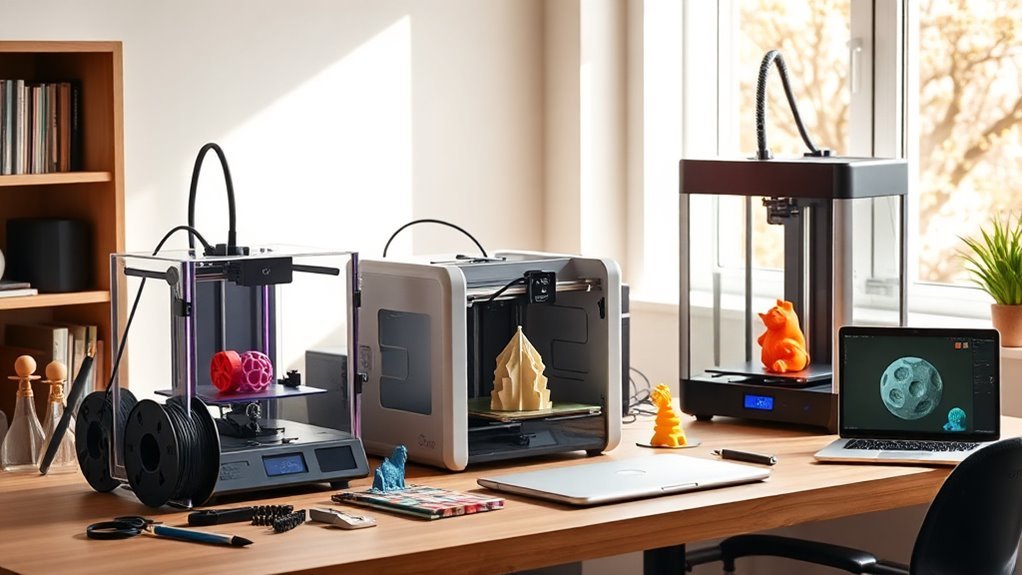
When choosing a 3D printer for students, you’ll want to take into account print volume size to match their project needs and ease of setup to keep things simple.
Printing speed and multi-color capability can boost creativity and efficiency, while noise level matters if the printer will be used in shared or quiet spaces.
Balancing these factors helps you pick the best fit for student use. It’s all about finding that sweet spot between functionality and convenience.
Print Volume Size
Because the print volume size directly impacts what students can create, you should carefully consider the maximum build dimensions of a 3D printer. Typical classroom printers range from about 100 × 100 × 100 mm for smaller models to around 250 × 250 × 250 mm for medium-sized prints.
Smaller volumes work well for quick, simple projects and save on time and filament. On the other hand, larger volumes let students print bigger or more complex models without splitting them.
Remember to check the usable print area after any bed fixtures reduce space, especially for tall prints like anatomical models or towers. It’s important to match the build volume to your curriculum goals and available storage.
Keep in mind, bigger prints need more room and sometimes sturdier printer parts. But, they’re ideal for prototyping and group projects.
Ease of Setup
After considering the print volume size to match your curriculum needs, you’ll want to focus on how easy the 3D printer is to set up. Choose printers that come fully assembled or need minimal assembly, ideally under 15 minutes, so you can start printing quickly without specialized tools.
Models with guided setup wizards and touchscreen interfaces simplify tasks like filament loading, bed leveling, and calibration, reducing errors. Automatic bed leveling and preconfigured Z-offsets save time and boost first-print success compared to manual adjustments.
Look for printers with quick-load nozzles and one-click filament loading to minimize downtime. Clear documentation and software offering step-by-step tutorials and sample print profiles will help you and your students achieve consistent results without complex manual tuning.
This way, the entire setup process becomes smooth and efficient, letting you focus more on creating than troubleshooting.
Printing Speed
Consider printing speed carefully to balance efficiency and quality in a classroom setting. Faster speeds, like over 60 mm/s printing and 200 mm/s travel, can cut model time but may reduce surface quality and need fine-tuning of acceleration and jerk.
High acceleration shortens moves but demands a stiff frame and well-maintained belts to prevent ringing. You can speed up prints by using thicker layers and fewer perimeters, but this lowers detail and strength.
For students, it’s best to aim for moderate speeds with reliable presets to avoid failed prints and keep projects on track. Remember, complex prints with multiple materials take longer due to tool changes, so plan accordingly.
Finding the right speed guarantees students get both quality prints and enough iterations to learn.
Multi-Color Capability
Balancing print speed with quality is important, but adding multi-color capability brings another layer of complexity to student 3D printing projects.
Multi-color printers use multi-extruder systems, tool-changing heads, or external material-switching units. These setups affect both cost and maintenance.
Native multi-color setups with multiple nozzles allow smooth color shifts, but they demand more calibration and upkeep. So, make sure the printer’s software supports at least four colors and handles color changes precisely to avoid visible seams.
Keep in mind that multi-color printing increases print time and material waste. It also requires extra filaments, including specialty supports like PVA.
For students, it’s worth weighing the educational benefits of multi-material projects against the steeper learning curve and ongoing maintenance. Don’t forget about safety considerations too, like proper ventilation for certain filaments.
Noise Level
Noise levels often play a crucial role when choosing a 3D printer for students, especially in busy classroom environments. Typical classroom-friendly models run around 40–50 dB, similar to a quiet office, while high-speed printers can exceed 60 dB, becoming disruptive during long prints.
Since stepper motors, fans, and vibrations drive noise, seek printers with rigid frames, vibration-damping feet, or enclosed designs to reduce sound transmission. You’ll also want models that let you adjust fan speeds and motion settings, so you can balance print speed with classroom comfort.
When setting up, keep the printer several feet from workstations, consider acoustic enclosures, and use a phone app to measure noise—aiming to keep levels under 50 dB for a productive learning environment.
Software Compatibility
How well your 3D printer works with software can make or break the student experience. You’ll want a printer that supports mainstream slicers like Cura, PrusaSlicer, or Simplify3D, accepting standard G-code. That way, students can tap into plenty of educational resources.
Check for cross-platform compatibility—Windows, macOS, and Linux—and whether the software offers cloud, desktop, or mobile apps. This helps make sure it matches your school’s devices.
Make sure it handles common file types (STL, OBJ, 3MF) securely, with user controls to protect student projects. Also, look for slicer features that are helpful in education, like material profiles, print time estimates, and mesh repair tools.
Finally, confirm firmware update options and community support. This way, advanced students can safely explore custom settings and even classroom automation.
Maintenance Requirements
Maintaining a 3D printer properly guarantees consistent print quality and extends the machine’s lifespan, which is especially important in a classroom setting. You’ll need to clean the nozzle regularly and replace it every 100–300 hours, depending on the filament’s abrasiveness, to prevent clogs.
Keep the bed surface clean by wiping it with isopropyl alcohol before prints. Replace or reglue build surfaces every 6–12 months with frequent use to ensure good first-layer adhesion.
Lubricate linear rails or rods and check belt tension every 50–100 hours or monthly if used heavily. Storing filament in sealed containers with desiccants is also key, and don’t forget to dry hygroscopic filaments to avoid jams.
Lastly, perform firmware updates and run calibration routines every few months. This helps keep your printer accurate and running smoothly.
Safety Features
When selecting a 3D printer for students, you need to prioritize safety features that protect both users and equipment. Look for enclosed or semi-enclosed build areas and hotend shrouds to prevent accidental contact with hot nozzles and heated beds.
Printers with physical safety interlocks or door sensors will pause printing if the enclosure opens, reducing burn or injury risks. Make certain the machine has certified power protection like fused inputs and grounded plugs, plus power-loss recovery to avoid electrical hazards and failed prints.
Check for filament run-out detection and thermal runaway protection in the firmware to prevent fires. Finally, choose printers with enclosed drive mechanisms, guarded belts, and clear pinch-point labels to minimize entanglement and injury risks, especially for younger users.
Frequently Asked Questions
What Safety Precautions Are Necessary When Using a 3D Printer?
You should always wear safety goggles and make certain there is proper ventilation. Avoid touching hot parts to keep yourself safe.
Keep your workspace clean and use the printer on a stable surface. Also, be sure to follow the manufacturer’s instructions closely.
These steps help prevent burns, fumes, and mechanical injuries while using your 3D printer. Staying cautious makes the whole process safer and smoother.
How Much Maintenance Do Student 3D Printers Typically Require?
Student 3D printers typically need moderate maintenance. You’ll clean the print bed, lubricate moving parts, and occasionally replace nozzles or belts.
Staying consistent with these tasks keeps your printer running smoothly and prolongs its lifespan. It’s not too complicated once you get the hang of it!
Are There Specific Software Programs Recommended for Student 3D Printing?
You should try software like Tinkercad, Ultimaker Cura, and Fusion 360; they’re user-friendly, perfect for students, and support various printers.
They’ll help you design, slice, and prepare models with ease and efficiency. Plus, they’re great for learning the ropes without feeling overwhelmed.
Can These Printers Handle Advanced Materials Like Metal or Resin?
Like a blacksmith forging a masterpiece, you’ll find some student-friendly printers can handle resin but rarely metal.
Most advanced materials need specialized machines, so don’t expect every student 3D printer to tame those tougher substances.
What Are the Best Practices for Storing Printed Models?
You should store printed models in a cool, dry place away from direct sunlight. Use airtight containers to prevent dust and moisture damage.
Label each model and handle them gently to avoid warping or breaking over time. It really helps keep them in good shape for longer.
Conclusion
Choosing the right 3D printer can boost your learning and creativity—did you know that 65% of students who use 3D printers feel more engaged in STEM subjects? Whether you want easy setup, multicolor options, or beginner-friendly features, one of these top picks will fit your needs perfectly.
Jump in, experiment, and watch your ideas come to life in 3D. Your next great project is just a print away!
With the best 3D printers for students in 2027, you’ll find models designed to simplify learning while inspiring innovation. From easy assembly to intuitive software, these printers cater to beginners and advanced users alike. So, whether your focus is on detailed prototypes or colorful creations, these top choices make 3D printing accessible and fun.
Get ready to explore new dimensions in education and creativity—your ideal 3D printer is waiting to help you bring your ideas into reality!