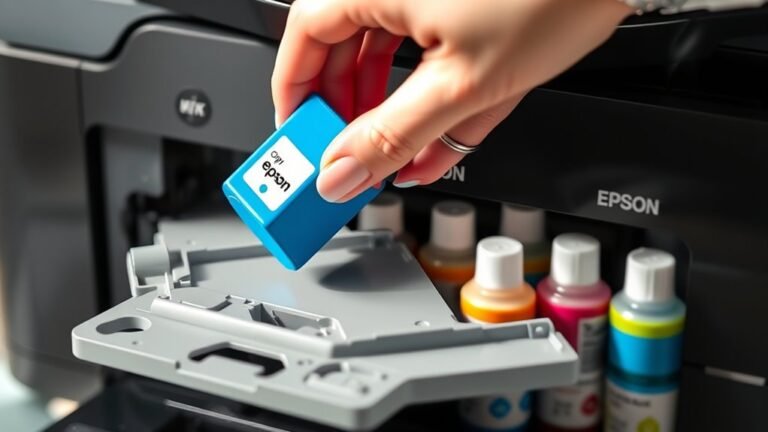
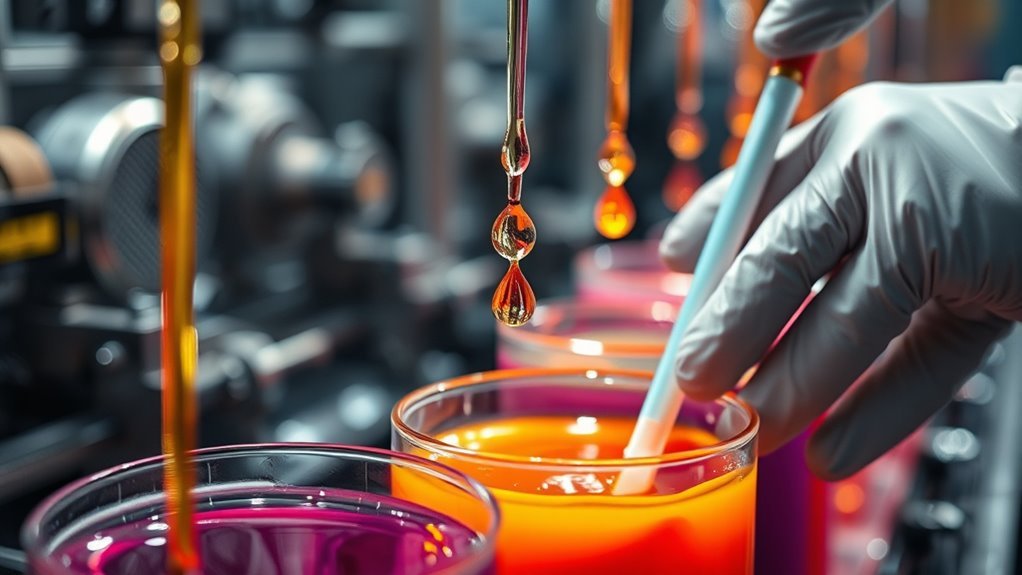
How Is Printer Ink Made Step-by-Step
You start printer ink by carefully mixing pigments or dyes with solvents that control flow and drying. These ingredients are crucial because they determine the color vibrancy and how well the ink spreads on paper. Then, additives like humectants and surfactants keep the ink stable and compatible with your printer.
The mixture undergoes fine dispersion and filtration to prevent clogging. This step ensures the ink flows smoothly through tiny nozzles without any hiccups. After that, thorough testing guarantees smooth nozzle ejection and consistent print quality.
Finally, automated machines fill, seal, and package the ink in a clean environment. This keeps everything hygienic and ready for use.
Keep exploring to uncover how each step affects your print quality and ink longevity. It’s fascinating how every detail counts when making printer ink!
Key Takeaways
- Pigments or dyes are precisely mixed with stabilizers and dispersing agents to create vibrant, durable ink colors. This careful blending ensures the colors pop and last long on paper.
- Then, solvents and viscosity modifiers are added. These help control the flow of the ink, speed up drying time, and make sure the printer nozzles don’t get clogged.
- Additives like surfactants, humectants, biocides, and pH buffers are included next. They keep the ink stable and boost the overall print quality.
- After mixing, the ink goes through multi-stage dispersion, filtration, and inline monitoring. This process checks particle size and consistency to make sure everything is just right.
- Finally, the ink is filled into cartridges or bottles inside HEPA-filtered cleanrooms. Automated systems handle dosing, sealing, and quality checks to keep everything clean and precise.
Overview of Printer Ink Ingredients
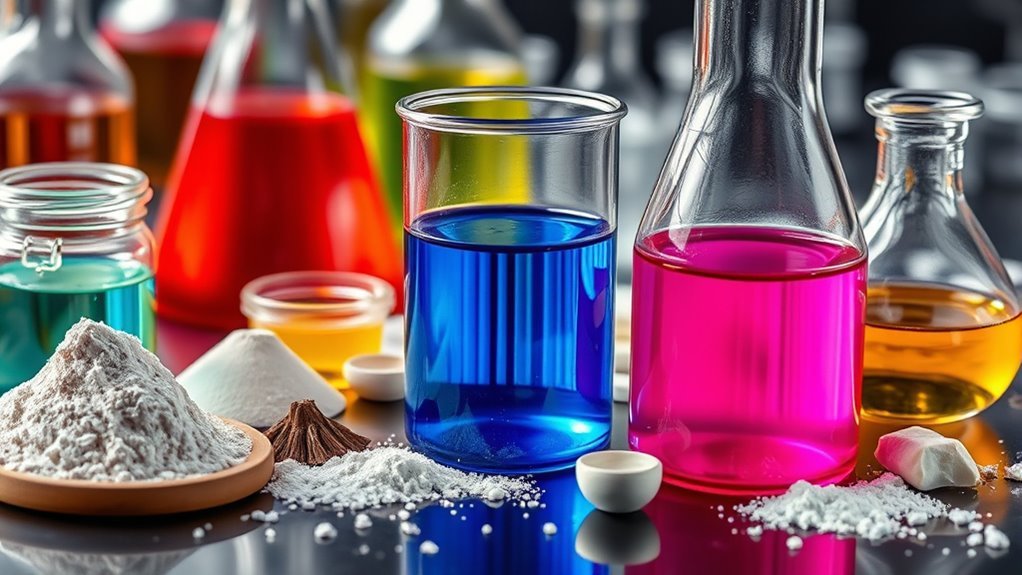
Let’s break down what goes into modern printer ink. You’ll find three main components: pigments, solvents, and additives.
Pigments are tiny solid particles, usually between 50 and 200 nanometers, that offer excellent light and water resistance. They’re suspended in the ink rather than dissolved, ensuring durable prints.
Solvents, often water or organic compounds like glycols and alcohols, control the ink’s viscosity and surface tension. This helps droplets eject smoothly through tiny nozzles and determines how the ink dries—whether by evaporation or absorption.
Additives make up less than 5% of the mix but play essential roles. Surfactants improve adhesion, humectants prevent nozzle drying, and biocides inhibit microbial growth.
Together, these carefully balanced ingredients create reliable, high-quality ink for your printer. It’s pretty neat how each part works to keep your prints looking sharp!
How Pigments and Dyes Create Color
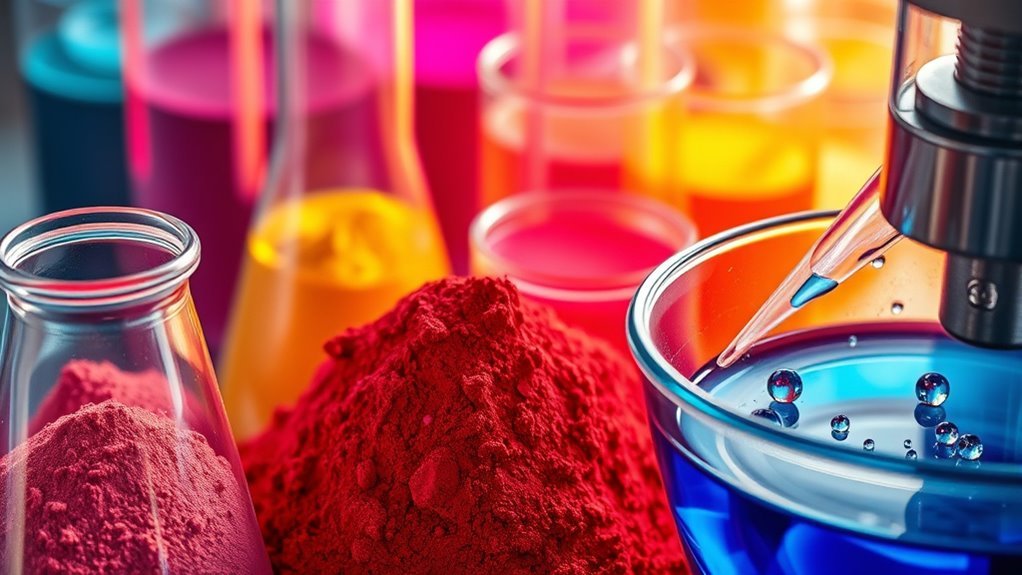
How do pigments and dyes work together to create the vibrant colors you see in printed images? Pigments are finely ground solid particles dispersed in the ink’s liquid base, providing opaque, lightfast colors that resist water and fading.
Pigments are tiny solid particles in ink that deliver durable, opaque colors resistant to water and fading.
To keep these particles evenly suspended and prevent clogging, manufacturers use dispersing agents and high-shear processes like bead milling.
On the other hand, dyes dissolve molecularly in the solvent, offering a wider, more vivid color range but with less durability against water and light.
Ink formulas carefully mix primary cyan, magenta, yellow, and black pigments or dyes in precise ratios. This matches target colors through spectrophotometric methods.
Stabilizers help maintain suspension stability, ensuring consistent droplet formation and reliable print quality every time.
Balancing Printer Ink Solvents for Flow and Drying
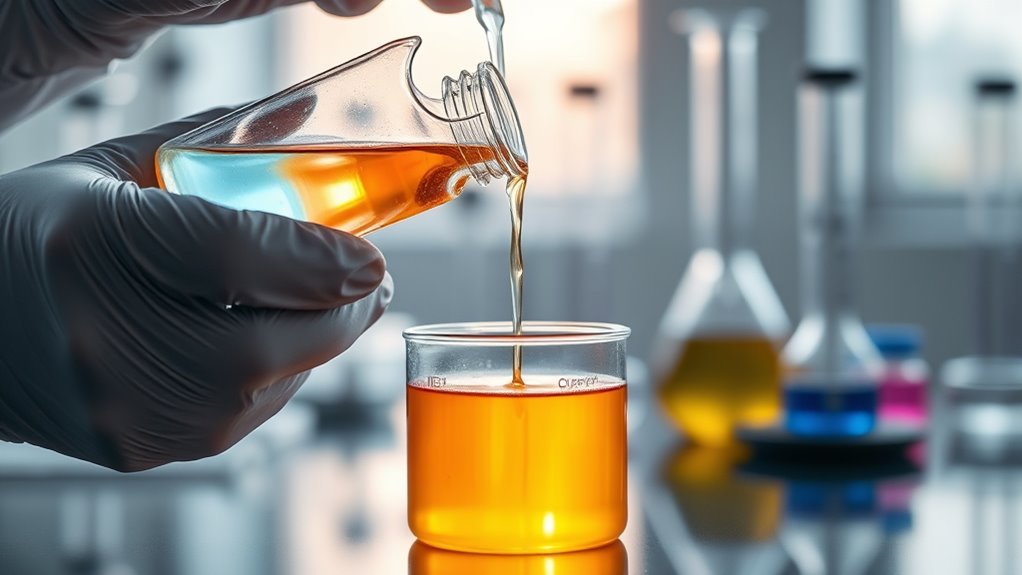
Although pigments and dyes provide color, the solvent blend in printer ink plays a pivotal role in guaranteeing smooth flow and proper drying. You’ll find that formulators use viscosity modifiers to keep the ink’s thickness between 1 and 10 mPa·s, allowing it to eject cleanly through tiny nozzles without creating unwanted satellite droplets.
Humectants like glycerol or propylene glycol prevent the nozzles from drying out by retaining moisture, while fast-evaporating solvents promote quick surface drying on paper. Surface tension modifiers fine-tune how droplets form and spread—too low, and the ink bleeds; too high, and it clogs the printhead.
How Additives Improve Printer Ink Performance
Enhancing printer ink performance hinges on carefully chosen additives that fine-tune its behavior from nozzle to paper. You rely on humectants like glycerol to keep the printhead moist, preventing clogging by slowing evaporation.
Surfactants reduce surface tension, guaranteeing ink droplets spread evenly without creating unwanted satellite droplets. Rheology modifiers adjust viscosity and stop foam, keeping pigment particles suspended and cartridges filling smoothly.
| Additive Type | Function |
|---|---|
| Humectants | Retain moisture, prevent nozzle drying |
| Surfactants | Lower surface tension, improve droplet spread |
| Rheology Modifiers | Control viscosity, prevent foam formation |
| Biocides & Buffers | Stabilize ink, suppress microbial growth |
These additives guarantee consistent print quality and reliable cartridge operation every time. They really make sure your printing experience stays smooth and hassle-free.
Printer Ink Manufacturing Process
You start by carefully mixing ingredients in a specific order to make certain color and consistency. Then, the ink undergoes fine filtration and rigorous quality checks to meet strict standards.
Finally, precise automated filling seals the ink into cartridges, ready for your printer’s exact needs. It’s all about making sure everything works perfectly for you.
Ingredient Mixing Order
When you start mixing printer ink ingredients, you first wet and pre-disperse the dry pigment powders in a portion of the solvent using high-shear mixing to break up clumps. The pigments provide vibrant color and opacity.
Next, add the resinous binder slowly to coat pigment particles evenly and control rheology. This step helps everything blend smoothly.
Then, introduce viscosity modifiers like glycols and humectants to adjust flow and prevent nozzle drying. These ingredients keep the ink flowing just right.
Finally, blend surfactants, defoamers, and pH buffers to guarantee stability and performance. They make sure the ink stays consistent and works well.
| Step | Ingredient Type | Purpose |
|---|---|---|
| 1 | Pigments | Provide color and opacity |
| 2 | Resinous binder | Coat pigments, control rheology |
| 3 | Viscosity modifiers | Adjust flow, prevent drying |
| 4 | Surfactants | Control surface tension |
| 5 | Additives | Stabilize, prevent microbial growth |
Filtration And Quality
Although the ink mixture looks ready, it must pass through multi-stage filtration to remove particles that could clog tiny printhead nozzles measuring 10 to 70 micrometers. This process starts with coarse filters and ends with fine sub-10 micrometer membranes, assuring smooth flow.
After filtration, you’ll find quality tests measuring viscosity, surface tension, pH, and color values to maintain consistency. The ink undergoes stability tests simulating months of use, checking for sedimentation or agglomeration.
All steps happen in clean-room environments to avoid contamination. Key points include:
- Multi-stage filtration removes harmful particulates
- Viscosity and colorimetric tests assure batch uniformity
- Stability tests confirm long-term ink performance
- Controlled environments prevent microbial contamination
This rigorous filtration and quality control guarantee your ink prints perfectly every time.
Cartridge Filling Precision
Automated lines fill cartridges with pre-blended ink, dosing precise volumes accurate to within ±0.5–1.0% to prevent air pockets or overfill. Before filling, the ink undergoes thorough filtration and degassing to remove tiny particles and dissolved gases that could clog nozzles.
Precision pumps then deliver the ink into cartridges, assuring exact fill levels while maintaining controlled viscosity and surface tension. Once filled, cartridges are immediately sealed with tamper-evident caps or membranes to lock in ink quality.
Automated systems verify mechanical parts like valves and chips to guarantee proper ink flow and electronic recognition. Inline quality controls check weight, leaks, viscosity, pH, and color, routing any defective units for rework.
This meticulous process makes certain every cartridge performs reliably from the moment you install it. It’s all about giving you a hassle-free experience and consistent print quality every time.
Testing Printer Ink for Printhead Quality
Ensuring printer ink meets stringent printhead quality standards requires rigorous testing of its physical and chemical properties. You need to verify viscosity, surface tension, and particle size to guarantee smooth printing without clogging or misfires.
Key tests include measuring viscosity (1–10 mPa·s) at controlled temperatures to ensure stable droplet formation through tiny nozzles. Testing surface tension (around 25–50 mN/m) confirms proper wetting and meniscus stability for thermal or piezo printheads.
Analyzing particle size (median 50–200 nm) helps avoid large agglomerates that could block nozzles. This is often combined with filtration down to about 10 µm to keep things running smoothly.
Finally, running accelerated nozzle-firing tests lets you monitor jetting stability, droplet volume, and firing response over millions of pulses. These steps really help maintain printhead reliability and keep your ink performing at its best.
Filling and Packaging Printer Ink
You’ll see that printer ink is filled into cartridges using automated systems to make certain exact volumes every time. These processes happen in clean environments to prevent contamination and keep the ink pure.
Once filled, cartridges go through sealing and leak tests to guarantee they’re secure and ready for use. It’s all about making sure the ink works perfectly when you need it.
Automated Filling Systems
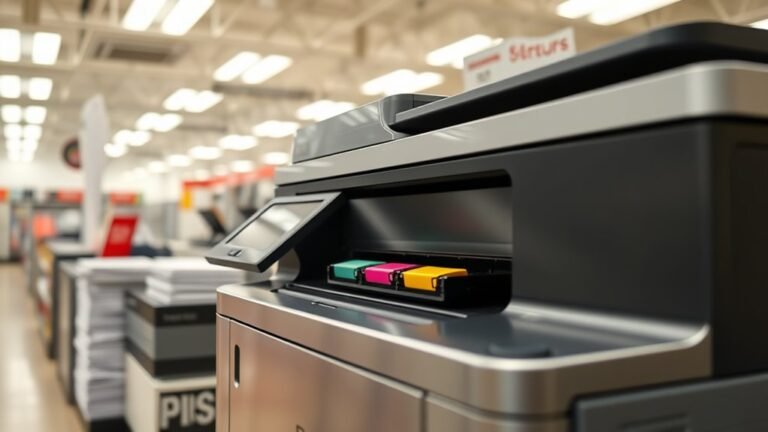
When precision is vital, filling lines use pumps and flow meters to dispense ink into cartridges or bottles with exact volumes, keeping each unit consistent. Automated filling lines operate in clean environments with HEPA filtration, guaranteeing pigment suspensions stay stable.
The process follows a strict sequence involving degas/air removal, metered filling, and sealing to maintain ink quality. It’s all about making sure the ink stays perfect from start to finish.
Key features include inline quality control stations that check volume, viscosity, color, and leaks. Plus, there’s multi-stage filtration that keeps particles below 10 micrometers.
You’ll also find automated capping, sealing, and tamper-evident labeling to guarantee secure packaging. Robotic systems add barcodes and prepare cases for storage and shipping.
This precise, controlled approach makes sure each ink unit meets exact specifications before leaving the production line. It’s all about consistency and quality every step of the way.
Contamination Control Measures
Because even tiny particles can clog nozzles or damage pigments, filling and packaging printer ink happens in cleanroom environments with HEPA-filtered air that keeps contamination to a minimum. You’ll find multi-stage filtration systems removing particles as small as 0.2 microns before and during filling to guarantee purity.
Automated filling lines use negative-pressure or piston-fill heads combined with inert-gas blanketing—usually nitrogen—to prevent air and microbial contamination. Every container and component is pre-cleaned and batch-traceable, while in-process quality checks monitor viscosity, pH, and microbial load to catch contamination early.
After filling, cartridges undergo leak tests and particulate inspections to maintain integrity. These contamination control measures guarantee the ink remains flawless from filling through packaging, protecting print quality and cartridge performance.
Cartridge Sealing Processes
Maintaining ink purity is only part of the process; securing that ink inside cartridges demands equally careful handling. Once precisely metered ink fills each cartridge, they’re sealed tightly to minimize evaporation rate and prevent contamination.
You’ll find sealing methods like heat-sealing foil membranes, ultrasonic welding plastic parts, or fitting engineered plugs and caps. After sealing, rigorous quality checks confirm reliability. Here’s what happens next:
- Automated leak testing confirms no ink escapes.
- Weight verification confirms exact fill volumes.
- Optical sampling checks pigment concentration.
Cartridges get labeled and packaged with protective materials. Finally, environmental stability tests simulate temperature and humidity changes to verify long-term seal integrity.
These steps guarantee your cartridge stays sealed, maintaining ink performance until you’re ready to print.
How Ink Formulations Affect Print Quality and Longevity
Although choosing the right ink formulation might seem technical, it directly impacts the quality and longevity of your prints. Pigment-based formulations offer superior lightfastness and water resistance, keeping your prints vibrant for decades.
Humectants like glycerol prevent nozzle clogging but must be balanced to avoid longer drying times and blurring. pH buffers help maintain color stability and prevent microbial growth, preserving print integrity over time.
| Component | Role | Effect on Prints |
|---|---|---|
| Pigment-based formulation | Lightfastness, water resistance | Long-lasting, sharp images |
| Humectants | Prevent nozzle drying | Reliable printing, controlled drying |
| pH buffers | Stabilize colorants | Prevent color shifts, nozzle clogging |
Choosing wisely keeps your prints sharp and durable. It’s definitely worth paying attention to!
Frequently Asked Questions
How Is Ink Made?
You start by mixing pigments or dyes with solvents, then add binders and additives for stability and flow.
Next, you break down particles uniformly, filter the mixture, test quality, and finally package the ink carefully.
It’s a pretty detailed process, but each step helps make sure the ink works just right.
What Is the Profit Margin for Printer Ink?
Printer ink’s profit margin is a gold mine, often ranging from 60% to 85%. You’ll find the raw materials cost just a few dollars, while manufacturers rake in hefty profits through clever pricing and costly packaging.
It’s pretty wild when you think about it. A small bottle of ink can cost way more than what it actually takes to make. That’s why companies keep prices high—they know people will pay for the convenience.
Is It Possible to Print Without Black Ink?
Yes, you can print without black ink by mixing cyan, magenta, and yellow, but your prints will look weaker. They’ll also use more ink, and text won’t be sharp.
It’s not ideal for high-contrast or archival prints. So, if you want crisp, clear text, it’s better to use black ink.
What Is the Main Ingredient of Ink?
You know, the heart of the matter is the solvent or liquid vehicle—usually water or organic solvents—that carries the colorants. Without it, ink wouldn’t flow or stick, so it’s the main ingredient you rely on every time.
Think about it: without this liquid part, the ink would be just a dry pigment. It’s what makes the ink usable and effective for writing or printing.
Conclusion
Now that you know how printer ink is made, you can see it’s more than just color in a bottle. The pigments, solvents, and additives all work together to guarantee smooth printing and vibrant results.
You might’ve heard that ink is just dye and water—but it’s actually a carefully balanced formula designed for precision and longevity. Every ingredient plays a role in making sure your prints come out sharp and last long without fading.
Next time you print, you’ll appreciate the science behind every drop. Printer ink isn’t just a simple liquid; it’s a complex mixture made to bring your images and documents to life with vivid color and clarity. Understanding how printer ink is made adds a new level of appreciation for the technology that keeps your printing smooth and reliable every day.