6 Best 3D Printers for Nylon Carbon Fiber in 2027
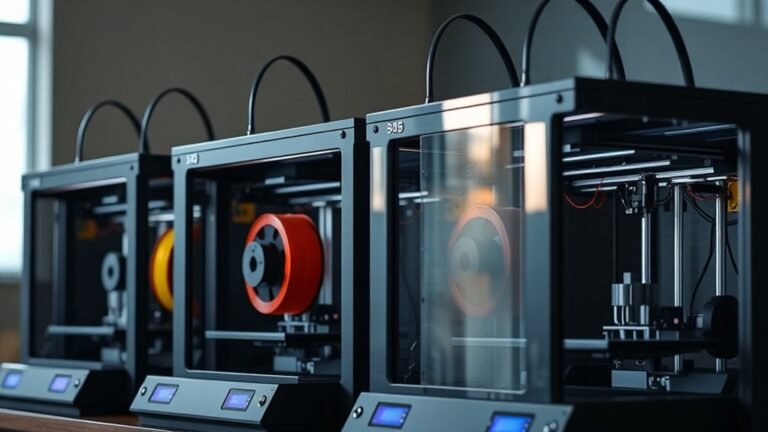
You’ll want a 3D printer with an all-metal hotend that reliably holds 250–300°C. It should handle abrasion-resistant nozzles and offer precise temperature control for strong nylon carbon fiber prints.
Look for enclosed chambers to reduce warping. Features that support filament drying or dry boxes are a big plus since nylon carbon fiber is moisture-sensitive.
Models that support hardened steel or ruby nozzles work best. Stable extrusion at high speeds is also important to handle these tough filaments without issues.
Keep scanning for detailed picks and setup tips that match your printing goals. Finding the right printer makes all the difference when working with nylon carbon fiber.
| Image | Name | Editor's Rating | Price |
|---|---|---|---|
|
|
||

|
|
||

|
|
||

|
|
||

|
|
Polymaker Fiberon PA6-CF20 Carbon Fiber Nylon Filament 1.75mm, Black, 0.5kg
- 20% Carbon Fiber Reinforced PA6: Fiberon PA6-CF20 combines Nylon 6 with 20% carbon fiber for high stiffness, strength, dimensional stability, and strong layer adhesion...
- Engineering Performance After Annealing: Typical TDS values include 109.3 MPa dry X-Y tensile strength and an 8.64 GPa Young’s modulus. Heat deflection temperature...
- Dry Before and During Printing: PA6 is moisture-sensitive. Dry the filament at 100°C for 10 hours before printing, then store and print below 20% relative humidity...
- Advanced Printer Setup Required: Use a 280–300°C nozzle, a 40–50°C build plate, and an all-metal hotend with the cooling fan off. A heated chamber is not required...
- Use a Wear-Resistant Nozzle: Carbon fiber is abrasive, so a hardened steel or ruby nozzle is required instead of a standard brass nozzle. For optimum heat resistance and...
If you need a filament that delivers exceptional strength and rigidity for tough applications, the Polymaker Fiberon PA6-CF20 Carbon Fiber Nylon is an ideal choice. Designed to solve issues with weak or dimensionally unstable parts, it blends Nylon 6 with 20% carbon fiber for enhanced performance. This combination ensures prints withstand mechanical stress and high temperatures without deformation.
Printing with this filament requires careful temperature control, between 280–300°C, and a build plate heated to 40–50°C. Keeping the cooling fan off helps maintain layer adhesion and dimensional accuracy. Because the material is sensitive to moisture, drying it at 100°C for 10 hours before use is essential to avoid print defects and ensure consistent quality.
The filament’s abrasive carbon fiber content demands the use of a hardened steel or ruby nozzle, protecting your equipment while delivering precision. Its high tensile strength and heat resistance make it perfect for creating strong, heat-tolerant functional parts and prototypes.
Best for: engineers and advanced hobbyists seeking durable, stiff, and dimensionally stable components with excellent heat resistance.
What We Like:
- High tensile strength and stiffness for durable prints
- Excellent heat deflection temperature after annealing
- Strong layer adhesion for precise, reliable parts
- Requires pre-print drying to maintain quality
- Compatible with hardened steel or ruby nozzles for abrasion resistance
Specification:
| Attribute | Details |
|---|---|
| Manufacturer | Polymaker |
| Diameter | 1.75 mm |
| Weight | 0.5 kg |
| Material | Nylon 6 with 20% carbon fiber |
| Color | Black |
Polymaker Fiberon PA612-CF15 Carbon Fiber Nylon Filament 1.75mm, Black, 1kg
- 15% Carbon Fiber Reinforced PA612: Fiberon PA612-CF15 is a long-chain PA612 nylon reinforced with 15 wt% carbon fiber. It combines lower moisture sensitivity than...
- Strength Retention After Moisture Exposure: Typical TDS values include 91.9 MPa dry X-Y tensile strength and 83.1 MPa after the specified annealing and...
- Heat Performance After Annealing: The heat deflection temperature reaches 175°C at 0.45 MPa after annealing at 100°C for 16 hours. Annealing also helps improve...
- Lower Moisture Sensitivity Still Requires Dry Storage: PA612-CF15 is less moisture-sensitive than PA6-based nylon but remains hygroscopic. Keep the filament below...
- Advanced Printer and Wear-Resistant Nozzle Required: Use an all-metal hotend, a 250–300°C nozzle, a 40–50°C build plate, and a hardened steel or ruby nozzle with...
Polymaker Fiberon PA612-CF15 is designed for professionals who need durable, high-strength nylon carbon fiber filament. It combines PA612 nylon with 15% carbon fiber to deliver parts that outperform standard nylon in strength and moisture resistance. This filament helps reduce common nylon printing issues like warping and weak tensile strength.
Its unique formulation offers lower moisture absorption than PA6, which means fewer print defects and more consistent results. With a heat deflection temperature reaching 175°C after annealing, it is ideal for applications that require thermal stability, such as tooling, jigs, and automotive components.
To maintain optimal performance, store the filament in a low-humidity environment below 20%. If moisture absorption occurs, dry it at 100°C for 10 hours before use. Print with an all-metal hotend at 250–300°C and a hardened steel nozzle. Keep the cooling fan off to ensure smooth layer adhesion and prevent print failures.
This filament is engineered for functional parts where strength and heat resistance are critical. The need for specialized hardware and moisture management means it suits users prepared to handle advanced materials.
Best for: Engineers and manufacturers needing strong, heat-resistant nylon carbon fiber filament for industrial and prototyping applications.
What We Like:
- Enhanced tensile strength with 15% carbon fiber reinforcement
- Lower moisture sensitivity reduces print defects
- Heat deflection temperature up to 175°C after annealing
- Compatible with all-metal hotends and hardened steel nozzles
Specification:
| Feature | Details |
|---|---|
| Manufacturer | Polymaker |
| Material | PA612 Nylon + 15% Carbon Fiber |
| Diameter | 1.75 mm |
| Weight | 1 kg |
| Color | Black |
| Recommended Print Temp | 250–300°C |
| Heat Deflection Temp | Up to 175°C (annealed) |
IEMAI PA6-CF Carbon Fiber Nylon 3D Printer Filament 1.75mm, 3kg Black
- 1️⃣【Exceptional Mechanical Performance】IEMAI 3KG spool PA6-CF filament is reinforced with 20% chopped carbon fiber to increase stiffness, structural strength, and...
- 2️⃣【Superior Wear Resistance】Engineered for friction-intensive applications, our PA6 CF delivers outstanding wear resistance and low-friction performance, making...
- 3️⃣【High Temperature Resistance】IEMAI PA6 carbon fiber nylon filament offers reliable heat Temperature Resistance up to 150°C. Perfect for functional components...
- 4️⃣【Outstanding Print Quality】With +/-0.03mm dimensional accuracy, this carbon fiber PA6 filament offers strong interlayer adhesion, minimizing warping...
- 5️⃣【Industrial Matte Surface Finish】The carbon fiber reinforcement PA6 creates a rigid matte black surface with reduced visible layer lines, delivering a...
The IEMAI PA6-CF filament offers a reliable solution for producing tough, heat-resistant parts with precise dimensions. Its 20% chopped carbon fiber content significantly improves stiffness and strength, making it ideal for demanding mechanical components. This filament helps reduce wear and friction, which is essential for parts like gears and brackets that face constant motion.
Designed with a matte black finish, it delivers a clean, professional look while minimizing visible layer lines. To ensure optimal performance, printing requires a nozzle temperature of 250–280°C and a heated bed set between 80–100°C. Using an enclosed chamber helps to prevent warping during the printing process.
Proper maintenance includes drying the filament at 70°C for 5–8 hours before use to avoid moisture-related printing issues. Because of the abrasive carbon fibers, a hardened steel or similarly wear-resistant nozzle is necessary to maintain print quality and longevity.
This 3 kg spool supports consistent production of durable, functional parts suited for engineering and industrial applications.
Best for: Professionals and hobbyists needing durable, heat-resistant, and high-strength 3D printed mechanical and functional parts with excellent dimensional accuracy.
What We Like:
- Enhanced stiffness and load-bearing strength from 20% chopped carbon fiber reinforcement
- Excellent wear resistance and low friction for friction-intensive parts
- Matte black finish reduces visible layer lines for a polished appearance
- Requires drying before use to maintain filament quality
- Needs a hardened steel nozzle and enclosed chamber for best results
Specification:
| Feature | Details |
|---|---|
| Manufacturer | IEMAI |
| Material | PA6 Nylon with 20% Carbon Fiber |
| Diameter | 1.75 mm |
| Spool Weight | 3 kg |
| Color | Matte Black |
| Recommended Nozzle | Hardened Steel or Wear-Resistant |
| Nozzle Temperature | 250–280°C |
| Heated Bed Temperature | 80–100°C |
| Printing Environment | Enclosed Chamber Recommended |
SUNLU PA12-CF 20% Carbon Fiber Nylon 1.75mm 3D Printing Filament, Black 1KG
- ①【SUNLU PA12-CF Heat-Resistant Spool】- SUNLU PA12-CF 3D Filament made of 20% Carbon Fibers and 80% PA Nylon, use heat-resistant spool to facilitate drying before...
- ②【Superior Oil & Fuel Resistance】- PA12 CF is resistant to grease, gasoline and solvents. It is suitable for printing fuel tank caps or workshop tool handles, etc...
- ③【Extreme Wear Resistance】- SUNLU carbon fibers create a smooth, low-friction surface that is ideal for moving parts such as gears, bearings or sliding mechanisms...
- ④【High Temperature Resistance up to 347℉(175℃)】- PA-CF filament retains its shape over time in extreme conditions—like car engine parts, outdoor gear in...
- ⑤【Low Density & Light Weight】- PA12-CF's carbon fiber-reinforced nylon 12 (density: 1.04 g/cm³) delivers metal-like strength without the weight. Perfect for...

Experience the strength and reliability of SUNLU PA12-CF filament, designed to enhance your functional 3D prints. This filament combines 20% carbon fiber with PA12 nylon to deliver parts that stand up to wear and friction. It’s ideal for components like gears, bearings, and sliding mechanisms where durability matters.
This black 1.75 mm filament resists oils, fuels, and solvents, making it suitable for demanding environments. It maintains shape and stability at temperatures up to 175°C, so your prints perform well in high-heat conditions. Using a hardened steel nozzle is essential to protect against wear during printing.
Proper maintenance includes drying the filament before use to prevent moisture absorption and warping. Print between 260–280°C with a bed temperature of 50–70°C for optimal results. The 1 kg spool design supports heat resistance and easier filament handling for consistent, robust prints.
Best for: Professionals and hobbyists creating strong, wear-resistant parts for load-bearing and high-temperature applications.
What We Like:
- Strong carbon fiber reinforcement improves wear resistance.
- Excellent chemical resistance for harsh environments.
- High thermal stability supports diverse functional parts.
- Hardened steel nozzle compatibility extends tool life.
- Drying capability reduces moisture-related print issues.
Specification:
| Feature | Details |
|---|---|
| Manufacturer | SUNLU |
| Material | PA12 Nylon with 20% Carbon Fiber |
| Diameter | 1.75 mm |
| Weight | 1 kg |
| Color | Black |
| Recommended Temp. | 260–280°C (nozzle), 50–70°C (bed) |
ELEGOO Carbon Fiber PAHT 3D Printer Filament 1.75mm Black 0.5KG
- Superior Heat Resistance - Withstanding ambient temperatures of up to 194 °C, the material maintains its structural strength and stability, making it suitable for use in...
- Low Water Absorption - ELEGOO PAHT-CF filament has a much lower water absorption rate than regular PA-CF for consistent performance
- Excellent Mechanical Properties - The addition of carbon fibers significantly increases the strength and stiffness of the material, and the excellent interlaminar...
- Abrasion Resistance & Dimensional Accuracy - With carbon fiber added, ELEGOO PAHT-CF 3D printer filament excels in abrasion resistance and dimensional accuracy, making it...
- Compatibility & Tips - Universally compatible with most enclosed 1.75 mm FDM 3D printers. It’s recommended to use hardened steel nozzle with a diameter of no less than...
ELEGOO’s Carbon Fiber PAHT filament is designed to elevate your 3D printing projects with exceptional strength and precision. This black, 1.75mm carbon fiber reinforced nylon filament delivers superior stiffness and abrasion resistance, making it ideal for parts that demand durability and reliability.
Its low water absorption and heat resistance up to 194 °C ensure your prints maintain dimensional accuracy even under stress. This filament is perfect for creating functional components like gears, bearings, and structural parts that perform well over time.
To maintain optimal performance, use a hardened steel nozzle of 0.4 mm or larger and print within the recommended temperature range of 260–300 °C. These requirements help prevent wear on your nozzle and ensure consistent extrusion during printing.
The 0.5 kg spool size is suitable for medium-scale projects, offering a manageable amount of filament without excessive waste. Compatible with most enclosed FDM printers, this filament supports professional and hobbyist needs for high-strength, heat-resistant 3D prints.
Best for: Professionals and enthusiasts needing durable, heat-resistant filament for mechanical and structural FDM printing.
What We Like:
- Carbon fiber reinforcement for enhanced strength and stiffness
- Excellent abrasion and corrosion resistance
- Low water absorption preserves print quality
- Compatible with most enclosed FDM printers
- Requires hardened steel nozzle for durability
Specification:
| Feature | Details |
|---|---|
| Manufacturer | ELEGOO |
| Material | Carbon Fiber Reinforced PAHT Nylon |
| Diameter | 1.75 mm |
| Color | Black |
| Spool Weight | 0.5 kg |
| Print Temperature | 260–300 °C |
| Heat Resistance | Up to 194 °C |
| Recommended Nozzle | Hardened Steel (≥0.4 mm) |
SainSmart 1.75mm Black Carbon Fiber Nylon Filament
- [Incredible Strong] We use a new formula to improve its rigidity and print performance: 80% nylon coupled with 20% carbon fiber, which is ready to take on your next...
- [Lower Shrink Rate] It features with lower shrink rate, higher strength, and rigidity, less warpage and more resistant to wear and tear compared to the traditional nylon...
- [Smooth Printing] Produce high-quality parts that are easy to process and look great; all while delivering functionality, stiffness, dimensional stability and heat...
- [Application] It is suitable for those looking to make both strong and flexible industrial parts, prosthetic, medical equipment, and complex costumes, etc. Optimal print...
- [Tips] Carbon Fiber is abrasive and in general, these fibers will rapidly accelerate the nozzle-wear of brass nozzles. It is highly recommended that you use nozzles made...
Choose SainSmart’s 1.75mm Black Carbon Fiber Nylon Filament for prints that need strength and durability. This filament combines nylon’s flexibility with carbon fiber’s rigidity, solving common issues like warping and shrinkage. It delivers parts that hold their shape well, even under heat and stress.
The blend of 80% nylon and 20% carbon fiber enhances stiffness and dimensional stability. You get smooth, industrial-quality parts suitable for prosthetics, functional prototypes, or demanding mechanical components. Printing at 260–290°C with a heated bed of 45–80°C ensures optimal results.
Because carbon fiber is abrasive, using hardened or stainless steel nozzles is necessary for maintenance and durability. This filament prints easier than many other carbon-filled nylons, making it accessible for both home and professional 3D printing setups.
Best for: professionals and hobbyists needing a reliable, heat-resistant filament for precise, durable parts in industrial and medical applications.
What We Like:
- Strong dimensional stability with reduced warpage
- Smooth finish for functional, high-quality prints
- Easier printing compared to similar carbon fiber nylon blends
- Compatible with both home and professional 3D printers
Specification:
| Feature | Details |
|---|---|
| Manufacturer | SainSmart |
| Diameter | 1.75 mm |
| Material | 80% Nylon, 20% Carbon Fiber |
| Color | Black |
| Printing Temp. | 260–290°C |
| Heated Bed Temp. | 45–80°C |
| Nozzle Type | Hardened/Stainless Steel |
Factors to Consider When Choosing a 3D Printer for Nylon Carbon Fiber
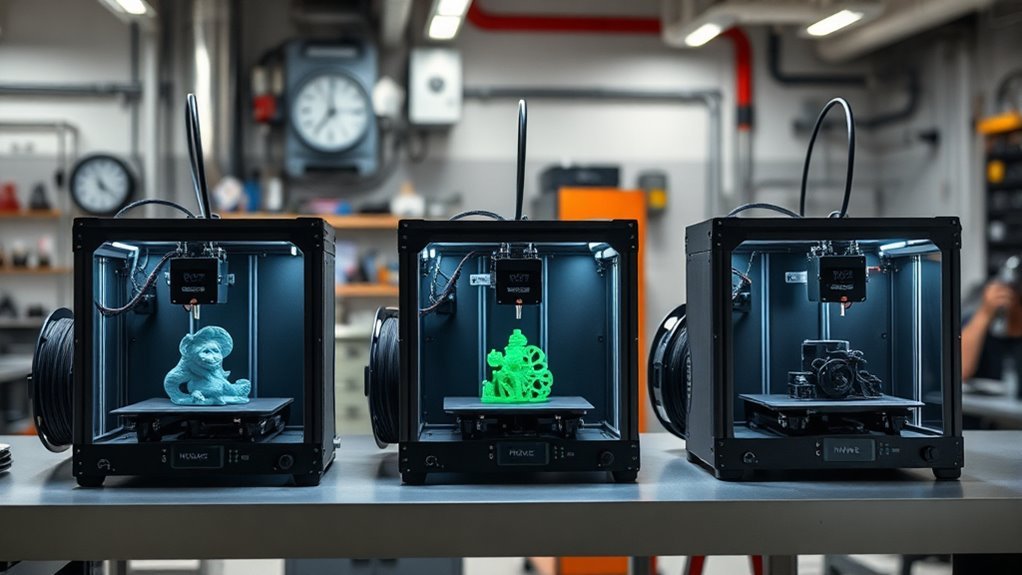
When choosing a 3D printer for nylon carbon fiber, you need to check if the nozzle material can handle abrasive filaments. Make certain the printer supports the high temperatures required and has proper filament drying options to prevent moisture issues.
Also, consider build plate adhesion and print speed to guarantee smooth, reliable prints. These factors play a big role in getting the best results without constant troubleshooting.
Nozzle Material Compatibility
Handling nylon carbon fiber filaments demands nozzles built to resist wear from abrasive chopped fibers. You should avoid soft brass nozzles, which erode quickly, and opt for hardened steel, stainless steel with high hardness, or plated/ruby nozzles. These materials withstand the abrasion and sustain high printing temperatures, usually between 250–300 °C, essential for nylon-carbon blends.
Choosing a nozzle diameter of 0.4 mm or larger helps reduce flow resistance and extends nozzle life without sacrificing print quality. Additionally, consider nozzles with inner coatings like nickel or titanium nitride for smoother filament flow and less adhesion.
Finally, make certain your nozzle is compatible with your printer’s extruder and hotend hardware since harder alloys may affect thermal conductivity and mechanical fit differently than standard nozzles. It’s something worth double-checking before you start printing.
Printing Temperature Range
Because carbon-fiber–filled nylons require high hotend temperatures between 250 and 300°C, you’ll need a 3D printer with an all-metal hotend that can maintain these levels consistently. PTFE-lined hotends can degrade quickly at these temperatures, so avoid them.
Alongside the hotend, the heated bed should reach between 40 and 120°C, depending on the nylon grade. This helps reduce warping and makes sure you get good first-layer adhesion.
You’ll also want to minimize cooling fans during printing since strong interlayer bonding relies on higher extruder temperatures and slower cooling.
Keep in mind that moisture in nylon can affect melting behavior. Sometimes this means you’ll need slightly higher temperatures to compensate for steam-related extrusion issues.
Choosing a printer with precise temperature control is key for reliable carbon fiber nylon prints. It really makes a difference in getting consistent results.
Filament Drying Requirements
Although nylon carbon fiber filaments offer excellent strength and durability, they’re highly hygroscopic and must be dried thoroughly before printing to avoid defects. You should dry filament at 70–110°C for 4–16 hours, depending on how long it’s been exposed to moisture.
Keep ambient and storage humidity below 20% RH by using sealed packaging with desiccants or a dry box. Even brief air exposure can rehydrate nylon, so for long prints, use a filament dryer or an enclosed, heated filament path to maintain dryness.
Wet filament often causes nozzle popping, rough surfaces, and weak layer adhesion, but these improve after proper drying. Also, avoid exceeding the filament’s max spool temperature (usually ≤110°C) during drying to prevent spool warping or polymer damage.
Build Plate Adhesion
Proper filament drying sets the stage for strong adhesion, but ensuring your nylon carbon fiber prints stick well to the build plate involves several other factors.
Use a heated bed set between 40–120°C depending on your nylon grade—commonly 40–70°C for PA6/PA612 and 100–120°C for PAHT/PA12. This helps reduce warping and boosts first-layer grip.
Apply adhesion aids like thin PEI sheets, garolite, nylon-specific adhesives (PVA-based glue sticks or sprays), or textured surfaces to prevent lifting. These little tricks can make a big difference.
Print the first layer slowly (10–30 mm/s) with slightly increased flow (0–10%) and lower the nozzle height by 0.1–0.2 mm for better mechanical contact. It’s all about getting that perfect first layer.
Keep the build plate clean and dry. Also, consider using brims, filleted bases, or sacrificial tabs to increase surface area and minimize corner warping during cooling. It really helps keep your print stuck where it should be.
Print Speed Capabilities
When printing nylon carbon fiber, you can often push speeds higher than with regular nylon, reaching up to around 300 mm/s for less detailed areas. However, high speeds raise the risk of under-extrusion and weak layer adhesion.
For small features, bridges, and outer perimeters, slow down to 30–100 mm/s to maintain surface quality and accuracy since carbon fiber adds brittleness. Make sure your hotend holds stable temperatures between 250–300 °C at these speeds to avoid cold ends.
Use a smooth, low-friction filament path and a powerful extruder—geared or direct drive—to prevent slipping or grinding. Balance speed with cooling and layer time because faster printing shortens layer-cure windows, potentially compromising interlayer bonding.
At the end of the day, prioritize adhesion and strength over raw speed for load-bearing nylon carbon fiber parts. It’s better to be a bit slower and stronger than fast and fragile.
Enclosed Chamber Necessity
Since nylon carbon fiber blends are sensitive to rapid cooling, using an enclosed chamber plays a crucial role in maintaining a stable ambient temperature. This stability helps reduce warping and layer delamination.
For PA6 and PA612 carbon-filled nylons, especially when printing large or thin parts, an enclosure prevents cracking and boosts interlayer strength. It does this by keeping the environment consistently warm, usually just tens of degrees above room temperature.
PA12-based carbon-fiber nylons absorb less moisture and warp less, so an enclosure isn’t always essential. However, it still improves dimensional stability on bigger prints.
If your printer lacks an enclosure, try slowing down the print speed and turning off fans. Also, use active bed heating and print smaller parts to minimize warpage and layer failures.
Choosing a printer with an enclosed chamber really simplifies achieving reliable, high-quality nylon carbon fiber prints. It just makes the whole process smoother and more consistent.
Moisture Sensitivity Handling
Although carbon-fiber-reinforced nylon offers excellent strength and stiffness, it demands careful moisture management to guarantee print quality. Since this material is hygroscopic, you must dry it before printing—typically at 80–110°C for 4 to 16 hours depending on the filament.
Keep storage and printing humidity below 20% by using sealed bags with desiccant or a dry box. Moisture uptake leads to steam bubbles, stringing, weak layer adhesion, surface roughness, and inconsistent extrusion.
For long prints, maintain dryness with an inline filament dryer or a heated enclosure around the spool. If you notice hissing, popping, or under-extrusion, re-dry the filament at the recommended temperature until these defects disappear.
Handling moisture correctly guarantees your prints retain their mechanical properties and smooth finish every time. It’s worth the effort to keep your filament dry!
Wear-Resistant Components
Keeping your nylon carbon fiber filament dry is just one part of ensuring top-quality prints. You also need wear-resistant components to handle its abrasive nature. Avoid standard brass nozzles; instead, opt for hardened steel or stainless steel nozzles with wear treatment.
Your filament path should include hardened Bondtech gears, PTFE liners, and durable bearings to prevent accelerated wear. Choose an all-metal hotend with an abrasion-resistant throat and nozzle that can withstand high temperatures (250–300°C) without PTFE degradation.
Don’t forget a spool holder and filament guide with low-friction surfaces and smooth rotation to avoid filament grinding. For long-term reliability, use corrosion- and wear-resistant springs, screws, and bushings on your bed and extruder mounts. These will handle the mechanical stress from high temperatures and abrasive filaments.
Frequently Asked Questions
How Do I Maintain My 3D Printer When Using Carbon Fiber Nylon?
You should regularly clean your nozzle and use a hardened steel or ruby nozzle to avoid wear. These nozzles handle the abrasive nature of carbon fiber nylon much better than standard ones.
Keep your printer’s bed clean and calibrated. This helps ensure your prints stick well and come out just right.
Also, don’t forget to lubricate moving parts regularly. It keeps everything running smoothly and prevents unnecessary wear.
Finally, monitor your filament storage to prevent moisture absorption. Keeping your filament dry is key to getting the best print quality every time.
Can Carbon Fiber Nylon Filaments Be Recycled After Printing?
Think of carbon fiber nylon prints as a puzzle with tricky pieces—you can’t easily recycle them like regular plastics.
You’ll find recycling options limited, so it’s best to reuse scraps or explore specialized recycling programs instead.
What Safety Precautions Are Needed When Printing With Carbon Fiber Nylon?
You should always use proper ventilation, wear a respirator mask, and gloves to avoid inhaling fibers or fumes. Keep your printer’s enclosure closed, and clean surfaces regularly to prevent airborne carbon fiber dust exposure.
It might sound like a lot, but these steps really help keep you safe. Plus, they make your workspace a lot cleaner and healthier in the long run.
How Do Humidity Levels Affect Carbon Fiber Nylon Filament Storage?
Humidity levels act like a sponge, soaking into your carbon fiber nylon filament and causing it to swell or become brittle.
You’ll want to store it in airtight containers with desiccants to keep prints strong and consistent.
Trust me, keeping moisture out is key to getting the best results from your prints.
Are There Specific Bed Adhesives Recommended for Carbon Fiber Nylon Prints?
You’ll want to use adhesives like PVA glue stick, Magigoo, or ABS slurry for carbon fiber nylon prints. These improve bed adhesion and reduce warping, helping your prints stick firmly during the entire printing process.
Using these adhesives can make a big difference, especially since carbon fiber nylon tends to warp more than regular filaments. So, giving your print bed a good prep with one of these options really pays off!
Conclusion
Choosing the right 3D printer for nylon carbon fiber doesn’t have to be overwhelming. With options like Polymaker, SUNLU, and ELEGOO, you’re set for strong, durable prints.
Each filament offers unique qualities, so why settle for less when you can get the best? Consider your project needs and printer compatibility carefully.
Ready to bring your ideas to life with precision and strength? The perfect carbon fiber nylon filament is just a print away! Whether you’re aiming for high strength, lightweight parts, or superior durability, selecting the best 3D printer for nylon carbon fiber is key. With the right setup, your prints will not only look great but also stand up to real-world use. So dive in, explore your options, and make your next project truly exceptional with the best nylon carbon fiber 3D printer available.