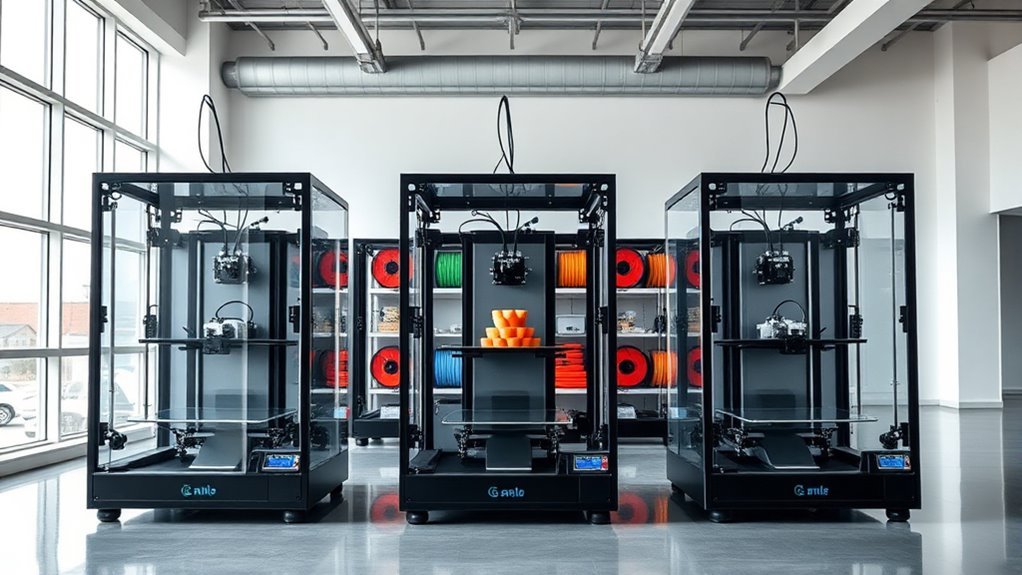
6 Best Big Volume 3D Printers for 2027
You’ll want a big volume 3D printer like the Sovol SV08 MAX, which boasts a massive 500×500×500 mm build area and a speedy CoreXY system. This makes it perfect for tackling large projects without sacrificing speed or precision.
Another great option is the QIDI Max4 Combo, offering precise printing with a 65°C heated chamber that can handle tough materials with ease. For those detailed, multi-color projects, the QIDI Plus5 Combo is definitely worth checking out.
If you’re looking for a balance between size and speed, the Creality Ender 3 V3 Mega and Ender 5 Max are solid choices. They deliver reliable performance for a variety of uses.
Lastly, the versatile Original Prusa XL rounds out your top picks, offering features that suit many ambitious projects.
Each of these big volume 3D printers brings unique strengths, so you can find the perfect fit for your creative needs.
| Image | Name | Editor's Rating | Price |
|---|---|---|---|
|
|
||
|
|
||

|
|
||

|
|
||

|
|
QIDI Max4 Combo 3D Printer, 390×390×340mm Build Volume, 65℃ Heated Chamber
- Ultra-Large Build Volume: QIDI Max4 Combo has a 390×390×340mm printing area, 55% larger than its predecessor MAX3, enables you to print large industrial parts, complex...
- High Precision & Stability: QIDI Max4 Combo 3D Printer equipped with closed-loop motors on X/Y axes, Achieve a maximum printing speed of 800mm/s and an acceleration of...
- Wide Material Compatibility: 40mm³/s high-flow hotend with hardened steel nozzle supports standard materials (PLA/ABS) and industrial-grade abrasive materials (carbon...
- Smart Monitoring & User-Friendly Design: Built-in AI camera automatically detects printing abnormalities (e.g., spaghetti-like failures) and pauses printing instantly to...
- Expandable Multi-Color Printing: Seamlessly connect with QIDI BOX to achieve 16-color and multi-material printing and enjoy intelligent filament management (e.g...
The QIDI Max4 Combo transforms large-scale 3D printing by addressing common issues like warping and material compatibility. Its spacious 390 × 390 × 340 mm build volume lets you create bigger projects without breaking them into parts. The 65℃ heated chamber ensures consistent temperature, reducing print failures and improving material stability.
Designed for both experts and dedicated hobbyists, this printer features a full-surface silicone heated bed that guarantees even heating and strong first-layer adhesion. The hardened steel nozzle and high-flow hotend easily handle a wide variety of materials, from standard filaments to tougher industrial-grade ones.
Maintenance is straightforward thanks to its robust construction and smart features such as dual Z lead screws and auto-leveling. An AI camera monitors prints in real-time, detecting failures early to save time and materials. While the printer is quite heavy and requires ample space, its design prioritizes precision and reliability.
Best for: professionals and advanced users who need to produce large, high-quality prints with diverse materials and benefit from advanced failure detection.
What We Like:
- Large build volume supports bigger and more complex projects
- Heated chamber and silicone bed reduce warping and improve print stability
- Durable nozzle and hotend accommodate various filament types
- Dual Z lead screws and auto-leveling enhance print precision
- AI camera provides smart failure detection for efficient printing
Specification:
| Feature | Details |
|---|---|
| Manufacturer | QIDI |
| Build Volume | 390 × 390 × 340 mm |
| Heated Chamber Temp | 65℃ |
| Heated Bed | Full-surface silicone |
| Nozzle Type | Hardened steel |
| Weight | 120 lb (approx. 54.4 kg) |
| Dimensions | Large, requires space |
Sovol SV08 MAX CoreXY 3D Printer, Voron 2.4 700mm/s High Speed 3D Printers
- Go Big Without Slowing Down: Sovol SV08 Max redefines true large-format printing, slashing print times by up to 50%. With up to 500×500×500mm³ of print space, SV08 Max...
- CoreXY Kinematics: With compact design, minimal moving mass, and optimized motion path, the CoreXY system enables Sovol SV08Max faster acceleration, reduced vibration...
- Eddy Current Sensor: Advanced Eddy Current Scanning system that delivers high-speed, contactless bed leveling with exceptional accuracy. It detects even the smallest...
- Camera & Remote Monitoring: Sovol SV08 Max comes equipped with a built-in 1280×720 HD camera, enabling seamless remote monitoring, time-lapse recording, and integration...
- High-Temp Nozzle: The hotend of SV08 Max supports a maximum temperature of 300°C. Perfectly handling a wider range of advanced and challenging filaments, such as...

The Sovol SV08 MAX CoreXY 3D Printer delivers powerful performance for fast, large-format industrial printing. Its generous 500 × 500 × 500 mm build volume lets you create oversized prototypes and parts with ease. The high-speed CoreXY motion system reaches up to 700 mm/s, reducing print times while maintaining accuracy.
Designed with full linear rails, this printer ensures smooth, precise movements and lowers mechanical wear. Maintenance is straightforward thanks to its open-source design, allowing upgrades like a heated chamber to expand material compatibility. The 300°C hotend handles a wide range of filaments, including carbon fiber blends, making it versatile for various applications.
Bed leveling is simplified with a contactless system, ensuring consistent first layers without manual adjustments. You can remotely monitor prints through the built-in HD camera and cloud integration, adding convenience for busy workflows.
The printer’s weight and footprint may limit portability, and the heated chamber is an optional add-on, which could increase costs. Some accessories and nozzle sizes are sold separately, requiring additional setup consideration.
Best for: professionals and enthusiasts needing high-speed, large-format 3D printing for industrial parts, oversized prototypes, and detailed custom projects.
What We Like:
- Large build volume for big and complex prints
- Fast CoreXY motion with precise linear rails
- Contactless bed leveling for reliable first layers
- Remote print monitoring via HD camera and cloud
- Open-source design supports future upgrades
Specification:
| Feature | Details |
|---|---|
| Manufacturer | Sovol |
| Build Volume | 500 × 500 × 500 mm |
| Max Print Speed | 700 mm/s |
| Hotend Temp | Up to 300°C |
| Weight | 86.8 lb (39.4 kg) |
| Motion System | CoreXY with linear rails |
Creality Ender 3 V3 Mega Large-Format 3D Printer, 420mm Build Volume
- 420mm³ LARGE BUILD VOLUME FOR BIGGER PRINTS: Print large models, prototypes, cosplay props, and functional parts with a 420 × 420 × 420mm build volume. Create more...
- 85A–95A TPU FLEXIBLE FILAMENT PRINTING: Go beyond standard rigid materials with support for 85A, 90A, and 95A TPU. The optimized extrusion system helps deliver more...
- KEEP LONG PRINTS RUNNING WITH SMART FILAMENT MANAGEMENT: Automatic filament relay helps switch to another loaded spool when filament runs out, while filament runout and...
- 500mm/s HIGH-SPEED PRINTING WITH VIBRATION COMPENSATION: Print at speeds up to 500mm/s with acceleration up to 8,000mm/s². Smart extrusion and vibration compensation...
- EASIER SETUP AND MAINTENANCE FOR DAILY PRINTING: 81-point auto leveling helps achieve a consistent first layer across the large build platform, while the quick-swap...
The Creality Ender 3 V3 Mega is designed to tackle large-scale projects with ease. Its 420mm build volume allows you to produce bigger, detailed models without worrying about seams or assembly challenges. This makes it ideal for creators who need reliable and consistent results on large prints.
Maintenance is simplified with features like 81-point auto leveling and filament runout detection, ensuring smooth operation with minimal interruptions. The printer’s optimized dual gear extruder supports materials such as PLA, PETG, and flexible TPU, providing versatility for various project needs.
Its design includes smart vibration compensation and speeds up to 500 mm/s, which help maintain print quality even during fast production. Although it has a significant physical footprint and weighs 46.6 pounds, the printer’s WLAN control enables easy management of multiple devices, streamlining workflow in busy workshops.
This large-format 3D printer suits users who require speed, precision, and reliability for functional prototypes, cosplay props, and other detailed creations.
Best for: Makers, workshops, and small-batch producers needing large-format, high-speed 3D printing for detailed and functional projects.
What We Like:
- Large 420 × 420 × 420 mm build volume for bigger models with fewer seams
- Advanced 81-point auto leveling and filament runout detection for consistent prints
- Optimized dual gear extruder supports flexible TPU and other common filaments
- Smart vibration compensation ensures smooth, high-quality results
- WLAN control simplifies managing multiple printers
Specification:
| Feature | Details |
|---|---|
| Manufacturer | Creality |
| Build Volume | 420 × 420 × 420 mm |
| Weight | 46.6 lb (21.1 kg) |
| Supported Materials | PLA, PETG, TPU |
| Max Print Speed | 500 mm/s |
| Auto Leveling Points | 81 |
| Connectivity | WLAN |
QIDI Plus5 Combo Multi-Color 3D Printer, 320×320×300mm Large Build Volume
- 【Massive Build Volume for Large-Scale 3D Printing】: QIDI Plus5 3d Printer provide a 320×320×300mm build volume — 18% larger than Plus4 — this large 3D printer...
- 【Effortless for Engineering-Grade Filaments】: The QIDI Plus5 3D printers ware designed for high-performance materials including PPS-CF, PPA-CF, PC, and nylon etc...
- 【CoreXY+ Precision Motion System with Active Toolhead Cooling】: The QIDI Plus 5 3D printer is rigid CoreXY structure paired with X-axis linear guide rails and 9mm...
- 【Smart Print Management & Stable Overday 3D Printing】: Equipped with automatic bed leveling, AI-powered camera monitoring, and remote control via mobile APP; during...
- 【Multi-Material & Multi-Color 3D Printing with Active Drying】: Supports QIDI BOX (optional) for up to 16-color multi-material printing, featuring built-in active...
Experience seamless large-scale 3D printing with the QIDI Plus5 Combo, designed to tackle complex multi-color projects with ease. Its generous 320×320×300mm build volume lets you produce full-scale prototypes, batches, or oversized models in fewer print cycles, saving time and improving productivity.
The printer’s CoreXY+ motion system delivers fast, stable printing at speeds up to 600 mm/s, ensuring precision without sacrificing speed. An active heated chamber reduces warping, so you can confidently print challenging materials like carbon-fiber composites and nylon with consistent results.
Maintenance is straightforward, and the optional QIDI BOX supports multi-color printing by actively drying filaments to avoid defects. Smart features such as AI monitoring, cloud slicing, and batch printing streamline workflow and minimize downtime.
Encased in a reliable, flame-retardant enclosure, this printer balances safety and advanced functionality. Its robust design is ideal for professionals focused on prototyping, batch production, or industrial-grade applications requiring multi-material versatility.
Best for: professionals and businesses needing large-volume, multi-material 3D printing with advanced features for efficient prototyping and production.
What We Like:
- Large build volume supports oversized and batch models
- High-speed, stable printing with CoreXY+ system
- Multi-color capability with filament drying in QIDI BOX
- Smart AI monitoring and cloud slicing enhance workflow
Specification:
| Feature | Specification |
|---|---|
| Manufacturer | QIDI |
| Build Volume | 320×320×300 mm |
| Printing Speed | Up to 600 mm/s |
| Weight | 96.8 lb (43.9 kg) |
| Dimensions | 22×22×24 in (55.9×55.9×61 cm) |
| Enclosure | Flame-retardant |
Creality Ender 5 Max 3D Printer Large Volume
- 【Extra-Large 400×400×400 mm Build Volume】 Create significantly bigger models or batch-produce multiple parts at once with the expansive large build volume of...
- 【Ultra-Efficient CoreXY System Up to 700 mm/s】 Print more in less time with the ultra-fast Ender 5 Max 3D printer. The CoreXY structure and high-torque motors deliver...
- 【Built for Print Farms & Scaled Production】 Boost throughput on your Creality Ender 5 Max with WLAN multi-printer control, grouped management, and a tri-color status...
- 【Rigid All-Metal Frame & Precision Linear Rail】 The reinforced die-cast aluminum frame minimizes vibration on the Ender 5 Max 3D printer, ensuring stability for tall...
- 【 Fully Automatic 64-Point Leveling + Auto Z-Offset】 Start each project with perfect calibration on your Creality Ender 5 Max. The 64-point auto leveling system and...
The Creality Ender 5 Max is designed for those who need to build large, detailed prototypes or run continuous batch prints without interruptions. Its extra-large 400 × 400 × 400 mm build volume allows you to print oversized models or multiple parts at once, saving time and effort.
With a CoreXY motion system and high-torque motors, this printer achieves speeds up to 700 mm/s while keeping prints precise. The sturdy, reinforced all-metal frame minimizes vibrations, ensuring stable and accurate results even on tall objects.
Maintenance is straightforward thanks to the automatic 64-point leveling system, which simplifies calibration. The rapid-heating 1000 W bed and direct-drive dual-gear extruder handle a wide range of materials smoothly, reducing print failures and downtime.
Network control through WLAN lets you manage multiple printers easily, making the Ender 5 Max well-suited for demanding production workflows. Its robust design and advanced features provide a balance between speed, quality, and ease of use.
Best for: Professionals and advanced hobbyists needing reliable, large-scale 3D printing with minimal interruptions.
What We Like:
- Large, uninterrupted build volume for oversized prints
- Fast, precise CoreXY motion system
- Automatic 64-point bed leveling for easy setup
- Rapid-heating bed and versatile extruder for smooth material handling
- WLAN control simplifies multi-printer management
Specification:
| Feature | Details |
|---|---|
| Manufacturer | Creality |
| Build Volume | 400 × 400 × 400 mm |
| Motion System | CoreXY |
| Max Print Speed | Up to 700 mm/s |
| Bed Power | 1000 W rapid-heating |
| Frame Material | Reinforced all-metal |
| Leveling | Automatic 64-point |
| Connectivity | WLAN multi-printer control |
Original Prusa XL Semi-Assembled 1-Toolhead Large-Format 3D Printer

- The Original Prusa XL is the most innovative 3D printer on the market, offering possibilities that no single-nozzle multi-material printer can replicate. With a...
- This listing is a DIY KIT for self-assembly; We also offer a fully built and tested 3D printer
- Featuring lighting-fast toolhead swapping, unique segmented heatbed, perfect edge-to-edge print precision, a full set of network features, support for an optional...
- With up to five toolheads, the XL offers unmatched multi-material performance and speed with extremely fast tool changing and advanced technologies to deliver...
- The printer includes one Satin print sheet and a 1kg spool of Prusament PLA, Prusa Research offers lifetime technical assistance and 24 hours professional customer...
Experience the power of large-format 3D printing with the Original Prusa XL Semi-Assembled 1-Toolhead printer. Designed to tackle complex, multi-material projects, it offers precision and flexibility that elevate your creative process. The semi-assembled kit provides a solid foundation while allowing users to customize and upgrade as needed.
This printer’s Nextruder with Loadcell sensor ensures flawless first layers across its expansive 14.17-inch cubic build volume. Its embedded 32-bit platform enhances speed and accuracy, while features like Input Shaper and Pressure Advance maintain consistent print quality from edge to edge. These smart technologies reduce errors and improve reliability.
Maintenance is straightforward, thanks to the segmented heatbed that ensures even heating and easy troubleshooting. Prusa Connect support simplifies remote operation, keeping your projects on track with minimal hands-on time. The modular design allows toolhead upgrades from one to five, expanding your multi-material capabilities over time.
While the printer’s larger footprint requires sufficient workspace and some technical skill for setup, it delivers unmatched versatility for serious makers. Its advanced features and build volume make it ideal for professionals and enthusiasts working on large, intricate prints.
Best for: Large-format 3D printing enthusiasts and professionals needing precise multi-material printing with upgradeable toolheads.
What We Like:
- Fast toolhead swapping for efficient multi-material printing
- Loadcell sensor ensures perfect first layers every time
- Segmented heatbed simplifies maintenance and improves reliability
- Embedded 32-bit platform boosts printing speed and accuracy
- Prusa Connect enables seamless remote operation
Specification:
| Feature | Details |
|---|---|
| Manufacturer | Original Prusa |
| Build Volume | 14.17 in³ (cubic) |
| Toolhead | Semi-assembled, 1-toolhead, upgradeable to 5 |
| Sensor | Loadcell sensor |
| Platform | Embedded 32-bit |
| Heatbed | Segmented heatbed |
| Connectivity | Prusa Connect support |
| Dimensions | Larger footprint (exact size not specified) |
Factors to Consider When Choosing a Big Volume 3D Printer
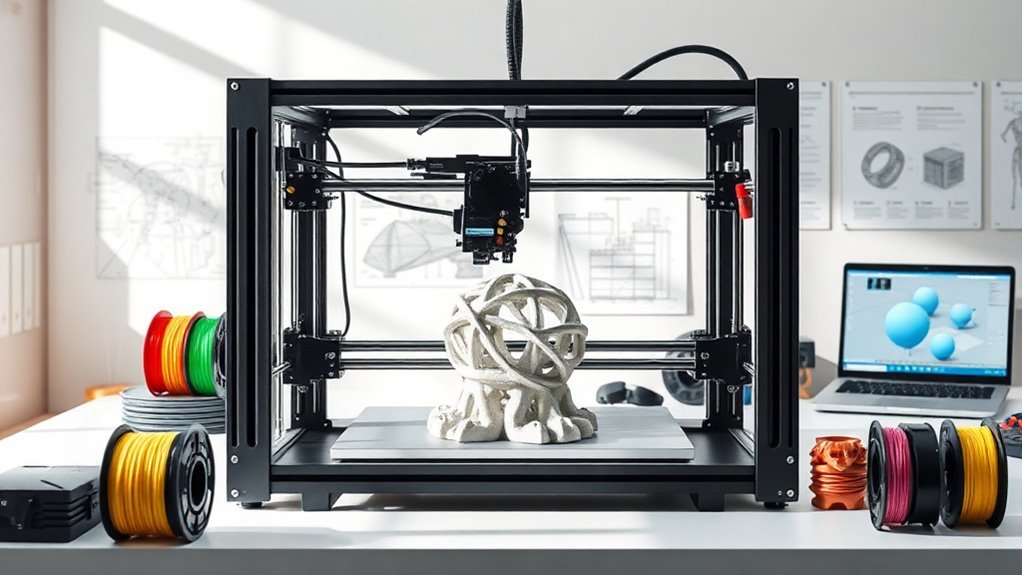
When choosing a big volume 3D printer, you’ll want to focus on build volume and printing speed to match your project needs. It’s important to pick one that can handle the size of what you want to create.
Consider the range of materials it supports and whether a heated chamber is included for better print quality. These features can make a big difference, especially with more complex prints.
Don’t forget to check the motion system type, as it affects accuracy and reliability. A good motion system helps ensure your prints come out looking great every time.
Build Volume Importance
Choosing a big volume 3D printer means you’ll benefit from printing large, single-piece prototypes or functional parts without splitting and assembling them later. Larger build volumes, like 400–500 mm on a side, save you time and preserve part strength.
However, bigger sizes require more attention to enclosure design to control ambient temperature. This is essential for printing heat-sensitive materials without warping. You’ll also need a robust motion system and precise bed leveling to guarantee first-layer consistency across the entire build plate.
Strong frame rigidity and durable Z-axis components help prevent layer shifting on tall prints. Keep in mind the trade-offs: larger printers demand more space, higher power for heated beds or chambers, and effective thermal management to maintain consistent print quality on big parts.
Printing Speed Impact
Large build volumes let you create impressive parts, but printing them quickly takes more than just raw speed. Higher top speeds—like 500 to 800 mm/s—can slash print times, but you need finely tuned acceleration and jerk settings to avoid ringing and accuracy loss.
Peak accelerations shorten travel across big plates but demand stronger frames, rails, and motors to handle the mechanical stress without sacrificing repeatability. You’ll also need high-flow hotends and the right nozzle sizes to guarantee proper layer adhesion and part strength at speed.
Thermal management becomes critical, too—heated beds, chamber control, and active cooling must balance heat to prevent warping and layer issues. Finally, firmware features like input shaping and closed-loop motor systems help maintain surface quality and dimensional accuracy when pushing velocity limits.
Material Compatibility Range
Since material needs vary widely across projects, you’ll want a big volume 3D printer that supports a broad range of filaments. Check if it can reach nozzle temperatures of 300–370°C and chamber temps of at least 60–65°C to handle high-temp polymers like PA, PC, PPS, and carbon-fiber nylons.
Also, confirm the hotend uses hardened steel or abrasion-resistant alloys for printing abrasive composites reliably. If you use flexible filaments like TPU (85A–95A), look for dual-gear or direct-drive extruders with fine-tuned retraction to avoid jams.
Sealed heated chambers and filament-drying features really help reduce warping and moisture issues, especially with nylon. Finally, make sure the electronics and firmware support specialty filaments, offering controlled cooling, filament runout detection, and multi-material toolpaths to prevent print failures with engineering plastics.
Heated Chamber Benefits
When you print big parts with materials like ABS, PC, or nylons, an active heated chamber set between 50 and 65°C can make a huge difference. It reduces thermal gradients during cooling, cutting down warping and delamination in high-CTE materials.
By keeping extruded layers above their glass relaxation temperature longer, you get stronger interlayer bonding and more durable parts. A heated chamber also expands your material options, enabling reliable printing of engineering and carbon-fiber–reinforced filaments that otherwise risk heat creep or stress.
For large-format prints, it guarantees even cooling, improving dimensional accuracy and cutting internal stresses that lead to cracking. Plus, you’ll likely need fewer extreme adhesion tricks, reducing print failures.
Just remember to manage part cooling carefully and follow safety protocols for high-temperature operation. It’s a bit of extra work, but totally worth it for better prints!
Motion System Types
A heated chamber helps maintain part quality by controlling temperature, but your printer’s motion system also plays a key role in handling big volumes smoothly.
CoreXY kinematics use stationary motors and lightweight belts, reducing moving mass for faster speeds and accelerations above 20,000 mm/s². That means your printer can move quicker and more efficiently.
Cartesian gantry systems, while simpler and robust, have heavier moving parts that limit speed. Still, they’re reliable and easy to maintain.
Opt for linear rails or full linear guides on all axes to boost rigidity and reduce play. This helps improve surface finish by keeping movements precise.
Closed-loop motors with position feedback keep prints reliable by preventing skipped steps during fast moves. So, you get consistent results even at high speeds.
For tall prints, dual-Z or synchronized dual-leadscrew setups minimize wobble and layer shifts by sharing the load evenly. This ensures your large projects stay precise and stable throughout long print times.
Precision and Accuracy
Although big volume 3D printers offer impressive build sizes, they also magnify even the smallest positional errors, so you need to carefully evaluate the motion system’s precision. Check X/Y motion kinematics—CoreXY designs with linear rails or full linear guideways reduce slop and maintain accuracy across the entire workspace.
For Z-axis consistency, look for fine-pitch lead screws with anti-backlash mechanisms like dual screws or nuts to minimize layer stair-stepping and wobble. High speeds can cause ringing and deviation, so make sure the printer supports input shaping, tuned acceleration, or closed-loop feedback.
Also, verify build-plate flatness and effective multi-point auto-leveling for uniform first layers. Finally, extrusion stability matters—opt for dual-gear drives, hardened feed parts, and high-flow hotends to keep filament flow consistent over long prints.
Monitoring and Connectivity
Since big volume 3D prints can take hours or even days, you’ll want to monitor your printer remotely to catch issues before they ruin a project. Look for a built-in camera with at least 720p resolution or a reliable external camera interface to visually track prints.
Make sure the printer supports cloud or network connectivity—Ethernet or Wi-Fi—with secure protocols and remote control. That way, you can manage jobs and check status from anywhere.
Real-time telemetry on temperature, layer progress, and filament usage is essential, along with notifications for pauses or filament runout. Integrated time-lapse and event logging also help with troubleshooting and refining prints.
Finally, prefer systems offering APIs or standard protocols like OctoPrint. This enables third-party monitoring tools for automated alerts and efficient fleet management.
Multi-Material Printing
Keeping an eye on your print remotely is just one part of managing complex projects—handling multiple materials effectively is another challenge you’ll face with big volume 3D printing. You need a printer supporting reliable tool changes or multi-extruder setups with repeatable nozzle-to-bed offsets (≤0.1 mm) to avoid misalignment and seams.
Make sure to check filament management features like independent drives, active drying, and runout detection. These help prevent contamination and failed prints, which can be a real headache.
Also, verify hotend specs—max temperature, hardened nozzle compatibility, and flow rate. This ensures you can handle abrasives and diverse materials without wear or inconsistency.
Don’t forget to confirm firmware and slicer support for multi-material strategies like purge towers and pressure advance. These features reduce stringing and color bleeding, making your prints look much cleaner.
Finally, evaluate chamber and cooling controls to improve adhesion and minimize warping, especially when working with high-temp engineering plastics. It all adds up to better print quality and reliability.
Frequently Asked Questions
What Materials Are Compatible With Big Volume 3D Printers?
You can print with PLA, ABS, PETG, TPU, and even nylon on big volume 3D printers. Some also handle composites like carbon fiber or metal-filled filaments, giving you plenty of material options for large projects.
It’s pretty cool because having these options means you’re not stuck with just one type of filament. Whether you want flexibility, strength, or a unique finish, there’s something that fits the bill for your big prints.
How Much Maintenance Do Large 3D Printers Require?
You’ll spend a few hours weekly maintaining large 3D printers, coincidentally while your prints cool down. Cleaning nozzles, lubricating rails, and checking calibrations keep your machine running smoothly and your prints flawless.
It’s not too bad once you get into a routine. Plus, it gives you a little break to step away from the screen and stretch. Keeping up with maintenance really pays off in the long run!
Are There Safety Concerns With Large Enclosed 3D Printers?
Yes, you should watch for heat buildup, fumes, and electrical risks with large enclosed 3D printers. Always use proper ventilation and follow safety guidelines.
Also, avoid touching hot surfaces to keep yourself safe during printing. It’s better to be cautious and stay protected while your printer is running.
Can Big Volume 3D Printers Be Used Commercially?
Yes, you can use big volume 3D printers commercially. You can produce large prototypes, manufacture custom parts, and accelerate product development.
They offer scalability, efficiency, and versatility. This lets you expand your business and innovate faster than ever before.
What Software Works Best With These Large 3D Printers?
You’ll find software like Ultimaker Cura, PrusaSlicer, and Simplify3D works best with large 3D printers. They handle big files efficiently and offer advanced settings.
Plus, they optimize prints for massive build volumes without slowing you down. It’s all about making the process smooth and manageable.
Conclusion
When choosing a big volume 3D printer, you might think bigger always means better. But the truth is, it’s about balance—build size, speed, and reliability all matter.
You want a printer that fits your projects without compromising quality or ease of use. So, don’t just chase the largest build volume; consider how each printer’s features align with your needs.
That way, you’re not just printing big—you’re printing smart. Finding the best big volume 3D printer means looking beyond size to factors like consistent performance and user-friendly design. After all, the right 3D printer will help you achieve high-quality prints efficiently, making your large-scale projects a success. Remember, when shopping for a big volume 3D printer, prioritize the balance between build size, speed, and reliability to get the most out of your investment.