3 Best 3D Printer Frames for 2027 That Boost Your Builds
For 2027, choosing the best 3D printer frames is all about finding the right balance between lightweight design and sturdy construction. Look for frames made from aluminum profiles paired with robust T-slot extrusions. For example, Kit D’s 235 mm reinforced frame or options featuring 300 mm and 400 mm 2020 aluminum rails are excellent choices.
These frames provide excellent stability and help reduce wobble during printing, which is crucial for high-quality results. Plus, they make it easy to mount sensors and add upgrades.
When picking a frame, focus on features like precise alignment, corrosion resistance, and modularity. These factors ensure smooth, reliable builds and help future-proof your machine. Keeping these in mind will definitely boost your print quality and overall 3D printing experience.
| Image | Name | Editor's Rating | Price |
|---|---|---|---|

|
|
||

|
|
||

|
|
3D Printer Aluminum Profile Frame Kit (Kit D)
- 3D Printer Replacement Components, Update Kits, Maintenance Accessories, High Temperature Wear Resistance, Auto Leveling Sensors
- Name: 3D Printer Frame
- Model: Z-axis Motor Mounting Bracket
- Color: Black
- This 3D printer frame adopts the structure, which is strong and durable,
Upgrade your 3D printer’s stability and durability with the 3D Printer Aluminum Profile Frame Kit (Kit D). This kit is designed to reinforce your printer’s structure using a sturdy 235mm aluminum profile. It addresses common issues like frame wobble, ensuring smoother prints and longer machine life.
The kit supports compatibility with auto-leveling sensors, simplifying assembly and ongoing maintenance. Its high-temperature wear-resistant design means it withstands operational heat without degrading. Despite its robust build, the kit remains lightweight, avoiding unnecessary bulk in your workspace.
Maintenance becomes easier thanks to the durable materials and straightforward design. Whether replacing worn components or upgrading your setup, this kit fits seamlessly into your existing 235mm profile printer frame. Its compact black Z-axis motor mounting bracket offers a neat, professional look.
While the kit is limited to a specific profile size and comes from a generic brand, it delivers reliable performance for those focused on functionality and durability. Responsive seller support is available to help resolve any concerns.
Best for: 3D printer enthusiasts and hobbyists needing a durable, high-quality aluminum profile upgrade or replacement for 235mm frame setups.
What We Like:
- Reinforces printer frame for improved stability
- Compatible with auto-leveling sensors for easy setup
- High-temperature resistant for longevity
- Lightweight design reduces workspace clutter
- Compact black Z-axis motor mounting bracket
Specification:
| Feature | Details |
|---|---|
| Manufacturer | Generic |
| Dimensions | Supports 235mm profile |
| Weight | 1.76 oz (50 g) |
| Material | Aluminum |
| Color Options | Black |
4pcs 300mm T Slot 2020 Aluminum Extrusion Rails
- ✦High-strength European standard aluminum profile, the surface is anodized, making the surface smoother and cleaner.
- ✦Applications: automation equipment, professional 3D printers, workbenches, lasers, stands, furniture, etc. machinery, fitness equipment, precision printers, automatic...
- ✦2020 Aluminum extruded profile are a good linear motion material with high strength and adjustable. It can be fixed on the side of 4 grooves such as M3, M4, M5 T-slot...
- ✦Made of 6063-T5 material, the T-slot has smooth edges.
- ✦4PCS per package, 20 * 20 * 300mm.
For those building or upgrading 3D printer frames, these 4pcs 300mm T Slot 2020 Aluminum Extrusion Rails provide a reliable and adaptable solution. Their precision design ensures stable support, helping to maintain smooth and accurate linear motion in your projects.
Crafted from high-strength 6063-T5 European standard aluminum alloy, these rails resist corrosion and wear. The anodized black finish adds durability, though surface scratches may appear with heavy use. Easy maintenance keeps your setup running smoothly over time.
The rails feature standard T slots compatible with M3, M4, and M5 nuts and pulleys. This versatility allows for precise adjustments and secure mounting of components, making them ideal for 3D printers, CNC machines, and automation systems.
Measuring 20×20×300 mm each, they fit compact builds but may require additional pieces for larger frames. With their sturdy construction and flexible mounting options, these extrusion rails enhance the performance and reliability of your mechanical assemblies.
Best for: Makers and professionals upgrading or building 3D printers, CNC machines, or automation equipment needing strong and adjustable aluminum extrusion rails.
What We Like:
- Durable 6063-T5 aluminum alloy with corrosion-resistant anodized finish
- Compatible with multiple T-slot nut sizes for flexible component mounting
- Ideal for precise linear motion in compact frame builds
- Smooth edges reduce wear on mounted parts and improve safety
Specification:
| Feature | Details |
|---|---|
| Manufacturer | Not specified |
| Dimensions | 20×20×300 mm (0.79×0.79×11.81 in) |
| Material | 6063-T5 European aluminum alloy |
| Color | Anodized black |
| Quantity | 4 pieces |
10 Pcs 2020 T Slot Aluminum Extrusion Profiles
- 【Durable 10 Piece Rail Set】 This set includes 10 black 2020 T slot aluminum extrusion rails for building or repairing compact frames, 3D printer structures, CNC...
- 【Reliable 20 x 20 mm Profile】 Each 2020 aluminum extrusion profile measures about 400 x 20 x 20 mm, giving you a standard square profile for light structural...
- 【Black Anodized Surface】 The surface of these T-slot aluminum profiles has been treated with anodizing technology, resulting in a smooth, clean surface with excellent...
- 【Versatile DIY Applications】Use these T slot 2020 aluminum extrusion rails for 3D printer upgrades, small CNC enclosures, laser engraver frames, robotics bases...
- 【Easy Planning Reminder】The package contains aluminum rails only, with each bar individually packed for cleaner handling. Before assembly, lay out the full frame...
Discover the LOYORTY 10 Pcs 2020 T Slot Aluminum Extrusion Profiles, designed to bring precision and stability to your compact 3D printer frames and small CNC fixtures. These rails help you create consistent, sturdy structures that improve the accuracy of your projects. Their uniform length and smooth finish reduce assembly complications and ensure a flawless fit every time.
Crafted from high-strength 6063 aluminum, each 400 mm rail features a black anodized, burr-free surface that resists wear and maintains a clean look. The standard 20 x 20 mm profile supports a wide range of M3, M4, and M5 T-nuts and accessories, making it easy to customize your setup without hassles.
Maintenance is simple due to the corrosion-resistant anodized coating. However, keep in mind that these rails do not include connectors or fasteners, so you’ll need to plan and source compatible hardware for assembly. Their light-duty design suits precise, small-scale builds but isn’t intended for heavy structural loads.
Using these extrusion profiles streamlines your build process, providing a reliable framework for laser engravers, robotics, and hobby projects. By ensuring matched rail dimensions, you reduce alignment errors and improve overall project stability.
Best for: DIY enthusiasts and professionals building compact, precision 3D printer frames, small CNC fixtures, or robotics bases requiring durable aluminum extrusion rails.
What We Like:
- Durable 6063 aluminum with smooth black anodized finish for long-lasting use
- Standard 20 x 20 mm T-slot profile compatible with common T-nuts and accessories
- Consistent 400 mm length for repeatable, precise assembly
- Burr-free edges simplify handling and reduce risk of damage
- Lightweight design ideal for small to medium-scale projects
Specification:
| Attribute | Details |
|---|---|
| Manufacturer | LOYORTY |
| Dimensions | 20 x 20 x 400 mm |
| Material | Aluminum 6063 |
| Color | Black (anodized finish) |
| Quantity | 10 pieces |
Factors to Consider When Choosing a 3d Printer Frame
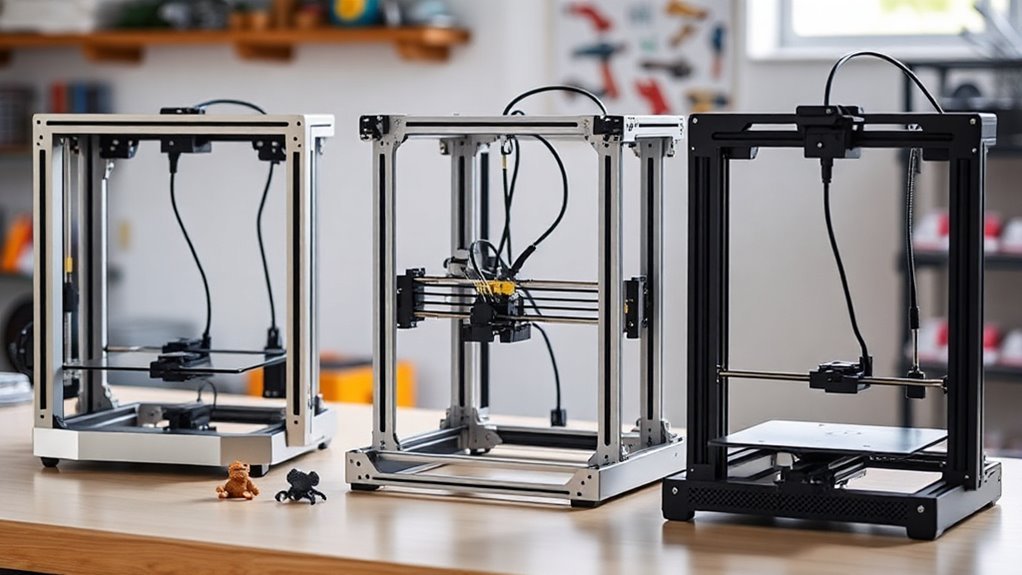
When choosing a 3D printer frame, you’ll want to focus on material strength and durability to guarantee long-lasting performance. Make sure the frame is compatible with your components and fits the size and dimensions you need.
Also, consider how easy it is to assemble, upgrade, and how well it handles heat and wear over time. These factors can make a big difference in your printing experience. So, take your time and pick a frame that suits both your needs and future plans.
Material Strength and Durability
Choosing the right material for your 3D printer frame means balancing strength, weight, and durability to guarantee consistent print quality. Aluminum extrusions, like 20×20 mm profiles, offer excellent stiffness-to-weight ratios. They resist bending in small-to-medium builds and help maintain accuracy.
Steel frames provide superior rigidity and vibration damping, but they add weight. Plus, they might need corrosion protection or thicker sections to prevent flex. Composite materials can cut weight and cost, but they might deform during long prints, which affects repeatability.
Compatibility With Components
Although selecting a 3D printer frame often focuses on strength and durability, making sure it’s compatible with your motion components and hardware is just as important. You need to confirm that the frame’s dimensions and profile size match your stepper motors, lead screws, and belts.
This helps avoid misalignment and ensures full travel. Also, check the T-slot or mounting hole spacing so you can securely attach rails, carriages, and limit switches without any hassle.
The frame material has to support your extruder, hotend, and bed properly to reduce vibration and keep accuracy high. Plus, make sure there’s enough clearance and mounting options for your electronics, power supply, and cable routing — this way, you can prevent any interference.
Finally, double-check that the frame accommodates your bed leveling and sensor systems. This guarantees reliable auto-leveling and smooth probe operation across the entire build surface.
Frame Size and Dimensions
Since your frame size directly impacts your printer’s build volume and workspace fit, you should pick dimensions that not only cover your desired printable area but also leave extra room for cable chains, mounts, and toolhead movement—usually an additional 20 to 50 mm on each axis.
Make sure the frame’s footprint fits comfortably in your workspace and allows easy maintenance access. Consider whether you need a taller Z axis for vertical parts or wider X/Y dimensions for broad prints or batch jobs.
As dimensions grow, prioritize rigidity by choosing stiffer materials or reinforcements to avoid sagging and resonance. Also, plan for mounting points and modularity within your frame size to accommodate upgrades like auto-leveling sensors and enclosures without redesigning your core frame.
Assembly and Upgrade Ease
As you finalize your frame size and materials, think about how easy it will be to assemble and upgrade your 3D printer later on. Choosing frame materials like extruded aluminum or steel is a smart move, especially when paired with simple joining methods such as T-slot profiles or bolted plates. This way, you’ll keep tool needs to a minimum.
It’s also a good idea to go with standardized profile sizes and hole patterns—like 20×20 mm T-slots and M3 to M5 fasteners. That makes replacement parts and mounts easy to find and swap out. Designing your frame with modular subassemblies and accessible mounting points can really simplify maintenance.
Plus, it supports common add-ons like auto-leveling sensors or different extruders. Using common hardware and fasteners helps keep things straightforward, and don’t forget to document your assembly details. This approach ensures your printer stays adaptable and easy to service as your needs change.
Heat and Wear Resistance
When choosing a 3D printer frame, you need to contemplate how materials handle heat and wear to guarantee long-term stability. Opt for frame materials with high heat deflection temperatures, like aluminum alloys with HDT above 100°C, to avoid warping near heated beds or enclosures.
Anodized or heat-treated metals resist oxidation and maintain shape through thermal cycles, reducing wear. Make sure bearing and linear rail contact surfaces use hardened or coated materials—surface-hardened steel or PTFE-coated guides—to minimize abrasion from particles and thermal expansion.
Use fasteners and mounts made from low-creep materials to keep rigidity and bed-leveling accuracy over time. Also, design your frame with thermal isolation, heat sinks, or ventilation near motors and hotends to limit heat transfer and prevent material fatigue.
Frequently Asked Questions
Can I Customize the Frame Color or Finish?
Yes, you can customize the frame color or finish on many 3D printers. Manufacturers often offer options, so you might find a color or finish that suits your taste right out of the box.
If not, no worries! You can also paint or wrap the frame yourself to match your style and workspace perfectly. It’s a great way to make your printer truly your own.
How Does Frame Weight Affect Printer Speed?
You’ll find that lighter frames can increase print speed by up to 20% because they reduce inertia. When your printer’s moving parts weigh less, it accelerates and decelerates faster.
This boost in speed improves overall efficiency without sacrificing quality. It’s a simple change that can make a noticeable difference in your printing process.
Are These Frames Compatible With Resin Printers?
Most frames designed for FDM printers aren’t compatible with resin printers due to different build requirements.
You’ll need frames specifically made or adaptable for resin setups to guarantee proper support and functionality with your resin printer.
What Tools Are Needed for Frame Assembly?
Grab your Allen wrenches, screwdrivers, and a trusty level. You’ll want pliers and a hex key set too—these tools fit together like puzzle pieces.
They help you build a sturdy, precise 3D printer frame effortlessly. It’s all about having the right gear to make assembly smooth and easy.
Do Aluminum Frames Affect Print Quality or Temperature?
Aluminum frames don’t directly affect print quality but help maintain stability and reduce vibrations, improving results. They dissipate heat well, so they won’t cause excessive temperature changes.
This keeps your prints consistent and reliable throughout the process. So, while they might not change the print itself, they do support a smoother, more stable printing experience.
Conclusion
Choosing the right 3D printer frame isn’t just a step—it’s the foundation that shapes every print you make. Whether you go for the sturdy Aluminum Profile Frame Kit, the versatile 300mm T Slot Rails, or the reliable 10 Pcs Extrusion Profiles, each option brings strength and precision to your builds.
So, don’t just pick a frame—choose the frame that empowers your creativity and lets your ideas take solid form, layer by perfect layer. A durable and precise 3D printer frame ensures stability, reduces vibrations, and improves print quality. Investing in the best frame sets you up for success, making every print smoother and more reliable.
In 2027, the right 3D printer frame is more than just a structural component—it’s the backbone that supports your creativity and boosts your builds. Choose wisely, and watch your prints come to life with unmatched accuracy and strength.