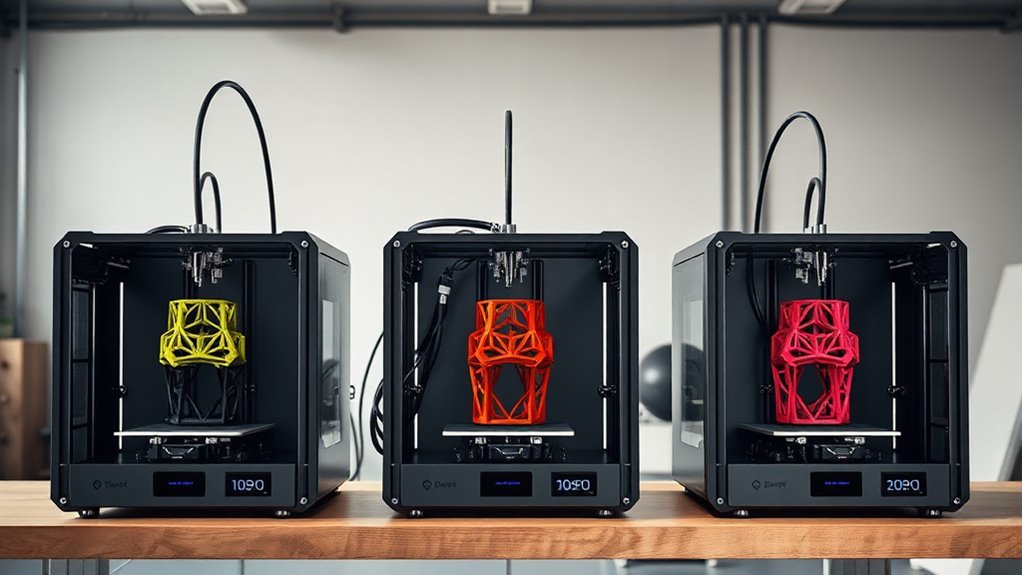
3 Best 3D Printers for Structural Parts in 2027
If you want 3D printers that build tough, precise structural parts in 2027, choose models compatible with a 235mm aluminum frame kit for stability and rigidity. These frames help keep your prints accurate and solid, especially when working on demanding projects. Plus, a sturdy frame reduces vibrations that can mess with your part quality.
Opt for printers supporting high-temp filaments like ELEGOO Carbon Fiber PAHT or Polypropylene Glass Fiber. These materials need hardened nozzles and enclosed chambers to handle the heat and abrasion they bring. Without the right setup, you risk nozzle wear and print failures.
Look for printers with strong thermal management, precise layer control, and advanced extrusion settings. These features ensure your structural parts come out strong and dimensionally accurate every time. Keep going to uncover what else makes a printer ideal for demanding structural prints.
| Image | Name | Editor's Rating | Price |
|---|---|---|---|

|
|
||

|
|
||

|
|
3D Printer Frame Kit for 235mm Aluminum Profile
- 3D Printer Replacement Components, Update Kits, Maintenance Accessories, High Temperature Wear Resistance, Auto Leveling Sensors
- Name: 3D Printer Frame
- Model: Z-axis Motor Mounting Bracket
- Color: Black
- This 3D printer frame adopts the structure, which is strong and durable,
Upgrade your 3D printer’s stability with the 3D Printer Frame Kit for 235mm Aluminum Profile. This frame kit is designed to deliver a strong, reinforced structure that enhances print precision and durability. It addresses common issues like frame wobble and alignment shifts, improving the overall print quality.
The kit includes a specially crafted Z-axis motor mounting bracket optimized for 235mm aluminum profiles. Its design supports high-temperature wear resistance, ensuring long-lasting performance under demanding printing conditions. Compatibility with auto-leveling sensors means your printer maintains accurate leveling automatically.
Maintenance is straightforward with this lightweight and compact frame component. Its robust construction reduces the need for frequent replacements, making it ideal for routine updates or repairs. The kit’s precise fitment helps streamline installation, saving time and effort during maintenance tasks.
While tailored specifically for 235mm aluminum profiles, this focus ensures a secure and reliable upgrade. Manufactured by Generic since May 2025, the product balances affordability and functionality, though it may lack wider brand recognition.
Best for: 3D printer enthusiasts and technicians seeking a durable, precise frame upgrade for printers using 235mm aluminum profiles.
What We Like:
- Reinforced design improves frame stability and print accuracy
- Supports auto-leveling sensors for consistent calibration
- Lightweight and compact for easy installation and maintenance
- High-temperature wear resistance extends product lifespan
Specification:
| Specification | Details |
|---|---|
| Manufacturer | Generic |
| Dimensions | Compatible with 235mm aluminum profiles |
| Weight | 1.76 oz (50 g) |
| Material | Aluminum alloy |
| Color Options | Not specified |
ELEGOO Carbon Fiber PAHT 3D Printer Filament 1.75mm Black 1KG
- Superior Heat Resistance - Withstanding ambient temperatures of up to 194 °C, the material maintains its structural strength and stability, making it suitable for use in...
- Low Water Absorption - ELEGOO PAHT-CF filament has a much lower water absorption rate than regular PA-CF for consistent performance
- Excellent Mechanical Properties - The addition of carbon fibers significantly increases the strength and stiffness of the material, and the excellent interlaminar...
- Abrasion Resistance & Dimensional Accuracy - With carbon fiber added, ELEGOO PAHT-CF 3D printer filament excels in abrasion resistance and dimensional accuracy, making it...
- Compatibility & Tips - Universally compatible with most enclosed 1.75 mm FDM 3D printers. It’s recommended to use hardened steel nozzle with a diameter of no less than...
Experience the strength and precision you need for demanding 3D printing projects with the ELEGOO Carbon Fiber PAHT filament. This filament blends durable nylon with carbon fiber to create parts that resist wear and maintain shape under stress. It’s designed to enhance your prints’ structural integrity while delivering excellent heat resistance.
The filament withstands temperatures up to 194 °C, making it suitable for parts exposed to high heat. Print it between 260–300 °C with a heated bed set to 100–120 °C for optimal results. Using a hardened steel nozzle is essential to prevent damage from the abrasive carbon fibers. An enclosed printer environment helps maintain stable printing conditions and improves part quality.
Thanks to its low water absorption and strong layer adhesion, this filament produces reliable gears, bearings, and other mechanical components. It offers excellent dimensional accuracy, reducing the need for post-processing and ensuring that your parts fit precisely where needed.
While this filament requires careful handling and specific printer setups, its unique combination of durability and heat resistance makes it ideal for professional and advanced hobbyist use.
Best for: Professionals and hobbyists needing a high-strength, heat-resistant filament for precision structural parts printed on enclosed 3D printers.
What We Like:
- Strong and stiff parts due to carbon fiber reinforcement
- High heat resistance up to 194 °C
- Low moisture absorption ensures consistent print quality
- Excellent dimensional accuracy reduces post-processing
- Compatible with hardened steel nozzles for durability
Specification:
| Feature | Details |
|---|---|
| Manufacturer | ELEGOO |
| Diameter | 1.75 mm |
| Weight | 1 kg |
| Material | Carbon Fiber Reinforced PAHT Nylon |
| Color | Black |
Polypropylene Glass Fiber(PP-GF) 3D Printer Filament 1.75mm&700g
- 【20% Glass Fiber Reinforced for Superior Strength & Rigidity】Engineered with 20% glass fiber filling, this PP-GF filament dramatically boosts stiffness and impact...
- 【Exceptional Chemical & Moisture Resistance】Built to thrive in harsh environments, PP-GF filament resists strong acids, fuels, oils, and industrial cleaning agents...
- 【Excellent Electrical Insulation Properties】With outstanding dielectric performance, polypropylene glass fiber filament provides reliable electrical insulation for...
- 【Precision Dimensional Accuracy ±0.02mm】Manufactured to strict tolerances with a diameter accuracy of ±0.02mm, this 1.75mm filament delivers smooth, consistent...
- 【Print-Ready with Professional Guidance】Optimized for FDM 3D printers using hardened steel or tungsten carbide nozzles (0.4–0.6mm recommended). Print settings...
Experience the strength and reliability of the Polypropylene Glass Fiber (PP-GF) 3D Printer Filament, designed to tackle the challenges of creating durable, high-performance parts. Its unique blend of polypropylene reinforced with 20% glass fiber delivers exceptional stiffness and impact resistance. This makes it ideal for producing structural components and functional prototypes that need to withstand stress and wear.
The filament’s low shrinkage and excellent chemical resistance ensure your printed parts maintain their shape and integrity over time. It also absorbs very little moisture, which keeps prints dimensionally stable even in humid conditions. Additionally, its natural electrical insulation properties expand its use in various technical applications.
To maintain optimal print quality, use a hardened steel nozzle at temperatures between 235–255°C and a heated bed set from 85–105°C. Pre-drying the filament before use is essential to avoid moisture-related defects. These steps ensure you get tough, lightweight parts ready for demanding environments.
This black 1.75mm filament weighs 700g and is tailored for professionals and enthusiasts who need reliable, chemically resistant, and dimensionally stable prints with excellent mechanical and electrical properties.
Best for: Engineers and hobbyists printing durable, high-strength parts that require chemical resistance and electrical insulation.
What We Like:
- Reinforced with 20% glass fiber for superior stiffness and impact resistance
- Maintains dimensional stability due to low moisture absorption
- Excellent resistance to chemicals for extended part lifespan
- Suitable for electrical insulation applications
- Requires hardened steel nozzle for wear resistance
Specification:
| Feature | Detail |
|---|---|
| Manufacturer | (Not specified) |
| Diameter | 1.75 mm |
| Weight | 700 g |
| Material | Polypropylene with 20% glass fiber |
| Color | Black |
| Recommended Nozzle | Hardened steel |
| Printing Temp | 235–255°C |
| Heated Bed Temp | 85–105°C |
Factors to Consider When Choosing a 3D Printer for Structural Parts
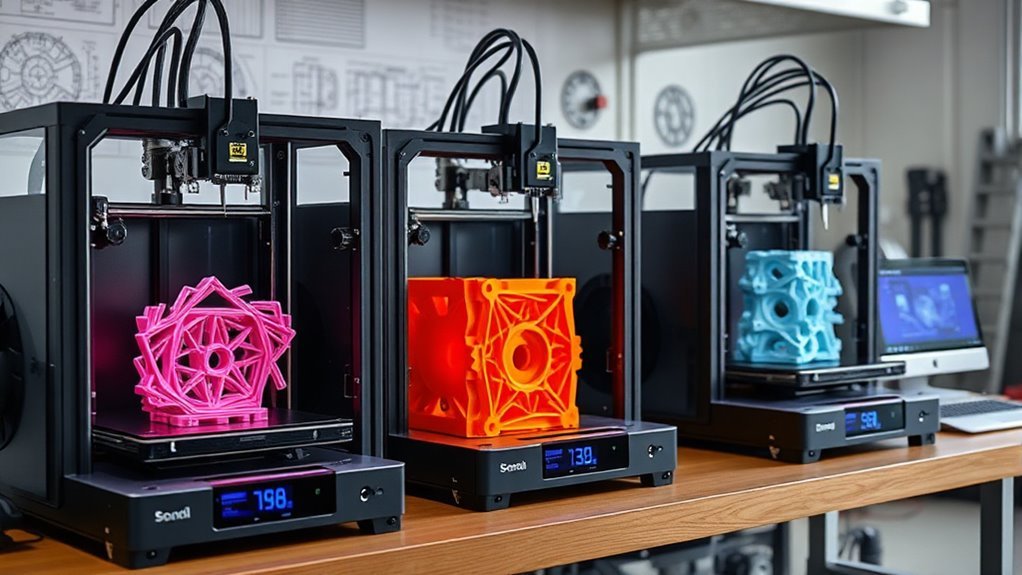
When choosing a 3D printer for structural parts, you need to focus on material strength and temperature resistance to guarantee durability. Precision in printing is vital to meet your design specifications accurately.
Also, check if the printer supports the materials you plan to use and can handle the demands of structural applications. It’s important to pick a printer that’s up for the task, so your parts come out strong and reliable every time.
Material Strength Requirements
Although selecting the right 3D printer is important, understanding the material strength requirements is critical for producing reliable structural parts. You need to determine tensile, flexural, and impact strengths based on expected loads. Designing for 1.5 to 3 times the maximum operational load helps guarantee safety.
Choose materials with tensile strength above 50 MPa and stiffness (Young’s modulus) greater than 2 GPa for rigidity. Also, consider fatigue resistance if parts face cyclic loads. In that case, selecting fiber-reinforced composites with proven fatigue data is a smart move.
Don’t forget environmental factors—heat, chemicals, and humidity can weaken materials by lowering stiffness or strength. Lastly, optimize part geometry and print orientation to align load-bearing fibers properly. This minimizes stress concentrators and offsets strength loss caused by anisotropy between printed layers.
Printing Precision Needs
Material strength lays the foundation for reliable structural parts, but printing precision guarantees those parts fit and perform as intended. You should aim for dimensional accuracy within ±0.1 mm to make certain mating features and load-bearing geometries align perfectly.
Layer heights between 0.1 and 0.2 mm offer a good balance between detail and build time. This improves interlayer bonding without causing excessive delays. Your printer’s positional repeatability and XY resolution must handle features as fine as 0.1–0.2 mm, especially for holes and thin walls.
When designing critical features like bolt holes or snap fits, factor in clearance allowances based on your printer’s calibration. Typically, that means +0.2 mm for holes and +0.1–0.3 mm for press fits.
Finally, controlling thermal deformation through build chamber conditions helps maintain precision. It also prevents warping on larger parts.
Temperature Resistance Capabilities
Because structural parts often face high temperatures, you should guarantee your filament and printed components can handle the maximum service conditions without deforming or losing strength. Check your material’s heat deflection temperature (HDT) or glass change temperature (Tg)—for demanding applications, aim for values above 100 °C.
Your printer must support the high extruder temperatures (250–300+ °C) and have a heated bed or chamber to prevent warping and ensure strong layer adhesion. Also, consider long-term thermal stability and resistance to creep.
This is especially important if parts will undergo thermal cycling or exposure to hot fluids and sunlight. Materials like semi-crystalline nylons, PEEK, or PAHT variants excel here.
Printer Compatibility Features
When choosing a 3D printer for structural parts, you’ll want to prioritize compatibility features that guarantee reliable performance with demanding materials and designs. First, make sure the printer supports your filament diameter (usually 1.75 mm) and can handle abrasive or high-temperature filaments with a hardened steel or all-metal hotend and nozzles ≥0.4 mm.
Verify the build volume and Z-height fit your part dimensions, and check the frame’s rigidity to minimize vibrations. You’ll want a sturdy setup to get the best print quality.
Look for an enclosed heated chamber and a hotend capable of sustained 260–300 °C nozzle temperatures for engineering polymers like PAHT. Also, confirm firmware and slicer support for advanced extrusion and infill controls—these really help with complex prints.
Finally, reliable bed adhesion options and compatibility with filament drying systems help maintain material integrity throughout printing. These features keep your prints looking great and performing well.
Durability of Printed Parts
Maximizing the durability of your printed structural parts starts with selecting the right combination of filament, print orientation, and settings. Choose high-strength materials like fiber-reinforced or engineering polymers. Focus on tensile strength and stiffness to make sure robust parts.
Print layers should align with principal load directions. Maintaining optimized interlayer temperatures boosts adhesion and interlaminar strength.
Use higher infill densities with load-bearing patterns such as rectilinear or gyroid. Increase skin and perimeter counts to enhance surface strength.
Post-processing techniques like annealing or chemical smoothing relieve internal stresses. This improves impact resistance and dimensional stability.
Finally, consider environmental factors. Make certain your material’s heat-deflection temperature and chemical resistance fit the expected operating conditions to prevent premature weakening of your printed structural components.
Print Speed Considerations
Selecting the right print speed plays a crucial role in ensuring the strength and accuracy of your structural parts. Generally, slower speeds between 20–60 mm/s improve interlayer adhesion and dimensional accuracy, which boosts strength and lowers the risk of delamination.
If you push speeds above 100 mm/s, print quality and bonding can suffer. You’ll need higher nozzle temperatures and better cooling to avoid weak layers.
Make sure to match speed to your material. High-temperature nylons and polyesters need slower printing for proper melt flow, especially with composite filaments.
When working with fiber-reinforced or abrasive-filled filaments, slower speeds and larger nozzles (≥0.4 mm) help maintain extrusion consistency and reduce nozzle wear.
For large prints, balance speed with thermal management. Using slower speeds alongside a heated bed and enclosure helps minimize warping and residual stresses.
Post-Processing Options
How can post-processing boost the performance of your structural 3D prints? Techniques like annealing relieve internal stresses, enhance interlayer bonding, and improve thermal resistance—just control size and fixtures to prevent warping.
Chemical smoothing reduces surface roughness and stress risers, boosting fatigue life. But keep in mind, it’s polymer-specific and risks surface weakening if overdone.
Resin impregnation penetrates porous prints, increasing stiffness, impact resistance, and moisture protection. This is especially effective in glass- or carbon-filled plastics.
Mechanical finishing removes crack initiators and, when paired with primers or coatings, enhances durability and fatigue performance.
Finally, protective coatings add abrasion and chemical resistance, seal against moisture for hygroscopic materials, and improve dimensional stability.
Considering these post-processing options helps you maximize your 3D-printed parts’ structural integrity and longevity.
Frequently Asked Questions
How Do 3D Printers for Structural Parts Compare in Print Speed?
You’ll find 3D printers for structural parts vary in print speed, with some prioritizing precision over speed.
Generally, faster printers use advanced tech, but slower ones guarantee stronger, more detailed components.
Choose based on your project needs. It really depends on what matters most to you — speed or strength.
What Software Is Best for Designing Structural 3D Printed Parts?
You’ll want to use software like SolidWorks or Fusion 360; they’re powerful, user-friendly, and perfect for designing strong, precise structural parts.
They let you simulate stress and optimize your designs before printing. Plus, both have great tools that make the whole process smoother and more efficient.
Are There Eco-Friendly Filament Options for Structural Parts?
Yes, you can use eco-friendly filaments like recycled PETG or bio-based PLA blends for structural parts. They offer strength and durability while reducing environmental impact.
This way, you get to print responsibly without sacrificing performance. It’s a win-win!
How to Troubleshoot Common 3D Printing Errors With Structural Materials?
When your print wobbles like a shaky bridge, check bed leveling and filament quality.
If layers don’t bond, boost temperature or slow speed.
Don’t forget cleaning the nozzle; it’s the heart keeping your structure strong and steady.
What Post-Processing Methods Improve Structural Part Strength?
You can improve structural part strength by annealing, applying epoxy coatings, or using chemical smoothing. These methods enhance layer bonding and surface finish, making your parts more durable and resistant to stress or environmental damage.
Basically, annealing helps relieve internal stresses, which boosts overall toughness. Epoxy coatings add a protective layer that guards against wear and moisture. And chemical smoothing not only improves appearance but also reduces surface flaws that can lead to weaknesses.
Conclusion
Choosing the right 3D printer for structural parts is like building a strong foundation for a skyscraper—you need durability, precision, and the best materials. By focusing on quality frame kits and advanced filaments like carbon fiber and polypropylene glass fiber, you’ll make certain your prints stand the test of time.
Keep these factors in mind, and you’ll be crafting parts as solid as steel, ready to support whatever challenges come your way. With the best 3D printers for structural parts in 2027, you can achieve unmatched strength and reliability in your projects. So, invest wisely in a printer that offers sturdy construction and compatibility with high-performance filaments. This way, your structural parts will not only look professional but also perform exceptionally under stress.