4 Best 3D Printer Filaments for Water Printing in 2027
If you’re looking for fast-dissolving, reliable water-soluble filaments for 2027, you’re in the right place. These filaments are perfect for creating supports that come off easily without damaging your main print.
Some top picks include ANYCUBIC PVA, Polymaker PolyDissolve S1, Fused Materials PVA, and Upgraded PVA (Yousu). They’re known for strong adhesion with popular filaments like PLA and TPU, which means your prints stay secure during the job.
Plus, they offer precise diameter control to keep your extrusion consistent. And when it’s time to remove supports, you just pop them in warm water—no mess, no residue.
Each filament handles moisture carefully to ensure the best print quality. Stick around to explore their unique strengths and get ideal printing tips to make the most of your water-soluble filaments!
| Image | Name | Editor's Rating | Price |
|---|---|---|---|
|
|
||

|
|
||

|
|
||

|
|
ANYCUBIC PVA Filament, 500g, Natural
- 【Truly Effortless Support Removal】Anycubic PVA Filament is a water-soluble support material designed for intricate prints and steep overhangs — simply dissolve in...
- 【Preserving the Finest Detail】Anycubic PVA is 100% water-soluble for effortless post-processing. Submerge the print to dissolve supports from complex internals, ball...
- 【Improved Printing Success Rates】Anycubic PVA 3D Printer Filament is a reliable support material for various filaments such as PLA, PETG, and TPU. Increase print...
- 【Moisture Control Packaging】Anycubic PVA comes vacuum-sealed in high-barrier aluminum foil with an anti-moisture seal, fully protecting it from humidity to ensure...
- 【Reusable Filament Spool】The reusable spool features a threaded connection system for stable pairing with spool-free filaments — minimizing entanglement...
Experience hassle-free 3D printing with the ANYCUBIC PVA Filament, 500g, Natural, designed to simplify support removal for intricate models. This filament dissolves completely in water, allowing you to maintain delicate details and complex internal structures without sanding or manual cleanup.
Its compatibility with popular filaments like PLA, PETG, and TPU ensures reliable adhesion and strong support for steep overhangs. This makes it ideal for creating precise, complex prints that would otherwise be difficult to finish cleanly.
The filament comes vacuum-sealed in moisture-controlled packaging to maintain optimal freshness and performance. Once opened, careful storage is essential to prevent moisture absorption, preserving print quality over time.
The reusable spool design minimizes tangles and keeps your printing workflow smooth and efficient. While it excels as a support material, it is not suitable for standalone prints, so it should be used specifically for supporting complex structures.
Best for: hobbyists, designers, and professionals who require dependable, easy-to-remove water-soluble supports for detailed 3D printing projects.
What We Like:
- 100% water-soluble for clean support removal
- Compatible with PLA, PETG, TPU, and more
- Moisture-controlled, vacuum-sealed packaging
- Reusable spool reduces filament tangling
Specification:
| Feature | Details |
|---|---|
| Manufacturer | ANYCUBIC |
| Weight | 500g (1.1 lb) |
| Material | PVA (Polyvinyl Alcohol) |
| Color | Natural |
Polymaker PolyDissolve S1 Water Soluble 3D Filament
- DISSOLVES IN WATER: PVA support material dissolves after printing, helping remove supports from internal cavities and tight spaces. Time varies with thickness, water...
- MATERIAL MATCH: Formulated for PLA, TPU, PVB and Nylon-based filaments in the Polymaker portfolio. Check your model material and run an interface test when changing...
- FOR COMPLEX PRINTS: Assign S1 to support structures or interface layers in your slicer for overhangs, enclosed channels and detailed geometry. Tune contact settings for...
- MOISTURE CONTROL: PVA absorbs moisture quickly. Keep the spool sealed, print from a dry box and dry when needed; the TDS lists 80°C for 12 hours for material that has...
- DUAL-MATERIAL SETUP: A two-nozzle, IDEX or toolchanger printer is recommended. For a 0.4mm nozzle, TDS settings are 215-225°C nozzle, 25-60°C bed and cooling fan on...
Polymaker PolyDissolve S1 offers a practical solution for 3D printing complex models with intricate geometries. This water-soluble support filament simplifies the removal of supports, allowing you to focus on the final design without worrying about damaging delicate details.
Designed from PVA, it dissolves quickly in water, making post-processing easier and faster. Its compatibility with PLA, TPU, PVB, and Nylon enables seamless multi-material printing. For optimal results, a dual-extruder setup is ideal, though single-nozzle printing is possible with purge routines.
Maintaining PolyDissolve S1 requires attention to moisture. It is highly sensitive and should be stored sealed and dry. If needed, drying at 80°C for 12 hours helps retain its quality and performance.
Printing temperatures between 215–225°C and a bed temperature of 25–60°C ensure good adhesion and print consistency. Cooling fans should remain on to achieve the best finish on your supports.
Best for: Professionals and hobbyists needing reliable, water-soluble supports for complex multi-material 3D prints.
What We Like:
- Dissolves easily in water for hassle-free support removal
- Compatible with multiple filament types for versatile use
- Suitable for dual-extruder setups or adaptable to single-nozzle printers
- Maintains detail integrity in complex geometries and overhangs
Specification:
| Specification | Details |
|---|---|
| Manufacturer | Polymaker |
| Material | PVA (Polyvinyl Alcohol) |
| Printing Temp | 215–225°C |
| Bed Temp | 25–60°C |
| Storage | Sealed, dry environment |
Fused Materials PVA 1.75mm Water-Soluble Filament
- PREMIUM PVA: Our professional grade filament ensures better dissolvability, stronger toughness, smoother printing, no bubbles, no warping, and a pleasant tangle-free...
- DISSOLVABLE FILAMENT - Fused Materials PVA is a water-soluble filament used with dual extruder 3D printers to print support structures, casts, complex shapes and more!
- OPTIMIZED FOR PLA – Fused Materials PVA was designed to be a user-friendly dissolvable material and works best with many common materials such as PLA.
- VACUUM SEALED: Fused Materials PVA is comes packaged in a vacuumed resealable mylar pouch with an added desiccant to preserve the filament quality. When the filament is...
- TECHNICAL SPECIFICATIONS: Consistent Diameter - +/- .03mm dimensional accuracy. Spool Diameter: 8" - Spool Width: 2.5" - Spool Hub Hole Diameter: 1.50; 1 kg spool...
Experience hassle-free 3D printing with Fused Materials PVA 1.75mm water-soluble filament, designed to simplify support removal for complex models. This clear, transparent filament dissolves effortlessly in water, eliminating the need for manual cleanup and reducing print damage risks.
Its strong toughness ensures that supports hold firm during printing without warping or bubbling. Compatible with popular materials like PLA, PETG, Nylon, and ABS, this filament works smoothly on most 1.75mm FDM printers, including Bambu Lab and Polymaker models.
To maintain optimal performance, store the filament in its vacuum-sealed, resealable pouch. Proper storage prevents moisture absorption, which can affect print quality and filament longevity. Printing is recommended at 190–220°C with a heated bed set between 50–80°C for consistent results.
This professional-grade filament offers precise diameter tolerance and certifications such as RoHS and CE, underscoring its quality and safety standards. Its water-soluble nature makes it ideal for dual-extruder setups requiring reliable support structures.
Best for: 3D printing enthusiasts and professionals needing dependable, water-soluble support filament for detailed dual-extruder prints using PLA, PETG, Nylon, or ABS on 1.75mm FDM printers.
What We Like:
- Smooth dissolving supports that reduce post-processing effort
- Strong and warp-resistant for stable support structures
- Wide compatibility with common 3D printing materials and brands
- Vacuum-sealed packaging to protect against moisture
- Certified quality with tight diameter control
Specification:
| Feature | Details |
|---|---|
| Manufacturer | Fused Materials |
| Diameter | 1.75 mm |
| Material | PVA (Polyvinyl Alcohol) |
| Color | Clear, transparent |
| Recommended Temp | 190–220°C (nozzle) |
| Bed Temp | 50–80°C |
| Certification | RoHS, CE |
| Packaging | Vacuum-sealed resealable pouch |
Upgraded PVA 1.75mm Water-Soluble 3D Filament
- 【Upgraded Water-Soluble Performance】Compared to the previous generation, this PVA filament features faster water dissolution and more efficient softening (works...
- 【Precise 1.75mm Diameter】Controlled by advanced CCD measurement and adaptive systems, the filament maintains a tight tolerance of ±0.02mm. Ensures consistent...
- 【500g Net Weight & Strong Compatibility】500g spool designed for extended printing sessions. Works well with PLA (and other low-temp filaments) due to similar printing...
- 【Reduced tangling and clogging】Manufactured using a precision winding machine to prevent tangling, breakage, or wire breakage. After 24 hours of constant-temperature...
- 【Moisture-Proof Packaging】Comes in a vacuum-sealed bag with a desiccant packet to lock out humidity. Keeps filament dry and ready for use, ensuring long-term storage...
Experience hassle-free support removal with the Upgraded PVA 1.75mm water-soluble filament, designed to simplify complex 3D prints. This filament dissolves quickly in water at 50–65°C, allowing you to remove supports gently without damaging delicate surfaces. It helps you save time on post-processing by softening supports for easy peeling.
Compatible with PLA and most FDM printers, this yellow PVA filament performs best at 180–210°C. Its precise diameter control (±0.02 mm) and advanced drying technology ensure smooth, consistent layers with minimal warping and clogging. You get reliable prints with less frustration.
To maintain performance, keep the filament vacuum-sealed with desiccant until use, and use it soon after opening to prevent moisture absorption. This care extends the filament’s shelf life and preserves print quality.
With technical support from Yousu, troubleshooting is straightforward. This filament is an excellent choice for users who need fast-dissolving, dependable water-soluble supports for intricate 3D printing projects.
Best for: users requiring quick, reliable water-soluble support material compatible with PLA and low-temperature filaments.
What We Like:
- Fast dissolution at 50–65°C for easy support removal
- Precise diameter (±0.02 mm) ensures smooth printing
- Advanced drying reduces warping and clogging
- Vacuum-sealed packaging preserves freshness
- Technical support available for troubleshooting
Specification:
| Feature | Details |
|---|---|
| Manufacturer | Yousu |
| Diameter | 1.75 mm |
| Material | PVA (Polyvinyl Alcohol) |
| Color | Yellow |
| Recommended Temp | 180–210°C |
| Dissolving Temp | 50–65°C |
Factors to Consider When Choosing 3d Printer Filament for Water
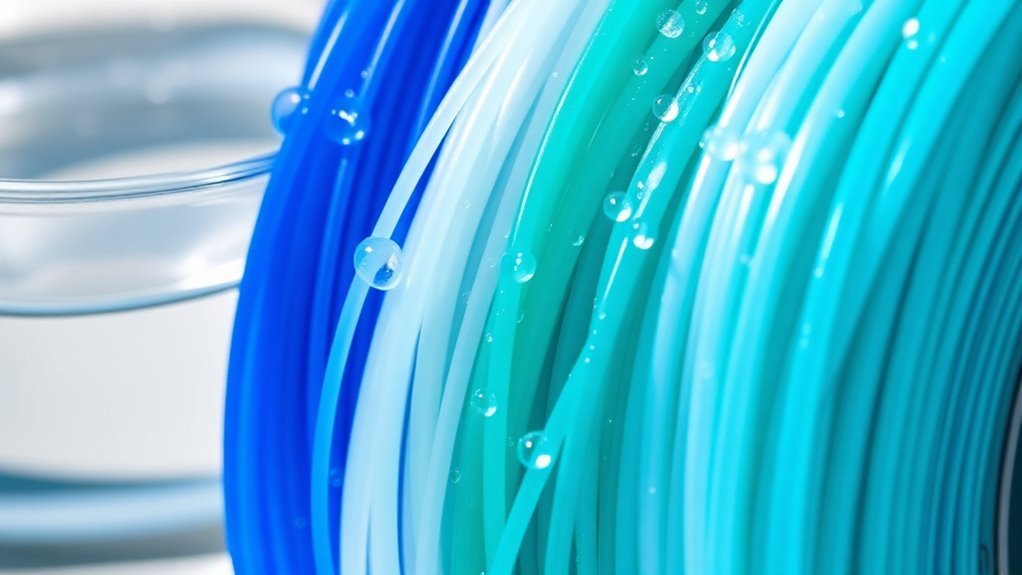
When choosing 3D printer filament for water printing, you need to contemplate how quickly it dissolves and whether it’s compatible with your printer. Pay attention to moisture sensitivity and the ideal print temperature to avoid issues during printing.
Also, think about how easily you can remove the supports once the print is finished. It makes a big difference when you’re trying to get clean results without a hassle.
Water Solubility Rate
Although water solubility rate varies widely among filaments, understanding how factors like thickness, temperature, and polymer structure affect dissolution can help you predict how quickly your supports will disappear. Thin walls or features from 0.4 to 1.0 mm can dissolve in minutes, while bulkier sections may take hours.
You can speed up dissolution by using warm water (40–60°C) and gentle stirring, which markedly shortens the time compared to cold, still water. Polymer properties matter too: amorphous or low-crystallinity filaments dissolve faster than highly crystalline ones.
Keep your filament fresh and properly stored since moisture and prior printing conditions influence solubility. Also, designing supports with high surface area, like lattice infills or perforations, maximizes water contact and speeds up dissolution.
This makes your post-processing smoother and way less of a hassle.
Filament Material Compatibility
Since exposure to water can markedly affect your print’s durability and function, you need to choose filament materials that remain stable during and after water contact. Select filaments chemically stable in the type and duration of water exposure—PLA and PETG handle brief contact but degrade with long immersion, while PVA dissolves by design.
Consider hygroscopicity: materials like nylon and PVA absorb moisture quickly, impacting print quality if not properly stored. It’s important to keep them sealed tight when not in use. Assess dimensional stability since some filaments swell or soften when wet, compromising part accuracy.
For multi-material prints, make certain support filaments adhere well during printing but remove easily in water without harming the main material. Also, match extrusion and bed temperatures to optimize bonding and reduce warping under humid or wet conditions. This helps preserve mechanical integrity and ensures your print lasts.
Moisture Sensitivity Handling
Choosing the right filament material for water printing means also managing how it reacts to moisture before and during printing. Many water-soluble filaments, like PVA-based ones, absorb moisture quickly, which can cause bubbling, stringing, and nozzle clogs.
To avoid this, store your spools vacuum-sealed with desiccants or in a dry box keeping humidity below 10–20%. If your filament has absorbed moisture, dry it in a filament dryer or convection oven at recommended temperatures, often 60–80°C for several hours.
During printing, use a sealed dry environment or a spool holder with a desiccant chamber to minimize exposure. Pay attention to popping or inconsistent extrusion, which signals moisture issues, and dry the filament again before continuing to guarantee smooth, high-quality prints.
Print Temperature Range
Optimize your print temperature to guarantee your water-exposed parts achieve full polymer fusion and strong layer adhesion. Choose a filament with a nozzle temperature typically between 180–230°C to minimize porosity and enhance water tightness.
Keep your bed temperature within the recommended range, usually 20–80°C, to prevent warping and layer separation that cause leaks.
When printing thin walls or functional water-holding parts, use the higher end of the extrusion temperature range to improve interlayer bonding and reduce micro-gaps. Just be careful not to exceed the polymer’s thermal stability, as overheating can degrade the material and compromise waterproofing.
For multi-material prints, align extrusion temperatures and cooling profiles to avoid differential shrinkage and weak interfaces that undermine water resistance. This approach guarantees durable, watertight 3D prints.
Support Removal Ease
When working with water-soluble supports, you’ll want to pick materials that dissolve completely without leaving residue or requiring tedious mechanical removal. Opt for support filaments like PVA-type polymers that offer high water solubility.
Keep in mind that thicker supports and denser infills take longer to dissolve, so using warmer water (40–60°C) and gentle agitation speeds up the process. Make sure your model and support materials bond well enough to prevent collapse during printing but still separate cleanly after soaking.
Also, consider the geometry—deep cavities may need longer soak times or water circulation for full removal. Finally, keep your support filament dry before printing; moisture can cause poor extrusion and weaker supports, which makes removal more complicated.
Packaging and Storage
To keep your water-soluble 3D printer filaments in top condition, you’ll want to store them carefully to prevent moisture absorption. Use vacuum-sealed, high-barrier packaging with desiccants to maintain dryness and extend shelf life.
After opening, place spools in resealable mylar bags or dry boxes to limit humidity exposure. This is important because moisture causes bubbling, stringing, and weak layer adhesion.
Store filaments in a controlled environment with low humidity and stable temperature. Avoid prolonged air exposure to keep them in the best shape.
Always note the recommended drying protocols—like drying PVA at 80°C for about 12 hours if it’s absorbed moisture—and follow them before printing.
Label your spools with the date opened and drying history to track storage. This way, you’ll know when re-drying is necessary to guarantee consistent print quality every time.
Print Surface Adhesion
Proper storage keeps your water-soluble filaments ready to perform, but ensuring strong print surface adhesion is just as important for water-exposed parts. Choose filaments with higher bed temperature requirements (50–80°C) to improve first-layer adhesion on heated beds and reduce warping.
Use materials with good interlayer bonding and maintain extrusion temperatures between 190–225°C to create watertight seals and prevent delamination. Pair your filament with an appropriate build surface like PEI, glass with adhesion promoters, or textured beds, and fine-tune the nozzle-to-bed gap to maximize contact.
Adjust first-layer settings by slowing print speed, thickening the first layer, and increasing extrusion multiplier to boost adhesion strength. For dual-material prints, carefully tune interface settings so supports stick well without harming your model’s surface during dissolution.
Filament Diameter Consistency
Consistently maintaining filament diameter is essential for achieving watertight 3D prints, especially when your parts will be exposed to water. Aim for a tight diameter tolerance of ±0.02–±0.03 mm for 1.75 mm filament to reduce extrusion flow variability and boost dimensional accuracy.
You should also check filament roundness and cross-sectional consistency. Variations here cause under- or over-extrusion, creating micro-gaps that lead to leaks.
Spool-to-spool uniformity matters too. Sudden diameter changes can cause weak seams that compromise water resistance.
Choose filament with documented specs and low standard deviation to avoid frequent extrusion recalibration. And if you’re using dual-extrusion with soluble supports, make sure to match diameter tolerances between filaments. That way, your extrusion calibrations stay accurate and interface layers remain leak-free.
Frequently Asked Questions
How Does Water Temperature Affect PVA Filament Dissolution Time?
You’ll find that higher water temperatures speed up PVA filament dissolution time markedly. Warmer water breaks down the material faster, while cooler water slows the process.
Can Water-Soluble Filaments Be Recycled or Reused?
Like catching smoke with your hands, water-soluble filaments can’t be reused once dissolved.
You can recycle unused dry filament, but once it’s in water, it breaks down. So, you’ll need fresh material for each print.
Are There Any Safety Precautions When Handling Water-Soluble Filaments?
Yes, you should wear gloves to avoid skin irritation and work in a well-ventilated area since fumes can form during printing.
Also, always store filaments in a dry place to prevent moisture absorption and maintain print quality. It really helps keep things running smoothly.
How Do Water-Soluble Filaments Impact Print Bed Adhesion?
Water-soluble filaments can make print bed adhesion feel like wrestling a slippery eel—you’ve got to prep the bed meticulously and use adhesives or textured surfaces.
Otherwise, your prints might just refuse to stick and slip away! It takes a bit of patience and the right setup to get things to hold firm.
What Are the Environmental Benefits of Using Water-Soluble Filaments?
You’ll reduce plastic waste since water-soluble filaments dissolve completely, leaving no harmful residues. They’re biodegradable, cutting down landfill impact.
Plus, you won’t need harsh chemicals for removal, which helps protect your local environment and water systems. It’s a win-win for both you and the planet!
Conclusion
When selecting a 3D printer filament for water printing, you’ll want to embrace materials that gracefully dissolve and leave minimal residue. This makes your projects effortlessly refined and easy to manage.
Each option we’ve explored offers a subtle harmony between performance and ease of use. This ensures your prints are not only functional but elegantly manageable.
By choosing wisely, you’ll transform complex post-printing tasks into a seamless, almost poetic experience. This will elevate your 3D printing journey to a new level of sophistication.
In the world of water printing, picking the right filament is key. It’s not just about how your print looks, but how smoothly the entire process flows—from printing to cleanup. So, when you choose the best 3D printer filaments for water printing in 2027, you’re setting yourself up for success. Your prints will come out crisp, and dissolvable supports will vanish with ease, making your projects look professional and polished every time.