10 Best Bambu Printers for TPU Filament in 2027
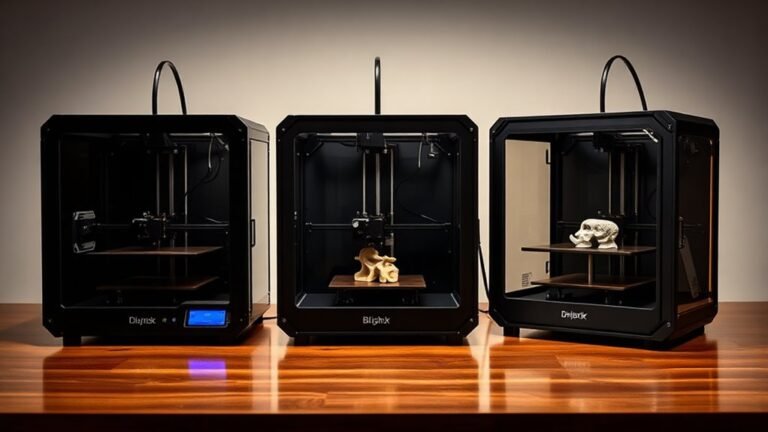
If you want the best Bambu printers for TPU filament in 2027, you’ll want to check out models designed specifically to handle flexible materials with ease.
The X2D with AMS 2 Pro stands out for multi-material and soluble-support printing, making it great for complex TPU projects. Then there’s the A2L, perfect for large-format, multi-colour prints, and it even features automated extrusion calibration to keep things smooth.
The compact A1 is another solid choice, especially if you need rapid nozzle changes for high-speed TPU work. Don’t forget about the TPU Feed Assist Module — it really helps ease flexible filament handling, which can be tricky sometimes.
These options combine reliable flexible material performance, advanced filament management, and fast printing speeds. Keep exploring to find the perfect Bambu printer that matches your specific TPU project needs!
| Image | Name | Editor's Rating | Price |
|---|---|---|---|

|
|
||

|
|
||

|
|
||
|
|
|
||
|
|
|
Bamboo TPU Flexible Filament for AMS 3D Printer
- Seamless AMS & AMS lite Integration: Optimized for use with the AMS system, Bamboo Lab TPU filament for AMS enables smooth and reliable multicolor printing with flexible...
- Tough Yet Flexible: With a Shore hardness of 68D, bamboo lab tpu filament for AMS combines exceptional toughness with the flexibility and durability of TPU. It is ideal...
- Goodbye, TPU Stringing: Say farewell to stringing with Bamboo TPU for AMS. Its special formulation greatly minimizes the common stringing problems found in traditional...
- Blazing Fast TPU Printing: TPU for AMS bamboo delivers up to 60% faster print speeds compared to TPU 95A HF, boosting efficiency without compromising on quality. Get more...
- Minimized Stringing with Clean Details: Thanks to its advanced formulation, this TPU filament 1.75mm for AMS not only reduces stringing but also ensures crisp, clean...
If you’re looking for a TPU filament that combines flexibility and durability for your Bambu Lab 3D printer, the Bamboo TPU Flexible Filament by TECKVIZEE is designed to meet that need. It works seamlessly with AMS and AMS Lite systems, ensuring smooth integration and consistent performance.
This filament offers a Shore hardness of 68D, providing a balance of toughness with enough flexibility to handle a variety of projects. It prints up to 60% faster than typical TPU 95A filaments, helping you save time without sacrificing quality. The special formulation also reduces stringing, resulting in clean and detailed prints.
To maintain optimal print quality, it’s important to dry the filament before use and store it in an airtight container with desiccant. This care prevents moisture absorption, which can affect print consistency and strength. The filament’s 1.75 mm diameter fits most Bambu Lab printers but may not be compatible with other brands.
Best for: Users of Bambu Lab printers who need a reliable, tough TPU filament optimized for fast, clean printing with AMS systems.
What We Like:
- Prints significantly faster than standard TPU 95A
- Reduces stringing for sharp, clean prints
- Seamless compatibility with Bambu Lab AMS systems
- Balanced Shore hardness for versatile flexibility
- Includes RFID for easy AMS recognition
Specification:
| Feature | Details |
|---|---|
| Manufacturer | TECKVIZEE |
| Diameter | 1.75 mm |
| Shore Hardness | 68D |
| Compatibility | Bambu Lab AMS & AMS Lite |
| Material Type | TPU (Flexible filament) |
TPU Filament 1.75mm, 95A TPU 3D Filament, 8 Pack 200g Spool Bundle
- [FLEXIBLE 95A HIGH-IMPACT STRENGTH] Designed to replace rigid, brittle plastics with ultra-durable, bendable strength! Our premium 95A TPU filament 1.75mm absorbs harsh...
- [8 COLOR FLEXIBLE DISCOVERY SET] Why limit yourself to one color? This 1.75mm TPU filament 8-pack set delivers 8 high-impact solid colors: Black, White, Grey, Red, Blue...
- [STRONG LAYER BONDING & OIL RESISTANT] Say goodbye to layer separation under heavy strain! Formulated with industrial-grade rubberized polymers, our flexible TPU filament...
- [NEAT WINDING FOR TANGLE-FREE PRINTING] Prevents ruined multi-hour prints caused by tangled line overlaps. Manufactured with strict ±0.03mm dimensional accuracy...
- [INDIVIDUAL VACUUM SEAL & DRYING GUIDE] Every mini spool of TPU 1.75mm filament is pre-dried and individually vacuum-sealed with a desiccant pack to block air humidity...

Discover the ACESAY TPU Filament 1.75mm, 95A, designed to enhance your 3D printing projects with outstanding flexibility and durability. This 8-pack bundle offers a variety of colors on convenient 200g spools, giving you a total of 1.6 kg of versatile material. It’s perfect for creating strong, impact-resistant parts like phone cases and drone bumpers that need to withstand daily wear and tear.
This TPU filament feeds smoothly through direct-drive extruders, minimizing jams thanks to its precise ±0.03 mm dimensional accuracy. Each spool is vacuum-sealed and pre-dried to maintain peak quality, reducing the risk of moisture-related printing issues. For ongoing print reliability, occasional drying is recommended after extended air exposure.
Ideal for flexible, ergonomic designs, this filament’s 95A hardness balances toughness with stretchiness. It’s not suitable for automatic material systems, as it requires careful feeding to maintain print consistency. The bundle supports a wide range of creative and functional applications with ease.
Best for: hobbyists and professionals seeking a flexible, durable TPU filament with multiple color options for direct-drive FDM printers.
What We Like:
- High flexibility with strong impact resistance for durable parts
- Smooth feeding and tight dimensional tolerance reduce print failures
- Vacuum-sealed, pre-dried spools preserve filament quality
- 24/7 technical support aids in flexible filament optimization
Specification:
| Feature | Details |
|---|---|
| Manufacturer | ACESAY |
| Diameter | 1.75 mm |
| Hardness | 95A |
| Spool Weight | 200 g per spool |
| Total Weight | 1.6 kg (8 spools) |
| Color Options | 8 colors |
| Dimensional Tolerance | ±0.03 mm |
| Compatibility | Direct-drive FDM printers |
Bambu Lab X2D 3D Printer with Filament Rolls, Tool Kit, AMS 2 PRO System
Experience the power of versatile multi-material 3D printing with the Bambu Lab X2D 3D Printer paired with the AMS 2 Pro system. This setup is designed to tackle complex projects by allowing seamless switching between filaments, so you can create intricate parts with soluble supports without stopping your workflow. Its true dual-nozzle design reduces waste and speeds up production, making it ideal for detailed prototypes and functional models.
The AMS 2 Pro system holds up to four filaments and can expand to over 24, giving you flexibility to experiment with TPU blends, composites, and engineering-grade materials. With a maximum nozzle temperature of 300°C and an actively heated chamber, this printer minimizes warping and delivers sharp, durable prints every time. Advanced motion control further enhances precision and consistency.
Maintenance is straightforward thanks to built-in sensors and filtration that ensure safe, quiet operation. Wi-Fi connectivity lets you monitor prints remotely, so you can manage your projects with ease. While the printer’s footprint and complexity may require dedicated space and some learning, the productivity benefits are substantial for users ready to advance their printing capabilities.
Best for: Professionals and enthusiasts seeking reliable, high-detail, multi-material 3D printing with advanced filament management and print quality.
What We Like:
- True dual-nozzle system for simultaneous printing of parts and soluble supports
- AMS 2 Pro supports up to 24+ filaments, including TPU and composites
- Active heated chamber and 300°C nozzle reduce warping and improve print strength
- Built-in sensors and filtration ensure safe and quiet operation
- Wi-Fi connectivity allows remote print monitoring
Specification:
| Manufacturer | Bambu Lab |
|---|---|
| Dimensions | Not specified |
| Weight | Not specified |
| Material Support | Multi-material, TPU, composites |
| Max Nozzle Temp | 300°C |
| Filament Capacity | 4 filaments (expandable to 24+) |
| Connectivity | Wi-Fi |
Bambu Lab A2L 3D Printer
The Bambu Lab A2L 3D Printer is designed to tackle large, complex printing projects with precision and ease. Its spacious build volume allows you to create oversized, single-piece models without the hassle of seams or alignment issues. This feature is especially valuable for professionals who require smooth, high-quality results from start to finish.
Equipped with advanced multi-colour filament management like AMS Lite and 2nd-Gen AMS, the printer supports up to 19 colors and offers climate-controlled storage. This ensures your filament stays in optimal condition, reducing maintenance and print failures. Users benefit from consistent, vibrant prints without the complexity often associated with multi-colour setups.
The printer’s Adaptive Vibration Compensation and precise flow calibration deliver sharp, detailed results quietly and with minimal emissions. These capabilities make it suitable for both home studios and professional environments where noise and air quality matter.
While its large format may demand more space and longer print times, the Bambu Lab A2L excels in batch printing and multi-tool workflows. Beginners might face a learning curve, but the payoff is high-quality, seamless prints with less manual adjustment.
Best for: Large-scale 3D printing enthusiasts and professionals needing seamless, multi-colour prints with precise detail and efficient batch production.
What We Like:
- Generous 330 × 320 × 325 mm build volume for single-piece and batch printing.
- Advanced multi-colour filament system supporting up to 19 colors with climate control.
- Adaptive Vibration Compensation ensures sharp, repeatable prints.
- Quiet operation with ultra-low emissions suitable for indoor use.
Specification:
| Feature | Details |
|---|---|
| Manufacturer | Bambu Lab |
| Build Volume (L×W×H) | 33 × 32 × 32.5 cm |
| Multi-Colour Support | Up to 19 colors |
| Filament Storage | Climate-controlled AMS |
| Emissions | Ultra-low |
| Noise Level | Quiet operation |
Black – Bambu Lab TPU 95A HF Filament – 1.75mm, 1kg
Discover a TPU filament designed to solve the challenge of balancing flexibility with durability while enabling faster print speeds. The Black Bambu Lab TPU 95A HF filament offers a high-flow formula that ensures smooth, consistent extrusion. This reduces clogs and helps you print more efficiently without compromising quality.
Its Shore hardness of 95A provides the perfect blend of elasticity and strength. This makes it ideal for creating impact-resistant parts such as phone cases, gaskets, and wearable components. The filament’s clean black finish results in neat, professional-looking prints every time.
Designed primarily for Bambu Lab X1 and P1 Series printers, it performs best with direct-drive extruders. This setup enhances layer adhesion and minimizes stringing, giving you reliable, durable results. Maintenance is straightforward with fewer feeding issues, although Bowden extruder users may need to adjust speeds and settings carefully.
Best for: Makers, engineers, and print farms looking for a flexible TPU filament that supports faster printing and consistent, high-quality production.
What We Like:
- High-flow formulation enables faster, smoother printing
- Strong 95A Shore hardness balances flexibility and durability
- Optimized for direct-drive extruders on Bambu Lab X1 and P1 Series
- Reliable layer adhesion with reduced stringing and clogging
Specification:
| Feature | Details |
|---|---|
| Manufacturer | Bambu Lab |
| Diameter | 1.75 mm |
| Weight | 1 kg |
| Material | TPU (Thermoplastic Polyurethane) |
| Color Options | Black |
Bambu Lab A2L 3D Printer Combo
The Bambu Lab A2L 3D Printer Combo redefines large-format multi-colour printing with precision and ease. Its generous build volume of 330 × 320 × 325 mm lets you create oversized parts or produce batches without sacrificing detail. This printer’s CoreXY-inspired design ensures stable, vibration-compensated movements for smooth, sharp prints every time.
Maintenance is simplified with automated calibration that adjusts extrusion based on filament conditions, reducing downtime and errors. The system supports up to 19 colours via AMS compatibility, perfect for complex, vibrant projects. Modular add-ons like blade cutting and pen drawing expand your creative toolkit, enabling hybrid workflows that combine 3D printing with mixed-media techniques.
Designed for professionals and makers, the A2L excels in producing functional prototypes, full-scale models, and advanced TPU prints. While its advanced features require some learning, the combination of build volume, multi-colour capability, and modular options offers unmatched versatility. Note that print times and filament use may increase with complex setups.
Best for: Professionals and makers seeking reliable large-format, multi-colour 3D printing with modular hybrid workflow support.
What We Like:
- Large build volume supports oversized parts and batch production
- Up to 19-colour printing with automated extrusion calibration
- Modular add-ons enable cutting and drawing for mixed-media projects
- Stable CoreXY-inspired mechanics ensure detailed, smooth prints
Specification:
| Feature | Specification |
|---|---|
| Manufacturer | Bambu Lab |
| Build Volume | 330 × 320 × 325 mm |
| Print Technology | Fused Filament Fabrication (FFF) |
| Colour Capability | Up to 19 colours with AMS |
| Additional Features | Automated calibration, modular add-ons |
Red – Bambu Lab TPU for AMS Filament – 1.75mm, 1kg
Experience reliable flexibility with the Red – Bambu Lab TPU for AMS Filament. Designed specifically for the Bambu Lab Automatic Material System, this filament ensures smooth feeding and reduces printing interruptions. Its elasticity and durability make it ideal for creating flexible hinges, protective cases, and wearable parts that last.
This 1.75mm, 1kg filament excels in multi-material workflows, thanks to its AMS-optimized formula. It minimizes jams and supports seamless material changes, improving print efficiency. The slightly matte finish also offers a clean look with less stringing when print speeds and retraction are properly calibrated.
Maintenance is straightforward but benefits from attention to print settings. Moderate speeds and fine-tuned retraction yield the best results. While optimized for Bambu Lab AMS printers, it can work well with other 1.75mm FDM setups, though some adjustments may be necessary.
The Red Bambu Lab TPU balances flexibility and stiffness to deliver consistent, functional prints. Its formulation addresses common issues in flexible materials, making it a practical choice for advanced users focused on quality and dependability.
Best for: users of Bambu Lab AMS-enabled 3D printers and other 1.75mm FDM setups seeking flexible, durable filament optimized for smooth feeding and multi-material printing workflows.
What We Like:
- AMS-optimized to reduce jams and improve feeding reliability
- Strong elasticity combined with structural durability
- Smooth, slightly matte finish with minimal stringing
- Supports complex multi-material print jobs
- Compatible with various 1.75mm FDM printers with minor tuning
Specification:
| Feature | Details |
|---|---|
| Manufacturer | Bambu Lab |
| Diameter | 1.75 mm |
| Weight | 1 kg |
| Material | TPU (Thermoplastic Polyurethane) |
| Color | Red |
A1 3D Printer by Bambu Lab
- Automatic Calibration
- Supports Multi-Color Printing (Combo Version)
- Dynamic Flow Rate Adjustment
- Rapid Nozzle Change with Single Clip
- Motor Noise Reduction Technology
The A1 3D Printer by Bambu Lab brings simplicity and precision to your printing projects. Its automatic calibration and RFID-sync technology eliminate guesswork, making it easy to print TPU filaments without manual adjustments. This means less downtime and more focus on creating.
Designed for efficiency, the printer features a rapid nozzle change system and dynamic flow rate adjustment that together enhance print quality and speed. The quiet operation, thanks to motor noise reduction and a sturdy base, ensures a distraction-free workspace.
Maintenance is straightforward with durable components like the heated bed’s Kevlar-strengthened cables, built to withstand wear over time. The compact 256 x 256 x 256 mm³ build volume fits well in limited spaces while delivering consistent, high-quality results.
If you need a 3D printer that balances speed, precision, and ease of use for TPU and multi-color printing, the A1 offers a reliable solution that minimizes hassle and maximizes output.
Best for: users seeking a reliable, high-speed 3D printer optimized for hassle-free TPU and multi-color printing with automatic calibration and filament parameter adjustments.
What We Like:
- Automatic calibration and RFID-sync simplify TPU filament use
- Rapid nozzle change and flow rate control improve efficiency
- Motor noise reduction creates a quiet printing environment
- Durable heated bed cables enhance long-term reliability
Specification:
| Feature | Details |
|---|---|
| Manufacturer | Bambu Lab |
| Build Volume | 256 x 256 x 256 mm³ |
| Technology | Automatic calibration, RFID-sync |
| Special Features | Rapid nozzle change, motor noise reduction |
| Heated Bed Cables | Kevlar-strengthened |
Preassembled TPU Feed Assist Module for Bambu Lab 3D Printer

- 【AUTOMATIC TPU FEED ASSIST】 This TPU feed assist module uses filament tension to activate powered feeding when the printer pulls TPU filament, then stops when tension...
- 【ADJUSTABLE GRIP FOR 85A–95A TPU】 The external adjustment knob changes the spacing between the dual drive gears to control filament grip. Designed for TPU filament...
- 【3-WAY CONTROL & USB-C POWER】 The Forward / Stop / Reverse switch allows manual feeding, pausing and retraction assistance. An independent 5V USB-C input powers the...
- 【WIDE BAMBU LAB COMPATIBILITY】 Designed for Bambu Lab H2D, H2D Pro, H2S, H2C, P2S, X2D, X1C, P1S, P1P and A1 3D printers with the matching printable mounting bracket...
- 【PREASSEMBLED & FLEXIBLE SETUP】 The main TPU feeder module arrives preassembled, reducing assembly work. Print the model-specific bracket, mount the module and...
Upgrade your Bambu Lab 3D printer’s flexible filament handling with this Preassembled TPU Feed Assist Module. Designed to combat common feeding resistance issues, it ensures your TPU prints run smoothly without interruptions. The module detects filament tension and automatically powers feeding, reducing jams and improving print consistency.
Installation is straightforward but requires a model-specific mounting bracket to secure it in place. Simply connect the filament tubing and link the outlet to your printer’s PTFE feed tube for seamless feeding. Its adjustable grip supports TPU filaments with Shore hardness from 85A to 95A, accommodating various flexible materials with ease.
Powered independently via USB-C, this module does not drain your printer’s power. A manual 3-way switch allows precise control over feeding, helping you optimize print quality without hassle. Maintenance is minimal, with the main task being careful connection of tubing to maintain reliable operation.
This module is a practical upgrade for users looking to improve feeding reliability and print quality when working with flexible TPU filaments on Bambu Lab 3D printers.
Best for: Bambu Lab 3D printer users who regularly print with flexible TPU filaments and want a more consistent, jam-free feeding experience.
What We Like:
- Auto-activates powered feeding based on filament tension for smoother prints
- Adjustable grip fits TPU filaments ranging from 85A to 95A Shore hardness
- Independent USB-C power input with manual 3-way switch for flexible control
- Simple maintenance with easy tubing connections for reliable operation
Specification:
| Feature | Details |
|---|---|
| Manufacturer | Bambu Lab |
| Dimensions | Model-specific bracket size |
| Weight | Lightweight |
| Material | Durable plastic and electronics |
| Color Options | Standard black |
TPU 95A Flexible 3D Printer Filament 1.75mm 1KG (2.2lbs) Black

- HIGH-ELASTICITY & WEAR-RESISTANT TPU MATERIAL - AICOPYTO black tpu engineered for unparalleled flexibility and durability. Featuring Shore hardness of 95A, AICOPYTO tpu...
- EXCELLENT LAYER ADHESION & SMOOTH SURFACE FINISH - Setting the standard for impeccable layer adhesion and delivering impressive results. AICOPYTO 95A TPU features optimal...
- CLOG-FREE & BUBBLE-FREE FOR SMOOTH PRINTING - Each spool undergoes a thorough 24-hour drying process before being vacuum-sealed with high-quality desiccant to ensure a...
- WIDE COMPATIBILITY & MULTIPLE COLOR OPTIONS - Strict dimensional control guarantees a 1.75mm diameter with ±0.02mm tolerance. AICOPYTO rubber filaments seamlessly...
- AICOPYTO SUPPORT - AICOPYTO provides dedicated after-sales support for a worry-free 3D printing experience. Whether you are a professional engineer prototyping industrial...
Experience the perfect balance of durability and flexibility with TPU 95A Flexible Filament. Designed for 1.75 mm FDM 3D printers, this black filament excels in producing wear-resistant parts that need a slight stretch, such as phone cases and watch bands. Its Shore 95A hardness provides resilience against wear, oil, and impact, ensuring your prints stand up to everyday use.
This filament offers excellent layer adhesion and a smooth finish, making your printed objects not only functional but visually appealing. The flexible nature allows for shock-absorbing components that can handle stress without breaking. It’s an ideal material for projects requiring both toughness and elasticity.
Maintaining TPU 95A is straightforward due to its vacuum-sealed packaging with desiccant, which keeps it moisture-free. Proper storage or drying is recommended to avoid printing issues related to humidity. A slight learning curve may exist for newcomers to flexible filaments, but the results are worth the effort.
Best for: hobbyists and professionals needing a durable, flexible filament for wear-resistant, elastic 3D prints on 1.75 mm FDM printers like those from Bambu Lab.
What We Like:
- Durable prints with high elasticity and Shore 95A hardness
- Smooth surface finish with strong layer adhesion
- Moisture-resistant vacuum packaging for consistent printing
- Suitable for flexible, impact-absorbing parts
- Compatible with a wide range of flexible printing applications
Specification:
| Feature | Details |
|---|---|
| Manufacturer | Not specified |
| Diameter | 1.75 mm |
| Weight | 1 kg (2.2 lbs) |
| Material | TPU (Thermoplastic Polyurethane) |
| Color | Black |
| Hardness | Shore 95A |
Factors to Consider When Choosing a Bambu Printer for TPU
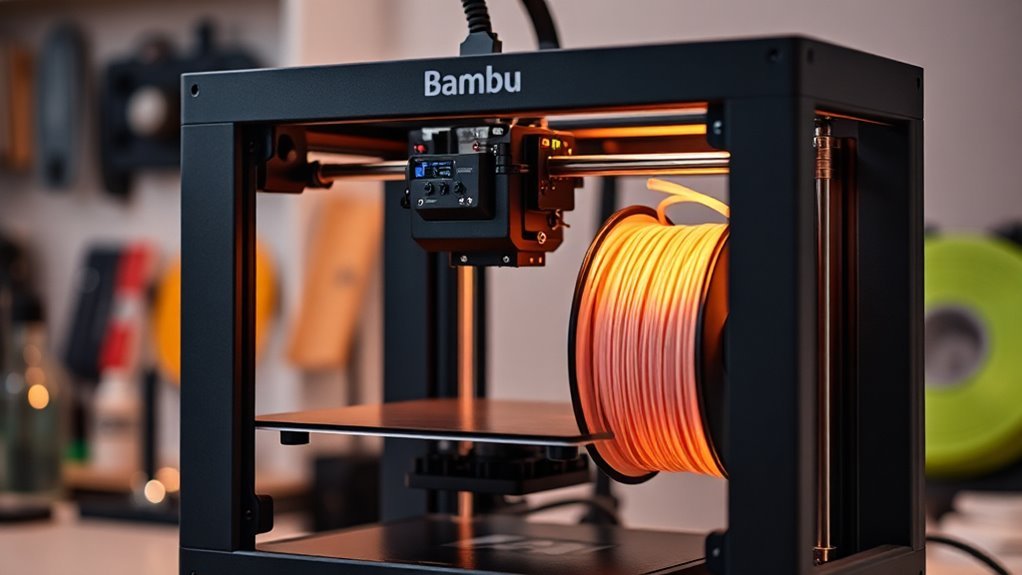
When choosing a Bambu printer for TPU, you need to focus on print speed compatibility and filament handling features to guarantee smooth prints. Consider the extruder type benefits and how precise temperature control can affect your results.
Don’t forget to check if the build volume matches the size of your projects. It’s all about making sure your printer can handle what you want to create without any hiccups.
Print Speed Compatibility
Although TPU offers flexibility and durability, its shore hardness and formulation directly impact the print speeds your Bambu printer can handle. Softer TPUs with lower shore hardness require slower feed rates and reduced acceleration to prevent filament buckling and compression.
If your printer features high maximum acceleration and travel speeds, it must also provide precise low‑force extrusion control—like closed‑loop or adaptive pressure systems—to avoid over- or under-extrusion during rapid movements. Avoid printers with long Bowden or complex filament paths, as these increase feed resistance and limit TPU speed.
Instead, choose models with short direct-drive or assisted feeding for smoother extrusion at higher rates. Remember, even high-flow TPU grades need carefully tuned retraction and slower detail moves to minimize stringing and jamming during faster prints.
Filament Handling Features
Since TPU is highly hygroscopic and sensitive to feeding issues, your Bambu printer’s filament handling features play a crucial role in print quality and reliability. Look for enclosed, climate-controlled filament paths or dry-box capabilities to store and dry TPU at the recommended ~70°C for 7–8 hours. This helps prevent moisture absorption, which can ruin your prints.
Active feeding systems with low-tension drives, feed-assist mechanisms, or external motorized feeders are great for avoiding buckling and kinks during long prints. Make sure the filament path uses short, guided PTFE tubing and supports 1.75 mm flexible filaments with consistent spool mounting and smooth rotation. These features help prevent jams and keep everything running smoothly.
Features like RFID or stored spool profiles are super handy because they automate filament-specific settings. This means less manual tuning for you, which is always a win. Lastly, filament sensors and runout detection pause prints whenever there’s a feed fault, letting you quickly address issues and keep your print going without a hitch.
Extruder Type Benefits
Handling TPU filament well sets the stage for reliable extrusion, but the extruder type you choose makes a big difference in print performance.
Direct-drive extruders are ideal because they minimize filament path length, reducing buckling and enabling higher print speeds with flexible TPU. Bowden setups, with longer PTFE paths, increase buckling risk and force you to slow down and carefully manage tension.
Look for closed-loop or servo-driven extruders—they offer fine pressure control to handle TPU’s variable compressibility and diameter. A dual-gear drive with adjustable grip pressure improves filament traction without crushing it, cutting down on slipping and under-extrusion.
Also, extruders with easy access and tool-free adjustments simplify jam clearing and tuning, letting you keep your TPU prints smooth and consistent.
Build Volume Importance
When choosing a Bambu printer for TPU filament, you’ll want to take into account the build volume carefully, as it directly impacts the size and complexity of your flexible prints. Larger build volumes, especially those over 300 × 300 × 300 mm, let you print seamless, single-piece flexible parts like wearables or large gaskets that hold up under stretch.
A taller Z-height supports multi-stage flexible assemblies or long hinges by allowing complex geometries in one go. Keep in mind, bigger build areas often mean longer print times, so make sure your printer’s enclosure and filament system can handle extended TPU runs.
Also, consistent bed adhesion is critical on larger beds to prevent warping or delamination. If you’re doing multi-material prints, confirm the workspace accommodates necessary tool changes without limiting your model size.
Temperature Control Precision
Although TPU’s flexibility offers unique printing challenges, maintaining precise temperature control is crucial for high-quality results. You need a Bambu printer with nozzle temperature control accurate to ±1–2°C to keep melt viscosity stable, avoiding stringing or weak layer adhesion.
A heated bed that holds steady temperatures within ±2–3°C guarantees the first layers stick well without warping. Look for active chamber or ambient temperature regulation to prevent uneven cooling, which can cause delamination or dimensional issues.
Fast-response thermistors and closed-loop extruder control help maintain smooth extrusion flow, especially within TPU’s typical 200–240°C range. Firmware features like gradual temperature ramps, pre-print soak, and per-tool temperature offsets let you fine-tune settings for different TPU shore hardness, minimizing thermal shock and filament sticking problems.
Filament Storage Solutions
Maintaining precise temperature control sets the stage for successful TPU printing, but what happens before your filament even reaches the nozzle plays an equally important role.
You need to store TPU spools airtight with desiccants like silica gel to keep humidity low and prevent moisture absorption. This is key because moisture leads to stringing and weak layer adhesion.
Use sealed filament boxes or dry cabinets equipped with hygrometers to maintain relative humidity below 10–20%. After exposure to air, dry your TPU filaments at about 70°C for 7–8 hours—or follow manufacturer guidelines for higher temps and longer drying—to remove moisture.
Keep spools neatly wound and secured to avoid tangles or feed jams, especially with multi-spool setups. Also, label and rotate opened spools into active use while keeping backups sealed to minimize exposure time.
That way, you’ll make sure your print quality stays consistent every time.
Frequently Asked Questions
How Do I Maintain My Bambu Printer for Long TPU Printing Sessions?
You should regularly clean the nozzle, lubricate moving parts, and check the filament path for jams.
Keep the printer’s firmware updated and monitor temperature settings to avoid overheating during long TPU printing sessions.
Doing these little things can really help your Bambu printer run smoothly for those extended TPU prints. It’s all about staying on top of maintenance so you don’t hit unexpected issues.
What Are Common Troubleshooting Tips for TPU Printing Failures?
Oh, TPU prints never fail, right? Just kidding! You should check your print speed and clean the nozzle regularly.
Also, guarantee proper bed adhesion, and don’t forget to adjust retraction settings. TPU loves slow, steady, and gentle handling for flawless prints.
Can Bambu Printers Handle Other Flexible Filaments Besides TPU?
Yes, you can print other flexible filaments like TPE or TPU blends with Bambu printers. Just make sure to adjust your print settings for each material’s flexibility and cooling needs.
This helps avoid jams or poor adhesion. It’s all about tweaking the settings to match the filament you’re using.
What Software Settings Optimize TPU Print Quality on Bambu Printers?
You’ll want to set print speed around 20-30 mm/s and use a 0.4 mm nozzle.
Also, enable retraction carefully to avoid stringing. Notably, TPU prints with 5% infill show excellent flexibility without sacrificing strength.
Are There Warranty Options Specifically for TPU Printing Components?
You won’t find warranty options specifically for TPU printing components, but Bambu Labs offers standard warranties covering hardware.
For extra protection, consider extended plans or third-party insurance tailored to your printing needs and usage. It’s always good to have a backup plan!
Conclusion
Choosing the right Bambu printer for TPU filament is like picking the perfect dance partner—you need precision, flexibility, and harmony. With the right match, your creations will flow smoothly, bending without breaking, just like TPU itself.
Trust in these top picks to guide your steps, ensuring every print moves with confidence and grace. Embrace the rhythm of innovation, and watch your ideas come alive, flexible and flawless, on every build.
When it comes to printing TPU filament, having a Bambu printer that offers excellent control and consistent quality makes all the difference. These printers are designed to handle the unique challenges of TPU, delivering prints that are strong yet flexible.
So whether you’re a hobbyist or a pro, picking the best Bambu printer for TPU filament means your projects will always turn out just right. Dive into the world of flexible 3D printing and let your creativity shine with the perfect printer by your side.