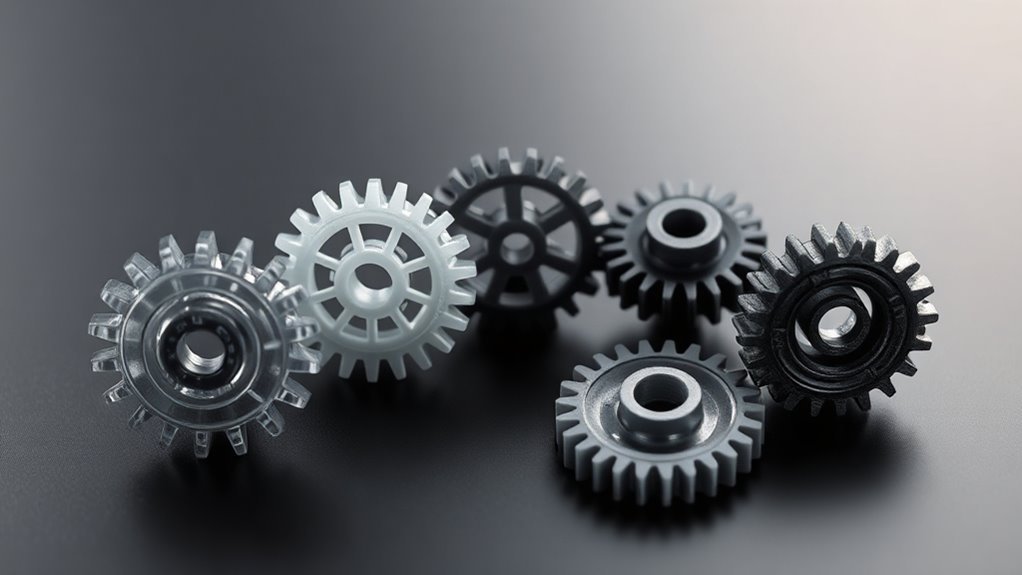
5 Best 3D Printer Materials for Gears in 2027
If you want strong, durable gears in 2027, choosing the right 3D printer materials is key. Materials like SUNLU PETG stand out for their excellent impact resistance and low warping, making them great for reliable gear performance.
Carbon fiber nylons, such as Polymaker Fiberon PA6-CF20 or SUNLU PA6-CF20, offer impressive stiffness and heat resistance up to 209°C. Just keep in mind, they require drying and hardened nozzles to print well.
ELEGOO’s Carbon Fiber PAHT is another solid option, known for its abrasion resistance.
Meanwhile, 3D-Fuel Pro PCTG delivers outstanding toughness and chemical resistance.
Always consider heat, moisture, and abrasion factors when selecting materials to ensure your gears last and perform well under stress. Exploring these options will help you find the perfect fit for your 3D printed gears.
| Image | Name | Editor's Rating | Price |
|---|---|---|---|
|
|
||

|
|
||

|
|
||

|
|
SUNLU PETG 3D Filament 1.75mm,250g*8,8 Colors-Combination
No products found.
Discover a 3D filament that delivers both toughness and precision for your printing needs. SUNLU PETG filament offers excellent layer adhesion and impact strength, making it ideal for creating durable gears and functional parts. Its ability to reduce warping ensures your prints remain sturdy and accurate.
This filament comes in eight vibrant colors on convenient 250g spools, totaling 2kg. The variety helps you easily switch colors for different projects without wasting material. Designed to minimize stringing and clogging, it provides consistent, smooth results with less maintenance.
The included spool adapter fits AMS and many 3D printers, simplifying setup and letting you focus on your work. Operating at a bed temperature of 60-70°C, this PETG filament requires a heated bed for optimal performance, which supports reliable printing and reduces failed prints.
Best for: hobbyists and professionals seeking a durable, vibrant PETG filament for impact-resistant parts with strong layer bonding.
What We Like:
- Eight vibrant colors on 250g spools for versatility
- Strong layer adhesion and high impact resistance
- Reduced stringing and clogging for easier printing
- Spool adapter compatible with AMS and many printers
Specification:
| Attribute | Details |
|---|---|
| Manufacturer | SUNLU |
| Diameter | 1.75 mm |
| Weight | 250 g per spool (8 spools total 2 kg) |
| Material | PETG |
| Color Options | Black, White, Red, Klein Blue, Green, Yellow, Sunny Orange, Lavender Purple |
Polymaker Fiberon PA6-CF20 Carbon Fiber Nylon Filament 1.75mm, Black, 0.5kg
- 20% Carbon Fiber Reinforced PA6: Fiberon PA6-CF20 combines Nylon 6 with 20% carbon fiber for high stiffness, strength, dimensional stability, and strong layer adhesion...
- Engineering Performance After Annealing: Typical TDS values include 109.3 MPa dry X-Y tensile strength and an 8.64 GPa Young’s modulus. Heat deflection temperature...
- Dry Before and During Printing: PA6 is moisture-sensitive. Dry the filament at 100°C for 10 hours before printing, then store and print below 20% relative humidity...
- Advanced Printer Setup Required: Use a 280–300°C nozzle, a 40–50°C build plate, and an all-metal hotend with the cooling fan off. A heated chamber is not required...
- Use a Wear-Resistant Nozzle: Carbon fiber is abrasive, so a hardened steel or ruby nozzle is required instead of a standard brass nozzle. For optimum heat resistance and...
Polymaker Fiberon PA6-CF20 is designed to tackle the challenges of demanding 3D printing projects. Its 20% carbon fiber reinforcement delivers exceptional strength and rigidity, making it ideal for parts that require durability and precision. This filament helps you create components that withstand mechanical stress and high temperatures, improving the reliability of your prints.
To maintain optimal performance, keep the filament dry by drying it at 100°C for 10 hours before printing. Store it in a low humidity environment to avoid moisture-related issues. The abrasive nature of carbon fibers means you should use a hardened steel or ruby nozzle and an all-metal hotend with a printing temperature between 280–300°C.
Turn off the cooling fan during printing to prevent warping and anneal your parts at 100°C for 16 hours to boost heat resistance and dimensional stability. These steps ensure your prints meet industrial standards for toughness and longevity.
Best for: Professionals and hobbyists needing high-strength, heat-resistant parts for automotive, tooling, or industrial applications.
What We Like:
- High tensile strength and heat deflection temperature after annealing
- Reinforced with 20% carbon fiber for enhanced durability
- Supports fast printing speeds with proper setup
- Requires specialized nozzles for wear resistance
Specification:
| Manufacturer | Polymaker |
|---|---|
| Material | PA6 Nylon with 20% Carbon Fiber |
| Diameter | 1.75 mm |
| Weight | 0.5 kg |
| Color | Black |
| Printing Temp | 280–300°C |
SUNLU PA6-CF20 Carbon Fiber Nylon 3D Printing Filament 1.75mm, 1KG, Black
- 【Stiff & Strong & Heat Resistant】 - SUNLU PA6-CF nylon filament 1.75mm is made of 80% PA and 20% Carbon Fibers. The carbon fiber reinforcement really provides...
- 【Good for Industrial Engineering Printing】 - SUNLU PA6 CF is very strong, durable and features an excellent heat resistance, the models printed with Carbon Fiber...
- 【Heat-Resistant】- PA6 Filament withstands up to 209°C, much higher than Easy PA, PC, ASA and other 3D printing filaments. It can be applied to parts that need to...
- 【Not Compatible with AMS】- PA6-CF is too brittle and prone to breaking inside the printer. Not recommended for use with AMS, AMS Lite, or other multi-color systems.
- 【Printing Setting】 - Nozzle: 270-290℃; Bed Temperature: 50-70℃; Speed: 50mm/s – 150mm/s; Annealing: 80℃~130℃ 5-12h (To ensure a good heat resistance of your...

Experience the power of SUNLU PA6-CF20, a carbon fiber-infused nylon filament designed to elevate your 3D printing projects. It solves the challenge of creating parts that need both strength and heat resistance, making it ideal for demanding applications. This filament enhances your prints by offering high stiffness and durability.
Combining 80% nylon with 20% carbon fiber, it withstands temperatures up to 209°C while maintaining excellent layer adhesion. This ensures your parts remain strong and reliable even under stress. The filament prints best at nozzle temperatures between 270-290°C, with a heated bed set to 50-70°C.
To achieve optimal results, dry the filament thoroughly before use to prevent moisture-related issues. Due to its abrasive nature, a hardened steel nozzle is necessary, which protects your equipment and prolongs nozzle life. Annealing can further boost its heat resistance for industrial-grade performance.
SUNLU PA6-CF20 is perfect for producing durable, high-performance gears and mechanical components in industrial and engineering settings. It provides a reliable solution when strength and heat endurance are critical.
Best for: Engineers, industrial designers, and advanced hobbyists needing a robust, heat-resistant 3D printing filament for functional parts.
What We Like:
- Reinforced stiffness and durability from 20% carbon fiber
- Heat resistant up to 209°C for high-temp applications
- Strong layer adhesion for long-lasting prints
- Requires abrasion-resistant nozzles to prevent wear
- Benefits from pre-print drying and annealing for best results
Specification:
| Feature | Details |
|---|---|
| Manufacturer | SUNLU |
| Material | 80% Nylon, 20% Carbon Fiber |
| Diameter | 1.75 mm |
| Weight | 1 kg |
| Color | Black |
| Recommended Nozzle Temp | 270-290°C |
| Heated Bed Temp | 50-70°C |
ELEGOO Carbon Fiber PAHT 3D Printer Filament 1.75mm Black 0.5KG
- Superior Heat Resistance - Withstanding ambient temperatures of up to 194 °C, the material maintains its structural strength and stability, making it suitable for use in...
- Low Water Absorption - ELEGOO PAHT-CF filament has a much lower water absorption rate than regular PA-CF for consistent performance
- Excellent Mechanical Properties - The addition of carbon fibers significantly increases the strength and stiffness of the material, and the excellent interlaminar...
- Abrasion Resistance & Dimensional Accuracy - With carbon fiber added, ELEGOO PAHT-CF 3D printer filament excels in abrasion resistance and dimensional accuracy, making it...
- Compatibility & Tips - Universally compatible with most enclosed 1.75 mm FDM 3D printers. It’s recommended to use hardened steel nozzle with a diameter of no less than...
ELEGOO Carbon Fiber PAHT filament stands out for its ability to deliver strong, heat-resistant prints ideal for demanding applications. It tackles the challenge of producing durable gears that maintain shape and function under high temperatures.
This filament withstands heat up to 194 °C, ensuring your parts retain their integrity in tough conditions. The added carbon fiber enhances stiffness and abrasion resistance, extending the lifespan of mechanical components like gears and bearings.
Designed for use with most enclosed 1.75 mm FDM printers, it requires a hardened steel nozzle to handle its abrasive nature. Printing temperatures range between 260-300 °C, so precise temperature control is important to achieve consistent results and prevent nozzle wear.
With low water absorption, this filament helps maintain dimensional accuracy and print quality over time. The 0.5 kg spool size suits projects that need precision and durability without excess material waste.
Best for: Engineers and hobbyists creating heat-resistant, high-strength parts such as gears, bearings, and structural components.
What We Like:
- High heat resistance up to 194 °C
- Carbon fiber reinforcement for enhanced strength and stiffness
- Low moisture absorption for reliable print quality
- Compatible with most enclosed 1.75 mm FDM printers
- Requires hardened steel nozzle for abrasion resistance
Specification:
| Feature | Details |
|---|---|
| Manufacturer | ELEGOO |
| Material | Carbon Fiber PAHT |
| Diameter | 1.75 mm |
| Color | Black |
| Spool Weight | 0.5 kg |
| Printing Temp | 260-300 °C |
| Max Heat Resistance | 194 °C |
3D-Fuel Pro PCTG Filament 1.75mm 1kg, Natural
- TOUGH AND STRONG: Pro PCTG is designed for your most demanding projects but prints smoothly and without fuss making it perfect for quick jobs. It's tougher and more...
- COMPATIBLE WITH ALL 3D PRINTERS with ALL METAL HOTEND: Tough Pro PCTG filament requires hot-end temperatures of 250 - 270C and a heated bed temp of 70C for the best...
- VACUUM SEALED: Each spool is vacuum packed and includes a dessicant packet to help keep your filament dry. PCTG is less moisture sensitive than PETG, but a...
- MADE IN THE USA: Our filament is made in the USA including a US sales and support team. No fillers are ever used, ensuring you are printing with the best filament.
- TEXTURE AND FINISH: Pro PCTG has a glossy finish once printed. Surface finish can be affected by printing temperature, layer height, and print speed.
3D-Fuel Pro PCTG filament delivers exceptional durability and chemical resistance, perfect for demanding 3D printing projects. Its impact toughness is 8 to 12 times greater than standard PETG, making it ideal for printing strong, reliable parts like gears and mechanical components.
This filament produces a naturally glossy finish that varies with print temperature, layer height, and speed, allowing customization to suit your design needs. It works seamlessly with all-metal hotends at 250-270°C and requires a heated bed set to 70°C for optimal adhesion and print quality.
Maintenance is straightforward thanks to vacuum-sealed packaging with desiccant, keeping the filament dry and less sensitive to moisture than typical PETG. Made in the USA by 3DomFuel, LLC, this natural-colored filament contains no fillers, ensuring consistent, high-quality results every time.
While it demands higher printing temperatures and precise settings to achieve the best finish, the trade-off is a premium, durable filament designed to withstand tough conditions without compromise.
Best for: Makers and professionals needing a tough, chemically resistant filament with a clean, glossy appearance for functional and aesthetic 3D prints.
What We Like:
- Impact toughness 8-12 times stronger than PETG
- Chemical resistant and less moisture sensitive
- Vacuum-sealed with desiccant for reliable storage
- Compatible with all-metal hotends at high temperatures
- Made in the USA with no fillers for consistent quality
Specification:
| Feature | Details |
|---|---|
| Manufacturer | 3DomFuel, LLC |
| Diameter | 1.75 mm |
| Weight | 1 kg |
| Material | PCTG |
| Color | Natural |
| Printing Temp | 250-270°C |
| Heated Bed Temp | 70°C |
Factors to Consider When Choosing 3D Printer Material for Gears
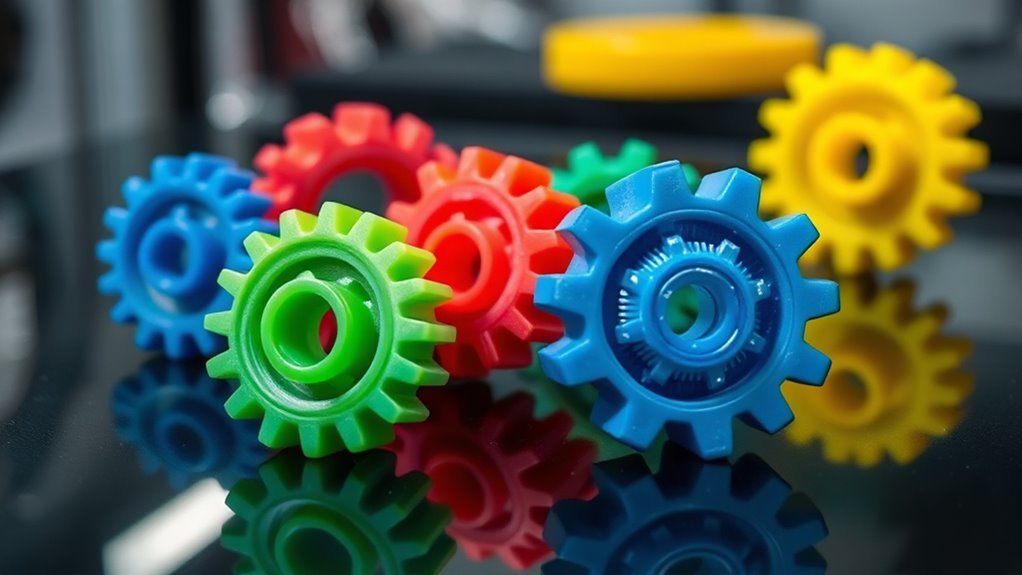
When choosing 3D printer material for gears, you need to prioritize strength and durability to handle mechanical stress. Consider heat resistance and how well the material withstands impact and abrasion during use.
Also, pay attention to moisture absorption and printing temperature requirements to guarantee reliable performance. These factors can make a big difference in how your gears hold up over time. So, it’s worth taking the time to pick the right material for the job.
Material Strength and Durability
Because gears endure constant mechanical stress, you need materials with high strength and durability to guarantee long-lasting performance. Aim for materials with tensile strength over 100 MPa to handle heavy loads without failing.
Carbon fiber reinforcement greatly boosts both tensile strength and impact resistance, making your gears tougher and more reliable. Don’t overlook layer adhesion—excellent inter-layer bonding prevents delamination, which can cause premature gear failure.
Abrasion resistance matters too, especially since friction wears down gears over time. Reinforced materials help maintain dimensional stability and extend gear life.
Heat Resistance Threshold
Although gears endure constant friction and mechanical stress, you’ll want materials that resist heat without warping or losing strength. Choosing a 3D printer material with a heat deflection temperature above 200°C is essential to maintain your gear’s structural integrity under intense thermal conditions.
Carbon fiber reinforced filaments shine here, offering enhanced heat resistance ideal for high-performance gears. Typically, a heat resistance threshold of at least 194°C guarantees your gears can handle continuous mechanical stress without deforming.
Additionally, you can boost heat tolerance through proper annealing processes, which improve durability and reliability in high-temperature environments. Prioritizing these heat resistance factors helps you select materials that keep your gears functioning smoothly and safely over time.
Impact and Abrasion Resistance
Heat resistance keeps your gears stable under thermal stress, but durability against physical forces plays an equally important role. Impact resistance is essential because your gears must withstand sudden forces without cracking or breaking.
Materials reinforced with carbon fiber greatly boost tensile strength and durability, handling demanding loads better. Abrasion resistance is just as critical, especially in high-friction environments, as it prevents wear and tear. This helps your gears maintain shape and function over time.
Choosing materials with excellent layer adhesion also reduces the risk of delamination under mechanical stress, increasing gear longevity. By selecting abrasion-resistant, high-tensile-strength materials like carbon fiber nylons, you guarantee your 3D-printed gears operate reliably and last longer. That way, your machinery stays efficient and runs smoothly.
Moisture Absorption Concerns
When selecting 3D printer materials for gears, you need to evaluate how moisture absorption can undermine their strength and durability. Materials like nylon absorb moisture readily, which can weaken the gear, cause warping, and reduce layer adhesion during printing.
To prevent these issues, store moisture-sensitive filaments in environments with less than 20% relative humidity. You should also dry filaments before printing—heating nylon at 100°C for several hours works well to restore its integrity.
Additionally, proper sealing and packaging are essential; vacuum-sealing filaments with desiccants keeps moisture out during storage and transport. By controlling moisture exposure, you guarantee your gears maintain mechanical strength and long-lasting performance, avoiding common printing defects linked to damp filaments.
Printing Temperature Requirements
Since different 3D printer materials require varying nozzle temperatures—typically between 240°C and 300°C—you’ll need to carefully adjust your printer settings to match the filament’s specifications.
For example, carbon fiber reinforced Nylon demands higher temperatures, around 270°C to 290°C, to melt properly and guarantee strong gears.
You should also consider the build plate temperature, as some heat-resistant filaments need a heated bed set between 40°C and 120°C to avoid warping.
Maintaining a stable printing environment is crucial because temperature fluctuations can cause stringing, warping, or weak layers.
Additionally, if you opt for specialized materials, you might need an all-metal hotend to safely reach higher temperatures without clogging.
Paying attention to these temperature requirements helps you produce durable, precise gears.
Layer Adhesion Quality
Although selecting the right material is important, ensuring strong layer adhesion is essential for producing durable 3D printed gears that won’t delaminate or fail under stress. You need materials like carbon fiber reinforced nylons, which bond layers tightly, boosting gear strength and reliability.
Keep in mind, nozzle temperature plays a big role; higher temps improve adhesion but can cause stringing if unchecked. Adjust printing speed and bed temperature too—slower speeds and ideal bed temps help layers fuse better.
Also, never skip drying your filament before printing. Moisture weakens layer bonds and creates weak spots in your gears. By focusing on these factors, you’ll achieve robust layer adhesion, ensuring your 3D printed gears perform well under mechanical stress and last longer.
Nozzle Compatibility Needs
Because abrasive filaments like carbon fiber reinforced nylons can quickly wear down standard brass nozzles, you’ll need a hardened steel or ruby nozzle to maintain print quality and longevity. These materials require nozzle temperatures between 270°C and 300°C for proper melting and flow, so your nozzle must handle high heat without degrading.
For less abrasive filaments like PETG or PCTG, which print between 240°C and 270°C, standard brass nozzles usually work fine. Don’t forget nozzle diameter—using at least 0.4mm helps guarantee peak extrusion and layer adhesion, especially with carbon fiber filaments.
Regularly inspect and maintain your nozzle to prevent clogs and keep your prints consistent. Matching your nozzle to your gear material is key to reliable, high-quality 3D prints.
Chemical Resistance Properties
Matching your nozzle to the gear material is just one part of ensuring lasting performance. You also need to evaluate chemical resistance, especially if your gears face oils, solvents, or harsh chemicals that can degrade standard plastics.
Nylon-based materials, particularly carbon fiber-reinforced nylon, offer superior resistance to chemical attack and maintain strength and durability in tough environments. PCTG is another solid choice, providing better chemical resistance than PETG while preserving gear integrity.
Look for materials with low moisture absorption, like specialized nylon blends, to keep your gears dimensionally stable and resistant over time. By prioritizing chemical resistance, you’ll extend gear lifespan and reliability, making your 3D-printed gears suitable for demanding industrial or mechanical applications.
Frequently Asked Questions
How Do Printing Temperatures Affect Gear Durability?
You’ll find that printing temperatures directly influence gear durability by affecting layer adhesion and material strength.
If you don’t use the right temperature, your gears might become brittle or weak, reducing their lifespan and performance.
What Post-Processing Techniques Improve Gear Performance?
To boost gear performance, you’ll want to smooth, strengthen, and seal. Sanding removes roughness, annealing enhances strength, and applying lubricants reduces friction.
These post-processing steps make your gears last longer and run smoother, no doubt. Taking these extra measures really pays off in the long run.
Can These Materials Be Recycled After Use?
Yes, you can recycle many 3D printing materials like PLA and certain nylons. But others, like ABS, need specialized facilities.
It’s always a good idea to check local guidelines first. That way, you can make sure you’re recycling properly and reducing your environmental impact effectively.
Which 3D Printers Are Best for These Filaments?
You’re the captain choosing your ship—Prusa i3 MK4 and Ultimaker S5 navigate filaments like PLA and PETG with ease.
Meanwhile, the Markforged Onyx steers through nylon and carbon fiber, ensuring your gears sail smoothly to perfection.
It’s all about picking the right vessel for your filament voyage!
How Do Environmental Conditions Impact Printed Gears?
You’ll find that temperature, humidity, and exposure to chemicals can weaken your printed gears, causing warping or brittleness.
Keeping them in stable, dry conditions helps maintain strength and performance over time, so protect them accordingly.
Conclusion
Choosing the right 3D printer material for gears might seem challenging, but it doesn’t have to be. You want durability, strength, and precision—qualities found in materials like carbon fiber nylons and PETG blends.
While some worry about cost, investing in high-quality filament saves you from frequent replacements and gear failures. So, pick a material that balances performance and budget, and you’ll enjoy smooth, long-lasting gear operation every time.
In 2027, the best 3D printer materials for gears focus on toughness and wear resistance. Materials such as carbon fiber nylon, PETG blends, and specialty polymers deliver the strength and precision your gears need. Remember, choosing the right filament not only improves durability but also enhances gear performance without breaking the bank. When selecting a 3D printer material for gears, aim for that perfect balance between cost, strength, and reliability—this ensures your gears run smoothly and last longer, making your 3D printing projects a solid success.