4 Best 3D Printers for Airsoft in 2027
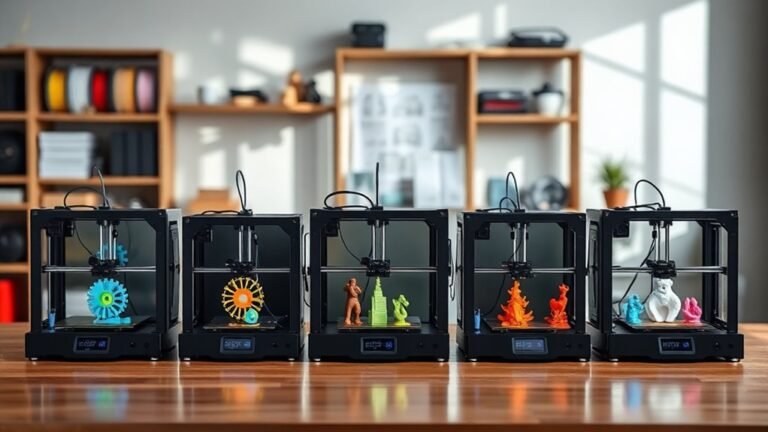
You’ll want fast, reliable 3D printers like the Bambu Lab P1S, which offers high speeds, automatic bed leveling, and multi-material support for durable airsoft parts. This printer is perfect if you’re looking to crank out quality builds without wasting time.
The Longer LK5 Pro delivers a large build volume and stability, ideal for big, precise prints. It’s great when your airsoft projects demand extra space and accuracy.
The Creality Ender 3 V3 SE suits beginners with easy setup and auto leveling, making it a solid choice if you’re just getting started. Meanwhile, the Anycubic Kobra 3 MAX handles massive multicolor projects, so it’s perfect for those who want to add flair to their airsoft gear.
Explore their features to pick the best fit for your airsoft builds. You’ll find something that matches your needs, whether it’s speed, size, or complexity.
| Image | Name | Editor's Rating | Price |
|---|---|---|---|
|
|
||

|
|
||

|
|
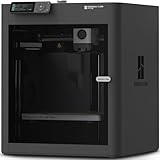
Bambu Lab P1S 3D Printer, Ready-to-Use FDM 3D Printer
- Up to 16 Colors: Bring your designs to life with vibrant multi-color/multi-material printing capabilities, perfect for showcasing your creativity. Note: Connecting Bambu...
- 500mm/s and 20000 mm/s² Acceleration True High Speed: Don't wait around for your masterpieces. Lightning-fast printing speed lets you focus on creating, not waiting.
- Enclosed Design: Fully enclosed body improves print performance for advanced filaments. Automatic Bed Leveling: Say hello to high-quality, successful prints. Auto bed...
- Set Up in 15 Minutes: Spend more time printing and less time setting up. User-friendly design ensures a hassle-free assembly experience for all skill levels.
- Supported Filament: Ideal: PLA, PETG, TPU, PVA, PET ABS, ASA; Capable : PA, PC; Not Recommended: Carbon/Glass Fiber Reinforced Polymer.
The Bambu Lab P1S 3D printer offers a seamless entry into 3D printing with its ready-to-use design and quick 15-minute setup. It solves common startup challenges, letting you focus on creating without a steep learning curve. Its compact CoreXY enclosed frame ensures fast, precise printing speeds up to 500 mm/s and accelerations reaching 20,000 mm/s², ideal for producing detailed airsoft accessories efficiently.
Maintenance is simplified thanks to automatic bed leveling, which reduces manual adjustments and keeps print quality consistent. The enclosed body supports advanced filaments like PLA, PETG, and TPU, allowing you to explore diverse materials while maintaining stable printing conditions. This versatility helps you craft durable, multi-material components with ease.
Designed for hobbyists and beginners alike, the P1S integrates smoothly with the Bambu Lab AMS for multi-color printing, expanding creative possibilities. While it handles many filament types well, it is not suited for carbon or glass fiber reinforced polymers. Its size and weight are notable, so it fits best in dedicated workspaces.
Best for: Beginners and hobbyists seeking a fast, reliable 3D printer with multi-material capability for projects like airsoft gear.
What We Like:
- Quick 15-minute setup with automatic bed leveling
- High-speed CoreXY enclosed design for precision
- Supports multiple advanced filaments and multi-color printing
- Easy maintenance with stable enclosed printing environment
Specification:
| Feature | Details |
|---|---|
| Manufacturer | Bambu Lab |
| Dimensions | 15.31 x 18.03 x 15.31 inches |
| Weight | 38.9 pounds |
| Print Technology | FDM (Fused Deposition Modeling) |
| Supported Filaments | PLA, PETG, TPU, others (excluding carbon/glass fiber reinforced polymers) |
Creality Ender 3 V3 SE Beginner-Friendly 3D Printer with Auto Leveling
- 250mm/s High-Speed Printing: Print at speeds of up to 250mm/s with 2500mm/s² acceleration, helping you complete prototypes, functional parts, and everyday projects...
- Easy Setup with Auto Leveling: Designed for a fast and straightforward setup, the Ender 3 V3 SE can be assembled in just a few simple steps. CR Touch Auto Leveling and...
- Proven Sprite Direct Drive Extruder: The upgraded Sprite Direct Drive Extruder provides smooth and consistent filament feeding for PLA, PETG, and TPU. Its proven design...
- Stable Motion System for Consistent Results: Dual synchronized Z-axis lead screws and precision Y-axis linear shafts work together to help reduce vibration and Z...
- Quiet Operation with Easy Print Removal: A 32-bit silent mainboard helps reduce operating noise for a more comfortable printing experience, while the flexible PC spring...
The Creality Ender 3 V3 SE is designed to simplify 3D printing for beginners and hobbyists. Its CR Touch auto leveling with automatic Z-offset calibration takes the guesswork out of bed leveling. This feature ensures a smooth first-layer setup, reducing print failures and saving time.
The printer’s upgraded Sprite Direct Drive Extruder improves filament feeding for materials like PLA, PETG, and TPU. This means fewer clogs and more consistent prints. Dual synchronized Z-axis screws and precision Y-axis shafts stabilize motion, minimizing vibration and wobble for better print quality.
Maintenance is straightforward, thanks to the printer’s reliable mechanical design and easy setup process. While some assembly is required, it is manageable with basic technical skills. The quiet 32-bit mainboard keeps noise low, making it suitable for home or office environments.
With a max printing speed of 250 mm/s, the Ender 3 V3 SE balances speed and precision, ideal for creating detailed prototypes and functional parts. Its compact design and simple controls make it a practical choice for everyday use.
Best for: Beginners and hobbyists seeking an easy-to-use 3D printer with reliable auto leveling and versatile material compatibility.
What We Like:
- CR Touch auto leveling with Z-offset calibration for hassle-free first layers
- Smooth filament feeding with upgraded Sprite Direct Drive Extruder
- Stable motion system reduces vibration and improves print quality
- Quiet operation with 32-bit mainboard for a distraction-free environment
Specification:
| Feature | Details |
|---|---|
| Manufacturer | Creality |
| Dimensions | Not specified |
| Weight | Not specified |
| Material Compatibility | PLA, PETG, TPU |
| Max Print Speed | 250 mm/s |
| Mainboard | Quiet 32-bit |
Longer LK5 Pro 3D Printer Large Build Volume
- 【Stable Triangular Structure & Higher Precision】3D printer uses reinforced inclined rods to form a stable triangular structure, minimizing vibration and ensuring...
- 【Larder Build Volume & Faster Printing Speed】The Longer LK5 Pro 3D printer measures about 20 x 20 x 15 inches, has a large build volume of 11.8 x 11.8x 15.7in...
- 【Advanced Extruder Technology:】Enhance print quality with our silicon carbide lattice glass platform, ensuring uniform temperature for strong adhesion and preventing...
- 【Filament Depletion Detection & Auto-Resume Printing】The LK5 Pro 3D printer, with its upgraded 32-bit mainboard, ensures improved print quality. It features sensors...
- 【Ultra-Quiet Driver & Open-Source Firmware】Experience the Longer LK5 Pro 3D printer, featuring an ultra-quiet TMC2209 driver and open-source firmware. Customize your...

The Longer LK5 Pro 3D Printer offers a large and precise build volume that meets the demands of airsoft enthusiasts and hobbyists. Its spacious 300 × 300 × 400 mm printing area allows you to create detailed, sizable parts in a single print, reducing the need for assembly and improving workflow efficiency.
Designed with a stable triangular frame and reinforced rods, this printer minimizes vibrations. This stability, combined with automatic X- and Y-axis calibration, delivers reliable accuracy up to 0.1 mm. Maintenance is straightforward thanks to a silicon carbide glass bed that provides even heating and dual fans for fast cooling, ensuring consistent print quality.
The LK5 Pro supports multiple filament types including PLA, ABS, PETG, and wood-filled materials. Features like filament runout detection and power-loss auto-resume help prevent print failures, making it easier to manage longer or complex prints without constant supervision.
Though it weighs 28.2 pounds and requires partial assembly, these factors contribute to its sturdy construction and precision. The printer’s maximum speed of 180 mm/s balances quality and efficiency, suitable for detailed airsoft gear production.
Best for: Airsoft enthusiasts and hobbyists who need a large, precise 3D printer capable of producing sizable, detailed parts with reliable performance and ease of use.
What We Like:
- Large 300 × 300 × 400 mm build volume for big, complex prints
- Stable triangular frame with reinforced rods for accuracy up to 0.1 mm
- Supports PLA, ABS, PETG, and wood-filled filaments
- Filament runout detection and power-loss auto-resume enhance print reliability
Specification:
| Feature | Details |
|---|---|
| Manufacturer | Longer |
| Build Volume | 300 × 300 × 400 mm |
| Weight | 28.2 lb (12.8 kg) |
| Frame | Triangular with reinforced rods |
| Filament Compatibility | PLA, ABS, PETG, wood-filled |
| Print Speed | Up to 180 mm/s |
Anycubic 3D Printer Kobra 3 MAX Only, Large Printing Volume
No products found.
Step into the world of large-scale 3D printing with the Anycubic Kobra 3 MAX, designed to handle projects that demand size and precision. Its massive build volume of 420 x 420 x 500 mm enables you to print life-sized models and complete setups without the hassle of assembling multiple parts.
This printer offers a unique advantage for creators wanting vibrant, multicolor designs. When paired with Anycubic ACE Pro units, it supports up to 8 colors, helping you bring detailed, complex prints to life with ease. The dual-axis core and SG15 bearings deliver smooth, stable printing at speeds reaching 600 mm/s, ensuring efficient production.
Maintenance is simplified through built-in AI print monitoring, which automatically pauses prints to prevent failures, saving you time and material. The large footprint requires thoughtful workspace planning, but its robust design supports extended use for demanding projects.
Best for: Large-scale 3D printing enthusiasts and professionals needing a jumbo build volume and multicolor capabilities for complex, vibrant, life-sized models.
What We Like:
- Massive build volume for printing large models in one go
- Supports multicolor printing with Anycubic ACE Pro units
- High-speed printing with advanced stability features
- AI-powered print monitoring to reduce errors
Specification:
| Feature | Details |
|---|---|
| Manufacturer | Anycubic |
| Build Volume | 420 x 420 x 500 mm |
| Print Speed | Up to 600 mm/s |
| Multicolor Support | Up to 8 colors (with ACE Pro) |
| Bearings | SG15 |
| Dimensions | Large footprint (requires ample space) |
Factors to Consider When Choosing a 3D Printer for Airsoft
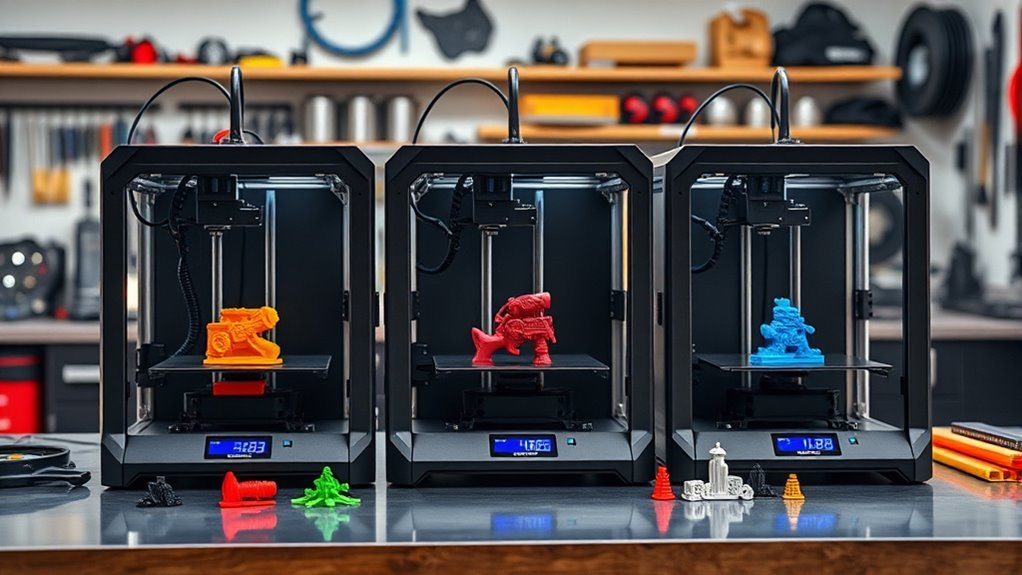
When choosing a 3D printer for airsoft, you’ll want to focus on print speed and material compatibility to get the best results. Consider the build volume to guarantee your parts fit and check the printer’s precision for detailed accuracy.
Don’t forget ease of setup, so you can start printing without hassle. It’s all about making the process smooth and efficient for you.
Print Speed Importance
Although faster print speeds can speed up your workflow, you’ll need to carefully balance speed with part quality when printing airsoft components. Printing at very high speeds, like 200–500 mm/s, cuts turnaround time but demands fine-tuned acceleration and jerk settings to avoid ringing and dimensional errors.
Insufficient cooling at these speeds weakens layer adhesion, which risks mechanical failure in stress-bearing parts. Remember, flexible filaments and engineering plastics require slower speeds to maintain extrusion consistency.
Also, faster printing calls for a rigid motion system to prevent vibration-induced layer shifts or surface defects that compromise fit. To find the sweet spot, test print at multiple speeds—say 40, 80, and 120 mm/s—to confirm your parts balance production efficiency with the strength and precision essential for airsoft use.
Material Compatibility Needs
Since airsoft parts must endure repeated stress and impact, you’ll want to choose materials that offer high strength and toughness, such as nylon, polycarbonate (PC), or ABS. These materials resist cracking and shattering, making them ideal for gear, magazine bodies, and other high-stress components.
For external shells and hop-up parts, filaments like PETG or ASA provide excellent layer adhesion and impact resistance. This reduces delamination from shocks or vibrations.
Avoid carbon- or glass-filled polymers for thin-walled, high-stress parts unless your printer and nozzle can handle abrasive filaments. Fillers may cause brittleness, so be careful with those.
For small precision parts, pick materials that balance stiffness and low creep. PC or reinforced nylons are great because they maintain tolerances over time.
Also, consider if your printer supports enclosed, high-temperature environments. This is needed for heat-resistant filaments to prevent warping and guarantee accuracy.
Build Volume Requirements
Choosing the right build volume for your 3D printer is vital because it directly affects the size and complexity of the airsoft parts you can create. First, determine the largest part you plan to print—whether that’s a full-size receiver or a magazine body—and choose a build volume with room to spare.
Typically, that means 200 × 200 × 200 mm for smaller parts or 300 × 300 × 400 mm for full-scale bodies. If you want to print multiple parts in one go for a perfect fit, make sure the XY build area can hold them all.
Don’t forget about height: your printer’s max Z must exceed tall pieces like suppressors. Keep in mind, bigger volumes mean longer prints and more filament, so balance size needs with prototype efficiency.
Also, pick a printer that lets you orient parts ideally for strength. It really helps to get the best results without wasting time or materials.
Precision And Accuracy
When you work with airsoft parts that need precise fits—like gears, hop-up units, or barrel spacers—your 3D printer must deliver at least 0.1 mm dimensional accuracy to guarantee everything mates and functions properly. To achieve this, maintain consistent layer heights of 0.2 mm or less and calibrate your extrusion multiplier carefully to control tolerances.
A rigid frame and tuned motion settings help minimize Z-wobble and X/Y backlash, preserving sharp edges and hole dimensions essential for pins and screws. Temperature control and filament choice also impact accuracy—PLA shrinks less than PETG or ABS, so adjust part scaling or slicer offsets accordingly.
Always verify precision with calibration prints and tolerance tests, then fine-tune slicer settings or perform post-print machining on critical surfaces. This way, you can be confident your parts will fit and function just right every time.
Ease Of Setup
Getting your 3D printer up and running quickly can save you valuable time and frustration, especially when you’re keen to print functional airsoft parts. Choose models with clear, tool-free assembly and setup times under 30 minutes to minimize downtime.
Automatic bed leveling or auto Z-offset calibration is essential for consistent first-layer adhesion. This helps ensure the accuracy of gear-like components.
Look for intuitive software with guided calibration wizards that simplify extrusion, temperature, and retraction settings for common filaments like PLA, PETG, and TPU. Filament auto-loading and runout detection help prevent failed prints during long or multi-part builds.
Finally, select printers backed by strong community support and preconfigured profiles. That way, you can avoid trial-and-error and get reliable mechanical fit and wear resistance right away.
Frequently Asked Questions
Can 3D Printed Airsoft Parts Withstand Outdoor Weather Conditions?
Yes, 3D printed airsoft parts can withstand outdoor weather if you use durable materials like PETG or ABS.
You’ll want to seal or coat them to protect against UV rays, moisture, and temperature changes for longer life.
This way, your parts will last much longer when you’re out playing. Just a little extra care goes a long way!
Are 3D Printed Airsoft Components Legal in All Regions?
You shouldn’t assume 3D printed airsoft components are legal everywhere; laws vary by region. Always check local regulations before using or selling them. This helps you avoid legal trouble and guarantees your parts comply with safety standards.
It’s better to be safe than sorry, right? Taking a moment to understand the rules in your area can save you a lot of hassle down the road. Just a quick check can make all the difference!
What Types of Filament Are Safest for Airsoft Applications?
You should use ABS or PETG filaments since they’re durable and heat-resistant, making them safe for airsoft parts.
Avoid brittle materials like PLA, as they can break easily and might pose safety risks during play.
Sticking to stronger filaments helps keep your gear reliable and safe. It’s just better for everyone on the field!
How Long Does It Take to Print a Typical Airsoft Accessory?
It takes mere minutes to hours—sometimes it feels like printing an airsoft accessory is as quick as a lightning bolt!
Usually, expect 1 to 4 hours depending on size, detail, and your printer’s speed settings.
Can 3D Printing Improve Airsoft Gun Customization Beyond Commercial Options?
Yes, 3D printing lets you create unique, tailor-made parts that commercial options don’t offer. You can customize grips, sights, and attachments to fit your style perfectly.
This not only enhances performance but also lets you personalize your airsoft gun like never before. It’s a game-changer for enthusiasts who want something truly their own.
Conclusion
Choosing the perfect 3D printer for your airsoft projects doesn’t have to feel like rocket science. Whether you want the precision of the Bambu Lab P1S or the massive build volume of the Longer LK5 Pro, these printers will transform your ideas into reality faster than a speeding BB.
Just remember to weigh factors like ease of use, print size, and reliability. With the right choice, you’ll be crafting airsoft gear that’s out of this world!
When picking a 3D printer for airsoft, think about what matters most to you—whether that’s detailed prints, speed, or a large build area. The best 3D printers for airsoft combine precision with durability, making sure your custom parts stand up to the action. So, take your time, compare features, and get ready to elevate your airsoft game with top-notch 3D printing gear!