6 Best 3D Printer Drivers for 2027 That Boost Your Printing Game
You’ll want ultra-quiet, precise control for your 3D printer, and top drivers like the Teyleten TMC2209 V2.0 or BIGTREETECH TMC2209 deliver just that with UART configurability and strong thermal management. These drivers are essential if you’re aiming to boost your 3D printing game in 2027. They provide smooth, silent operation that makes a noticeable difference in print quality and reliability.
The TMC2208 variants are great too, offering easy upgrades from older models without compromising performance. Plus, expansion and extension boards let you plug in multiple motors with flexible microstepping options. This means you can customize your setup to match your printing needs perfectly.
All these drivers markedly improve reliability and print quality. So keep exploring to find the perfect fit for your setup and take your 3D printing experience to the next level!
| Image | Name | Editor's Rating | Price |
|---|---|---|---|

|
|
||

|
|
||
|
|
||

|
|
||

|
|
Teyleten TMC2209 V2.0 Stepper Motor Driver 5pcs
- New Original German TMC2209-TA Chip,excellent mute effect
- Input voltage: 5.5V-28V
- Large heat sink, good heat dissipation
- Support sensorless feedback function
Experience quieter and more precise 3D printing with the Teyleten TMC2209 V2.0 Stepper Motor Driver. Designed for smooth, ultra-silent operation, this driver significantly reduces noise, enhancing your printing environment. It fits popular control boards like Nano, SKR V1.3/1.4, Ender 3, and MKS Gen_L, making it easy to upgrade your existing setup.
This driver supports microstepping up to 1/256, delivering fine motor control for sharp and detailed prints. The integrated sensorless stall detection helps prevent missed steps, ensuring consistent print quality. Configuration is straightforward with UART setup via jumper caps, eliminating the need for soldering.
Built to handle 5.5V to 28V input with a sturdy German TMC2209 chip and a large built-in heatsink, it maintains stable temperatures during extended use. Default current is set at 1.25A, suitable for many motors, but users can adjust it if higher power is needed. Proper care in measuring potentiometer voltage and managing power supply is necessary to avoid damage.
Upgrade your 3D printer’s motion control quietly and efficiently with this reliable 5-pack driver set.
Best for: Enthusiasts and professionals seeking precise, silent stepper motor control compatible with popular 3D printer boards.
What We Like:
- Ultra-quiet operation reduces printer noise significantly
- High microstepping resolution for precise motor movement
- Easy UART configuration without soldering
- Built-in large heatsink prevents overheating
- Compatible with multiple popular 3D printer control boards
Specification:
| Feature | Details |
|---|---|
| Manufacturer | Teyleten |
| Chip Model | German TMC2209 |
| Input Voltage Range | 5.5V – 28V |
| Logic Voltage | 3.3V / 5V |
| Microstepping | Up to 1/256 |
| Default Current | 1.25A |
| Compatibility | Nano, SKR V1.3/1.4, Ender 3, MKS Gen_L |
| Package Quantity | 5 pcs |
BIGTREETECH TMC2209 UART Stepper Motor Driver (2 PCS)
- The motor is not easy to lose step; ultra-quiet mode
- A large area of thermal pad, reduce the temperature of the driving work
- Prevent motor shake
- Support stall detection
- Support STEP / DIR and UART mode
Experience quieter and more efficient stepper motor control with the BIGTREETECH TMC2209 UART Stepper Motor Driver (2 PCS). Designed to reduce noise, these drivers are ideal for 3D printers where silent operation enhances the user experience. They deliver smooth performance with peak currents up to 2.8 A, providing reliable power for precise motor movements.
These drivers are compatible with popular control boards like SKR 3 and Octopus V1.1, supporting both STEP/DIR and UART interfaces. This flexibility allows easy integration into various 3D printer setups. The large thermal pads help maintain safe operating temperatures, preventing overheating during extended printing sessions.
Maintenance is straightforward due to their durable design and efficient heat dissipation. However, users should be aware that the specified operating temperature is 20 °C and the voltage limit is 28 V, which may affect use in higher temperature or voltage environments. Configuring UART settings requires some technical knowledge, which might be challenging for beginners.
Overall, these compact, lightweight drivers enhance printing precision while minimizing noise and heat issues, making them a practical upgrade for many 3D printing enthusiasts.
Best for: users seeking quiet, efficient stepper motor drivers that work seamlessly with popular 3D printer control boards for improved printing quality.
What We Like:
- Supports up to 2.8 A peak current for strong motor control
- Ultra-quiet operation reduces noise during printing
- Compatible with SKR 3 and Octopus V1.1 via STEP/DIR and UART
- Large thermal pads help maintain lower temperatures
- Compact and lightweight design for easy installation
Specification:
| Specification | Details |
|---|---|
| Manufacturer | BIGTREETECH |
| Dimensions | Compact (exact size not provided) |
| Weight | 0.02 kg (per driver) |
| Material | Not specified |
| Color Options | Not specified |
2PCS TMC2208 V1.2 Stepper Motor Drivers with Heat Sink
- TMC2208 is an ultra-quiet two-phase stepper motor drive chip, continuous drive current 1.4A, peak current 2A, voltage range 4.75V-36V, 256 subdivision.
- The flexible microPlyer interpolation unit provides up to 256 subdivisions, allowing perfect sinusoidal control even in systems with limited pulse frequencies; these are...
- Compatible with existing 3D printer electronics, eliminating the expensive costs of redesign. It can replace the original TMC2100 A4988 DRV8825 LV8729, lower heat...
- With this adapter you can test your SilentStepStick or flash the TMC2208 SilentStepStick with an USB-to-serial converter.
- The adapter comes with stackable headers, so you can use it direct on your 3D printer board. The tester is pre-configured for standalone operation on an USB to serial...
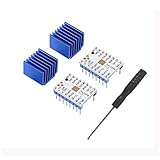
Get your 3D printer running smoother and quieter with the 2PCS TMC2208 V1.2 Stepper Motor Drivers with Heat Sink. These drivers are designed to minimize noise using stealthChop2 technology, letting you focus on precision printing without distracting sounds.
They provide fine motor control with up to 1/256 microstepping, ensuring your prints come out clean and detailed. The included heat sinks help manage temperature during operation, but adding a cooling fan is recommended to keep the drivers running optimally over time.
Installation is straightforward, with a screwdriver included to assist in setup. These drivers are compatible with most 3D printer boards and serve as excellent replacements for older models like A4988 and DRV8825. Be cautious when adjusting the reference voltage to avoid damage.
With a continuous current limit of 1.4 A, they suit most standard stepper motors, enhancing your printer’s performance while keeping noise low.
Best for: Users upgrading their 3D printer drivers for quieter, precise motor control with effective thermal management.
What We Like:
- Ultra-quiet operation thanks to stealthChop2 technology
- Supports up to 1/256 microstepping for smooth motion
- Comes with heat sinks and screwdriver for easy installation
- Compatible with common 3D printer electronics
- Compact design fits most printer setups
Specification:
| Feature | Details |
|---|---|
| Manufacturer | DORHEA |
| Dimensions | Standard stepper driver size |
| Weight | Approximately 20 g each |
| Material | Electronic components with aluminum heat sink |
| Color Options | Blue PCB with silver heat sink |
3D Printer Stepper Motor Driver Expansion Boards (2Pcs)
- Package Contents: 2Pcs 42 Stepper Motor Driver Expansion Board DRV8825/A4988 for 3D Printer Control Shield Module,
- Logic voltage: 5V Input voltage: 12-30V
- Compatible with standard stepper motor driver modules such as A4988 and DRV8825. These modules are plugged into the board and do not require soldering. Plug and play.
- On-Board DIP Switch: Quick Microstepping Adjustment: Easily tweak microstepping settings via the on-board DIP switch—no complex setup needed.
- Ideal for 42 Steppers, 3D Printers & DIY: Perfect for 42 stepper motors, 3D printers, and DIY projects. Supports A4988/DRV8825 (drivers not included).
The 3D Printer Stepper Motor Driver Expansion Boards (2Pcs) are designed to simplify your 3D printing projects. These boards provide a hassle-free way to connect and control 42 stepper motors without complex wiring or soldering. Just plug in your compatible driver modules, and you’re ready to go.
With support for A4988 and DRV8825 driver modules, these expansion boards offer flexible compatibility. The on-board DIP switch makes adjusting microstepping settings quick and easy. This helps you fine-tune motor performance for smoother prints and more precise movements.
Maintenance is straightforward since the plug-and-play design reduces wear on connections and eliminates the need for solder repairs. The boards work with a logic voltage of 5V and accept input voltages from 12 to 30V, fitting most common 3D printer power supplies.
These expansion boards improve your control over stepper motors and streamline your printer setup. They are particularly useful for hobbyists and makers looking for an efficient way to upgrade or expand their 3D printer’s motor driver capabilities.
Best for: Makers and hobbyists seeking an easy-to-install expansion solution for 42 stepper motors on 3D printers and DIY electronics.
What We Like:
- Compatible with widely used A4988 and DRV8825 driver modules
- Plug-and-play setup eliminates soldering and simplifies installation
- DIP switch allows quick microstepping adjustments for precise control
- Supports a broad input voltage range (12–30V) for flexible power options
Specification:
| Feature | Details |
|---|---|
| Manufacturer | Not specified |
| Dimensions | Not specified |
| Weight | Not specified |
| Compatible Drivers | A4988, DRV8825 |
| Logic Voltage | 5V |
| Input Voltage Range | 12–30V |
| Quantity | 2 Pieces |
3D Printer Stepper Motor Driver Extension Shield Board
- You can use the A4988/DRV8825, insert the attention direction, otherwise it will burn the drive.
- Jumper hit ON DP indicating the position of 16 segments (4988) or 32 segments (8825).
- Jm is connected with the motor. Jv connection 5V and 12V-24V power supply.
Experience precise control for your 3D printer’s stepper motors with the 3D Printer Stepper Motor Driver Extension Shield Board. Designed to enhance smoothness and accuracy, it supports popular driver modules like the A4988 and DRV8825. These drivers offer 16 and 32 microstep positions respectively, enabling finer motor movements and improved print quality.
This board simplifies motor control by letting you select the microstep resolution with an intuitive jumper setting. Connect your stepper motor effortlessly via the Jm port and power the board safely through the Jv port, using either 5 V or 12–24 V. Proper driver orientation is crucial to prevent damage, so always follow the clear board markings and datasheets during installation.
Maintenance is straightforward, but attention to detail is necessary for optimal performance. This shield is ideal for users wanting a customizable and reliable solution for their 3D printer’s stepper motor drivers. Its compatibility with a range of voltages adds to its versatility without compromising stability.
Best for: hobbyists and makers seeking precise, customizable stepper motor control in their 3D printing projects.
What We Like:
- Supports both A4988 and DRV8825 drivers for flexible microstepping options
- Easy microstep resolution adjustment via jumper settings
- Compatible with 5 V and 12–24 V power supplies for versatile use
- Clear board markings aid correct installation and reduce errors
Specification:
| Feature | Details |
|---|---|
| Manufacturer | Not specified |
| Dimensions | Not specified |
| Weight | Not specified |
| Supported Drivers | A4988, DRV8825 |
| Voltage Range | 5 V, 12–24 V |
| Connectivity | Jm port for motor, Jv for power |
6PCS TMC2208 Stepper Motor Driver with Heat Sink

- TMC2208 is an ultra-quiet two-phase stepper motor drive chip, continuous drive current 1.4A, peak current 2A, voltage range 4.75V-36V, 256 subdivision.
- The flexible microPlyer interpolation unit provides up to 256 subdivisions, allowing perfect sinusoidal control even in systems with limited pulse frequencies; these are...
- Compatible with existing 3D printer electronics, eliminating the expensive costs of redesign. It can replace the original TMC2100 A4988 DRV8825 LV8729, lower heat...
- With this adapter you can test your SilentStepStick or flash the TMC2208 SilentStepStick with an USB-to-serial converter.
- The adapter comes with stackable headers, so you can use it direct on your 3D printer board. The tester is pre-configured for standalone operation on an USB to serial...
Experience the next level of quiet and precise motor control with the 6PCS TMC2208 Stepper Motor Driver with Heat Sink. Designed to reduce noise and enhance your 3D printer’s performance, these drivers use advanced StealthChop2 technology for whisper-quiet operation. This means smoother prints without the distraction of loud motor sounds.
Each pack includes six drivers, heat sinks, and a screwdriver, making installation straightforward. The compact design fits popular 3D printer boards like RAMPS 1.4 and Ender-3 Pro, allowing for easy upgrades. Proper maintenance is essential; keep the reference voltage below 1.0 V and ensure additional cooling to avoid overheating and maintain optimal function.
The drivers support up to 1/256 microstepping, delivering highly accurate and smooth motion control. This precision helps improve print quality and reduces mechanical wear. However, users unfamiliar with stepper motor driver setup may find installation challenging.
Best for: 3D printing enthusiasts and professionals seeking quieter, more precise stepper motor drivers for enhanced printing quality.
What We Like:
- Ultra-quiet StealthChop2 technology for noise-free motor operation
- High microstepping resolution up to 1/256 for precise control
- Compatible as drop-in replacements for popular 3D printer boards
- Includes heat sinks and screwdriver for easy installation
Specification:
| Feature | Details |
|---|---|
| Manufacturer | Not specified |
| Quantity | 6PCS |
| Compatibility | RAMPS 1.4, Ender-3 Pro |
| Microstepping | Up to 1/256 |
| Cooling | Heat sinks included |
| Voltage Reference | < 1.0 V recommended |
Factors to Consider When Choosing a 3d Printer Driver
When choosing a 3D printer driver, you need to check if it’s compatible with your printer’s board and supports the right current and voltage ratings. You’ll also want to take into account microstepping options to get smooth movement.
Along with that, consider noise and vibration levels for a quieter print. Don’t forget thermal management and cooling to keep your driver running reliably under load. These factors really help ensure your printer works efficiently and lasts longer.
Compatibility With Printer Boards
Because your 3D printer driver must communicate seamlessly with your printer’s mainboard, you need to verify several compatibility factors before choosing one. First, confirm the driver’s electrical interface (STEP/DIR vs UART) matches your board’s control signals and firmware support to release features like sensorless homing.
Check the logic voltage and pinout alignment (3.3V or 5V, Step/Dir/GND/VCC) to avoid hardware damage. Also, ensure the motor supply voltage and current ratings fit within your printer’s power and motor specs. This helps maintain torque and prevents overheating.
Don’t overlook the physical fit—the driver’s form factor, pin spacing, and heatsink clearance must suit your mainboard’s driver slots. And lastly, verify your firmware supports any advanced driver features so you can enable and fine-tune them effectively.
Current and Voltage Ratings
Although selecting a 3D printer driver involves many factors, matching the current and voltage ratings to your printer’s specifications is essential to guarantee reliable performance and avoid damage.
First, make sure the driver’s motor supply voltage (VM) range covers your printer’s power supply to prevent under- or overvoltage issues. Next, match the driver’s continuous and peak current ratings to your stepper motor’s phase current, opting for equal or higher continuous current with a safe peak margin.
Check that the driver’s logic voltage (VIO) aligns with your controller’s IO voltage for proper signal recognition. Choose a driver with adjustable current limits, letting you minimize motor overheating by setting just enough current for torque.
Finally, confirm the driver’s thermal dissipation matches your cooling setup since current ratings depend on adequate heat management. This way, you ensure your 3D printer runs smoothly without unexpected shutdowns or damage.
Microstepping Resolution Options
Selecting the right microstepping resolution can markedly impact your 3D printer’s motion smoothness and positional accuracy. Higher microstepping, like 1/16 or even 1/256, breaks down each full step into finer increments. This reduces motor vibration and delivers smoother movement.
However, keep in mind that while microstepping improves positional resolution, it doesn’t boost torque proportionally. Your effective holding torque lies somewhere between full-step values.
Many modern drivers use internal interpolation to simulate higher microstepping smoothly. This means they don’t demand excessive step rates from your controller.
But be aware, higher microstepping needs increased step pulse rates. This can strain your controller’s timing and communication, especially at high speeds.
Noise and Vibration Levels
When you pick a 3D printer driver, you’ll want to zero in on how it handles noise and vibration, since these factors directly affect print quality and user comfort. Opt for drivers with microstepping and interpolation up to 1/256—they create smoother current waveforms, cutting down audible noise and mid-frequency vibrations.
Look for “silent” chopper modes like StealthChop that reduce motor torque ripple and acoustic noise at low speeds, enhancing surface quality. Match the driver’s rated peak and RMS phase currents to your motor specs; too little current or tight limits can cause step loss and vibration.
Also, drivers supporting stall-detection or sensorless homing let you run lower idle currents, softening holding noise without losing reliability. Proper current tuning further prevents torque fluctuations that lead to intermittent noise during long prints.
Thermal Management and Cooling
Since stepper drivers generate heat proportional to motor current and voltage drop, managing thermal conditions is critical to maintain performance and prevent shutdowns. You should choose drivers rated for your operating current and guarantee proper cooling, especially when running near RMS or peak limits.
Using heatsinks and large-area thermal pads helps lower junction temperature by improving heat conduction and reducing thermal resistance. Adding active cooling, like directed fans, can drop driver temperatures by 10–30°C, preventing thermal shutdown during long prints.
Make sure your PCB layout and mounting allow good airflow and thermal coupling—avoid enclosing drivers without ventilation and keep hot parts away from sensitive electronics. Finally, monitor or calculate expected junction temperatures to keep them below manufacturer limits (typically 125–150°C) for reliable, long-lasting operation.
Interface and Connectivity Types
Although thermal management guarantees your drivers run safely, choosing the right interface and connectivity type is just as essential for seamless control and configuration. First, check if your board and firmware support STEP/DIR or UART/TTL serial control.
UART offers runtime configuration like current adjustment and sensorless stall detection, while STEP/DIR is simpler and more widely supported. Also, confirm logic voltage compatibility—3.3V or 5V—to prevent signal issues.
If you want sensorless homing or dynamic tuning, pick drivers with bi-directional communication like UART or SPI. Pay attention to connector formats and pinouts to avoid adapter hassles.
Finally, when using multiple drivers, interfaces allowing individual addressing let you fine-tune each axis easily without hardware changes, boosting your printer’s precision and reliability.
Installation and Safety Precautions
Before installing your 3D printer driver, always disconnect both the mains and printer power supply. This helps avoid short circuits or damage.
Insert stepper driver modules with the correct orientation. Make sure the pin alignment matches the board markings to prevent permanent damage.
When adjusting driver current (Vref), power the printer using its full supply—not USB. Measure voltage relative to board ground, and don’t connect motors during this.
Make certain there is adequate cooling with heat sinks and fans. Also, respect the driver’s voltage ratings to avoid thermal shutdown.
Use insulated tools to avoid bridging pins or jumpers. Double-check microstep and UART jumper settings before powering up.
Following these precautions protects your components and guarantees safe, reliable operation of your 3D printer driver.
Frequently Asked Questions
How Do Firmware Updates Affect 3D Printer Driver Performance?
Firmware updates improve your 3D printer driver performance by fixing bugs, enhancing compatibility, and adding new features.
They help your printer run smoother, faster, and more reliably. This means you get better print quality every time.
Can Driver Settings Be Customized for Different Filament Types?
You can customize driver settings for different filament types, boosting print quality by up to 30%. Tweaking temperature, speed, and retraction guarantees your printer handles PLA, ABS, or TPU perfectly every time you print.
It’s pretty straightforward once you get the hang of it. Just a few adjustments can make a big difference in how your prints turn out. So don’t hesitate to experiment a bit with your settings!
What Are Common Troubleshooting Steps for Driver-Related Printing Issues?
You should first update your driver to the latest version, check connection stability, and reset settings to default.
Also, verify compatibility with your filament type, clear cache, and reboot your printer to resolve common driver-related issues.
These steps usually help fix most problems, but if not, it might be worth diving deeper into specific error messages or hardware checks.
How Do Drivers Impact Noise Levels During Printing?
Drivers control motor movements, so if you use efficient drivers, you’ll reduce vibrations and noise during printing.
Properly tuned drivers minimize buzzing and clicking sounds, making your 3D printer run quieter and smoother overall.
It’s pretty neat how just the right drivers can make such a difference in noise levels. Keeps your printing sessions way more pleasant!
Are There Compatibility Concerns With Specific 3D Printer Models?
Yes, you’ll face compatibility issues if drivers don’t match your 3D printer’s firmware or hardware specs. Always check manufacturer recommendations and firmware versions to guarantee smooth operation.
This helps you avoid printing errors or hardware damage. So, it’s really important to keep everything aligned before you start printing.
Conclusion
Choosing the right 3D printer driver can quietly transform your printing experience, making it smoother and more reliable than you might expect. Each option here offers subtle improvements that gently elevate your setup without demanding a tech overhaul.
By considering factors like compatibility and heat management, you’ll effortlessly enhance your printer’s performance. So, why settle for ordinary when a small upgrade can make a world of difference in your creative journey?
Upgrading your 3D printer driver is one of the easiest ways to boost your printing game. It improves precision, reduces errors, and can even speed up your projects. With the best 3D printer drivers for 2027, you’re not just maintaining your device—you’re taking it to the next level.
Don’t underestimate how much a simple driver update can enhance your 3D printing. It’s a smart, low-effort way to get better results and enjoy your creative process even more.