2 Best 3D Printer Filaments for Plant Pots in 2027
For durable, eco-friendly plant pots in 2027, you’ll want to check out SUNLU PLA and Creality PLA filaments. These filaments are perfect for 3D printing plant pots that last, thanks to their tight ±0.02 mm diameter tolerance and well-wound spools. This means fewer jams and smoother prints every time.
SUNLU PLA offers reliable adhesion with a nozzle temperature range of 200–230°C, making it easy to work with. On the other hand, Creality’s plant-based PLA is made from renewable starch, giving you strong and long-lasting pots that are also environmentally friendly. They strike a great balance between strength, print quality, and sustainability.
Keep exploring these options to see why SUNLU and Creality filaments stand out for your plant pot projects in 2027. You’ll love how they combine performance with eco-conscious benefits!
| Image | Name | Editor's Rating | Price |
|---|---|---|---|

|
|
||

|
|
SUNLU PLA 3D Printer Filament, Black, 1KG
- ①【SUNLU PLA 3D Printer Filament】PLA material is the perfect choice for 3D printing enthusiasts! SUNLU PLA filament is reliable, versatile, and easy to use. No...
- ②【Neatly Wound 3D Filament Spool】SUNLU's self-developed neat winding device ensures that the filament is easy to use, with a 100% neat rate that reduces the risk of...
- ③【PLA Filament 1.75 mm】SUNLU 3D printer filament dimensional Accuracy +/- 0.02mm. SUNLU filament has wide compatibility due to the small diameter error, making it...
- ④【Filament Spool Diameter】Spool Diameter: 8.00", Spool Width: 2.50", Spool Hub Hole Diameter: 2.20". The size of the SUNLU filament spool is suitable for hanging on...
- ⑤【PLA Recommend Settings】To achieve the best printing results with SUNLU PLA filament, we recommend printing at a nozzle temperature of 200-230°C, a bed...
Achieve smooth and consistent 3D prints with the SUNLU PLA 3D Printer Filament in black. Designed to deliver precise results, this filament maintains a tight diameter tolerance of +/- 0.02 mm, which prevents common printing issues like clogging and uneven layers. Its reliable consistency helps you produce durable and visually appealing plant pots or other creative projects.
The filament comes on a neatly wound 1 kg spool, reducing the chance of tangles or jams during printing. This makes the printing process more efficient and less frustrating. SUNLU PLA performs best within a nozzle temperature range of 200–230°C and a heated bed temperature of 50–65°C, ensuring excellent layer adhesion and minimal warping.
Its broad compatibility with most 1.75 mm FDM 3D printers means you can start your printing projects quickly without compatibility concerns. While PLA material offers ease of use and good print quality, it may not be suitable for applications requiring high heat or exceptional strength.
Best for: Makers and hobbyists looking for a dependable PLA filament to produce high-quality, smooth 3D prints with minimal maintenance.
What We Like:
- Tight filament diameter tolerance (+/- 0.02 mm) for consistent results
- Well-wound spool minimizes tangles and printing interruptions
- Compatible with most 1.75 mm FDM 3D printers for versatile use
Specification:
| Feature | Details |
|---|---|
| Manufacturer | SUNLU |
| Material | PLA |
| Color | Black |
| Diameter | 1.75 mm |
| Diameter Tolerance | +/- 0.02 mm |
| Spool Weight | 1 kg |
Creality PLA 3D Printer Filament, Black & White, 2-Pack, 2KG Total
- Cost-Effective Filament Bundle: Get 2 "1kg" spools of PLA filament for the price of 1 with classic black and white color
- Smooth and Stable Printing: Patented design and manufacturing process ensures smooth, clog-free printing
- Durable and Strong: Improved toughness and strength for printing functional parts
- Compatible with Most Printers: Works with 99% of FDM and FFF 3D printers with heated beds
- Renewable Material: Made from starch derived from renewable plant resources for environmental friendliness
Creality PLA 3D Printer Filament offers a dependable solution for those seeking smooth, consistent printing with eco-conscious materials. Its plant-based composition helps reduce environmental impact while delivering strong, reliable results for everyday and advanced projects.
This filament’s precise diameter tolerance of ±0.02 mm minimizes clogs and printing errors, ensuring stable extrusion throughout your prints. Designed for use with 99% of FDM/FFF printers that have heated beds, it enhances toughness for durable, functional parts like custom plant pots and prototypes.
Maintenance is straightforward thanks to the neatly wound spools that reduce tangling and ease filament feeding. The black and white color options provide versatility for monochrome designs or dual-color projects, though users should note it requires a heated bed for best performance.
Creality PLA is ideal for hobbyists and professionals looking for an eco-friendly filament that balances quality and ease of use. Its renewable starch base adds a sustainable edge without sacrificing print reliability or strength.
Best for: Makers and designers needing reliable, plant-based PLA filament for everyday FDM/FFF 3D printing projects.
What We Like:
- Eco-friendly, renewable plant-based material
- Tight diameter tolerance (±0.02 mm) for consistent prints
- Compatible with most heated-bed FDM/FFF printers
- Neatly wound spools for smooth filament feeding
- Durable prints suitable for functional items
Specification:
| Feature | Details |
|---|---|
| Manufacturer | Creality |
| Material | Plant-based PLA |
| Color Options | Black and White |
| Filament Diameter | 1.75 mm |
| Tolerance | ±0.02 mm |
| Weight | 2 kg (2-pack total) |
| Compatible Printers | 99% of FDM/FFF with heated beds |
Factors to Consider When Choosing 3d Printer Filament for Plant Pots
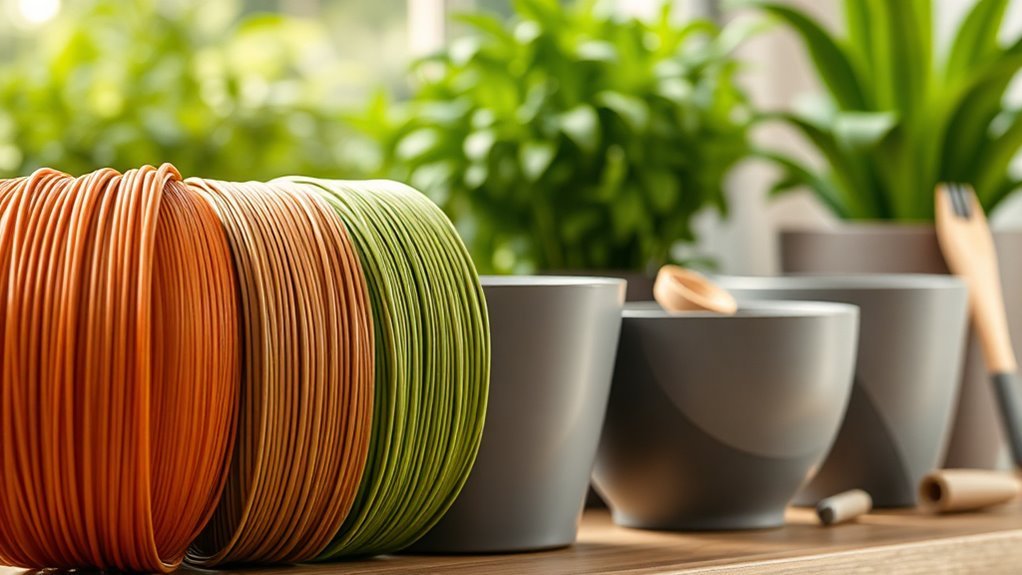
When choosing filament for your plant pots, you’ll want to focus on material durability and strength to guarantee they last. Consider the environmental impact and how easily the filament prints with consistent quality.
Also, check the temperature compatibility and how simple the filament is to handle during printing. These factors make a big difference in the final result and the overall experience.
Material Durability and Strength
Since plant pots must endure regular handling, outdoor conditions, and the weight of soil and plants, you’ll want a filament that offers high tensile strength and impact resistance—ideally above 40 MPa—to prevent cracking or breaking.
Choose materials with good UV and moisture resistance or plan to apply a protective coating, as exposure and watering can degrade plastics over time.
Also, consider stiffness: filaments with a higher Young’s modulus better maintain shape under heavy soil and growing plants. Low creep resistance is essential, too, so your pot’s rims and thin walls won’t sag under constant load.
Finally, make sure strong layer adhesion by printing within optimal temperature ranges to reduce delamination, especially for thick, water-loaded walls.
These factors combined will give your plant pots lasting durability and strength.
Environmental Impact Considerations
Although durability and strength are essential, you should also weigh the environmental impact of your filament choice for plant pots. PLA, a common bio-based option, is compostable but only under industrial conditions—not in home composts or landfills.
Its carbon footprint depends on feedstock and processing. While corn-based PLA can reduce fossil CO2, agricultural emissions may offset these gains.
Consider end-of-life options: recycling and industrial composting minimize harm, unlike landfill or incineration, which release microplastics or CO2. Additives and colorants may hinder compostability and recycling, so choose filaments without metal fillers or harmful dyes.
Also, balance longevity with disposability—a thicker, durable pot reduces environmental impact over time compared to thin, short-lived prints you replace frequently.
Print Quality and Consistency
Making sure print quality and consistency plays a pivotal role in creating durable, watertight plant pots with your 3D printer. You’ll want filaments with tight diameter tolerance (±0.02 mm or better) to make certain uniform wall thickness and steady extrusion.
Choose materials that bond well between layers and resist warping, so your pot stays strong even with moist soil inside. Consistent filament winding reduces tangles and extrusion interruptions that cause surface defects.
Stick to recommended nozzle temperatures and print speeds—around 200–230°C and 50–100 mm/s for PLA—to get smooth surfaces and accurate dimensions. Finally, monitor flow rate, retraction, and layer height to avoid under- or over-extrusion, preventing weak spots or rough finishes that compromise your pot’s quality and durability.
Temperature Compatibility Range
When selecting filament for plant pots, you’ll want to pay close attention to its temperature compatibility range to prevent warping and deformation. Choose filament with a glass softening temperature (Tg) well above the highest ambient and sunlight-exposed temperatures, ideally over 60–70°C.
Also, consider the heat deflection temperature (HDT), which indicates how well the material maintains its shape under load. For outdoor use, pick filaments with a wide safe printing range and nozzle temperatures comfortably below their degradation point to guarantee strong layer bonding.
If your pot will hold warm soil or sit on heated surfaces, check the continuous-use temperature and creep resistance to avoid slow deformation. And if you plan to anneal your prints, factor in dimensional changes to keep thermal tolerance and fit intact.
Ease of Use and Handling
Because printing plant pots often involves long, intricate prints with curved walls, you’ll want filament that feeds smoothly and consistently. Choose filaments with tight diameter tolerances (±0.02 mm or better) to minimize jams and guarantee even extrusion.
Look for smooth, neatly wound spools and materials with low brittleness to prevent tangles or breaks during hours-long jobs. Filaments that print reliably at moderate nozzle temperatures (190–230°C) simplify setup and reduce first-layer failures.
Prioritize those with good layer adhesion and low clogging or air-bubble risks to enhance pot strength and watertightness. Also, consider moisture sensitivity—pick filaments that stay stable or dry easily, because moisture-induced brittleness or bubbles can ruin your pot’s surface and cause print errors.
Frequently Asked Questions
Can I Recycle 3D Printed Plant Pots?
Yes, you can recycle 3D printed plant pots if the filament material is recyclable, like PLA or PETG. Just check local recycling guidelines, clean the pots well, and avoid mixing different materials to guarantee proper recycling.
It’s pretty straightforward once you know what materials you’re dealing with. Just keep things separate and clean, and you’re good to go!
How Long Do 3D Printed Plant Pots Typically Last Outdoors?
3D printed plant pots typically last 1 to 3 years outdoors, depending on filament type and weather exposure. You’ll want to choose UV-resistant materials and provide some shelter to extend their lifespan effectively.
It really helps to pick the right materials. Plus, giving your pots a bit of cover from harsh weather can make a big difference.
Are 3D Printed Plant Pots Safe for Edible Plants?
You might worry about chemicals leaching, but you can use food-safe filaments like PLA or PETG. These are non-toxic and safe for edible plants.
Can I Paint or Customize 3D Printed Plant Pots?
Yes, you can paint and customize 3D printed plant pots. Just make sure to use non-toxic, waterproof paints and sealants so they’re safe for plants and durable outdoors.
It’s a great way to add a personal touch. Let your creativity shine on your pots!
What Is the Environmental Impact of 3D Printing Plant Pots?
You’re gently adding to the planet’s story, as 3D printing plant pots uses less waste and energy than traditional methods.
Still, it’s smart to choose eco-friendly filaments to keep your impact light and positive.
Conclusion
When it comes to choosing 3D printer filament for plant pots, remember that “a stitch in time saves nine.” Picking durable, eco-friendly materials like SUNLU or Creality PLA guarantees your pots last and look great.
You’ll want consistent print quality and easy handling to make your 3D printing experience smooth. These factors help ensure your projects turn out just right without any hassle.
By considering durability, eco-friendliness, and ease of use, you’re setting yourself up for success. Choosing the best 3D printer filament for plant pots means your creations will be both beautiful and functional. In 2027, SUNLU and Creality PLA remain top picks because they combine strength, sustainability, and reliable print performance. So, go ahead and pick these filaments to make plant pots that stand the test of time and bring life to your space with style and durability!