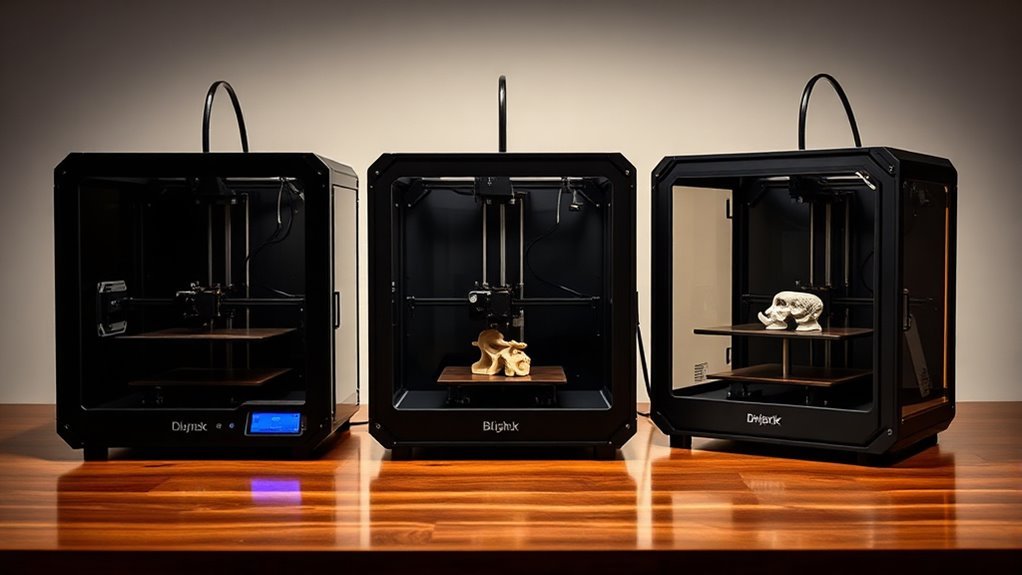
3 Best 3D Printers With 400x400x400 Build Volume for 2027
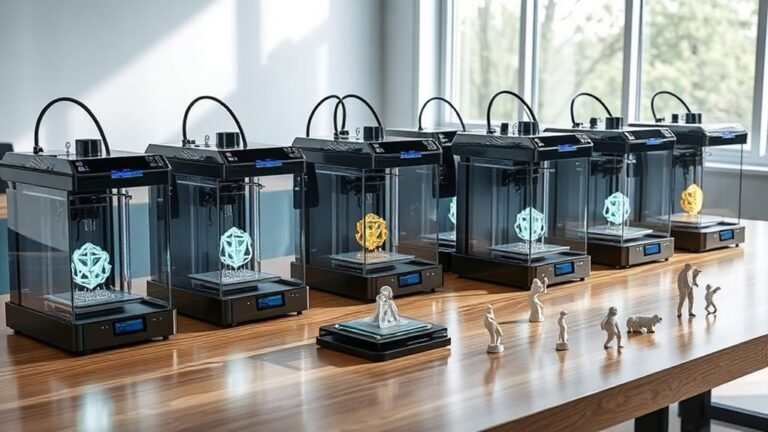
If you’re on the hunt for a 3D printer with a 400×400×400 mm build volume, you’re in luck! This size is perfect for tackling big projects without constantly worrying about running out of space.
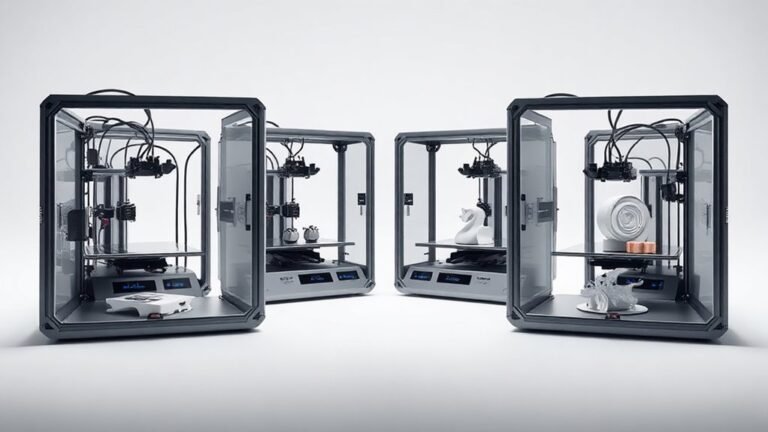
Two standout options are the Creality Ender 5 Max and the Snapmaker Artisan.
The Ender 5 Max boasts a rigid frame that helps keep your prints stable and consistent. Meanwhile, the Snapmaker Artisan offers dual extrusion, which is fantastic if you want to experiment with multi-material or multi-color prints.
Both printers come with strong thermal control and automated bed leveling, which means fewer headaches and better results.
Plus, their sturdy all-metal builds help reduce warping and layer shifts, especially important when working on large prints like these. They strike a great balance between print speed, material compatibility, and overall stability. Keep exploring to find out which one aligns with your specific needs!
Creality Ender 5 Max 3D Printer Large Volume
The Creality Ender 5 Max is designed to handle large-scale 3D printing with ease. Its massive 400 × 400 × 400 mm build volume lets you create oversized prototypes or multiple parts in one go, saving time and avoiding the hassle of splitting models. This printer is ideal for users who need to produce big or batch prints efficiently.
Its sturdy all-metal frame and precision linear rails ensure stable, accurate printing even when running at speeds up to 700 mm/s. The direct-drive dual-gear extruder improves filament feeding, while the 1000W rapid-heating bed cuts down waiting time, helping you maintain a smooth workflow.
Maintenance is simplified with automated 64-point bed leveling, reducing the need for manual adjustments. WLAN connectivity lets you monitor and control multiple printers remotely, making it easier to manage print farms or busy studios.
While its size and weight may limit portability, and the advanced features come at a higher price, the Ender 5 Max delivers reliability and precision for demanding projects.
Best for: Designers, studios, and businesses requiring large-volume, high-speed, and dependable 3D printing for oversized or batch production.
What We Like:
- Large 400 × 400 × 400 mm build area supports big or multiple prints without segmentation
- High-speed CoreXY system with precision rails ensures accurate, stable printing
- Automated bed leveling simplifies setup and improves print consistency
- Remote WLAN control allows easy management of multiple printers
- Robust all-metal frame offers durability and reduced vibrations
Specification:
| Feature | Details |
|---|---|
| Manufacturer | Creality |
| Build Volume | 400 × 400 × 400 mm |
| Print Speed | Up to 700 mm/s |
| Frame Material | All-metal |
| Weight | 70.4 lb (32 kg) |
| Bed Heating Power | 1000W |
| Bed Leveling | Automated 64-point leveling |
| Connectivity | WLAN |
Creality Ender-5 Max 3D Printer, Large Volume
The Creality Ender-5 Max 3D Printer offers a practical solution for users needing to produce large or multiple parts simultaneously. Its 400 × 400 × 400 mm build volume allows you to tackle bigger projects without the hassle of multiple print jobs. This spacious printing area enhances productivity for both professionals and enthusiasts.
Designed with a robust all-metal frame, the printer ensures stability during long print runs. Dual Z-axis motors and a linear rail on the X-axis deliver accurate and consistent results. These features reduce print errors and improve overall quality, helping you complete projects with confidence.
Maintenance is straightforward thanks to the 64-point automatic bed leveling system, which simplifies setup and calibration. The machine supports continuous 24/7 operation with minimal upkeep, making it suitable for demanding workflows. Powered by 42-76 stepper motors, it achieves speeds up to 700 mm/s, balancing efficiency with precision.
While the printer is solidly built, its weight and size may limit portability and workspace options. Some users have noted mixed satisfaction, but the Ender-5 Max stands out for its durability and capacity.
Best for: Professionals and hobbyists who require large-volume 3D printing with high durability and precision for both oversized objects and batch production.
What We Like:
- Large build volume supports extensive and batch printing.
- Sturdy all-metal frame with dual Z-axis motors ensures precision.
- 64-point automatic bed leveling simplifies setup.
- Designed for reliable 24/7 operation with low maintenance.
Specification:
| Feature | Details |
|---|---|
| Manufacturer | Creality |
| Build Volume | 400 × 400 × 400 mm |
| Weight | 57.1 lb (25.9 kg) |
| Frame Material | All-metal |
| Motor Type | 42-76 stepper motors |
| Bed Leveling | 64-point automatic |
Snapmaker Artisan Dual Extrusion 3D Printer
Experience the freedom to create large, detailed 3D prints with the Snapmaker Artisan Dual Extrusion 3D Printer. Its expansive 400 x 400 x 400 mm build volume solves the challenge of scaling up projects without compromising precision. The robust all-metal frame with steel guiderails and a die-cast base plate ensures stability during fast, high-accuracy printing.
Designed for professionals and makers, this printer’s dual-extrusion module allows you to print complex parts with multiple materials or colors in one go. This versatility supports over 600 filaments, including popular types like PLA, ABS, and TPU, helping you meet diverse project requirements. The modular quick-swap design simplifies maintenance and upgrades, reducing downtime.
Ease of use is enhanced by a responsive 7″ touchscreen, making control intuitive and efficient. While the printer’s nearly 80-pound weight limits portability, it adds to the machine’s solid build quality and precision. Ideal for those seeking reliable performance in demanding, professional-grade 3D printing tasks.
Best for: Creators and small businesses needing a large build volume and industrial-grade dual-extrusion 3D printing for intricate and professional projects.
What We Like:
- Large build volume for ambitious, detailed prints
- Durable all-metal frame with steel guiderails ensures stability
- Supports over 600 filament types including flexible and standard materials
- Quick-swap modular design for easy maintenance and upgrades
- Intuitive 7″ touchscreen enhances user control
Specification:
| Feature | Details |
|---|---|
| Manufacturer | Snapmaker |
| Build Volume | 400 x 400 x 400 mm |
| Weight | Nearly 80 lb (approx. 36 kg) |
| Frame Material | All-metal with steel guiderails |
| Touchscreen | 7-inch color touchscreen |
| Supported Filaments | 600+ types including PLA, ABS, TPU |
Factors to Consider When Choosing a 3D Printer 400x400x400
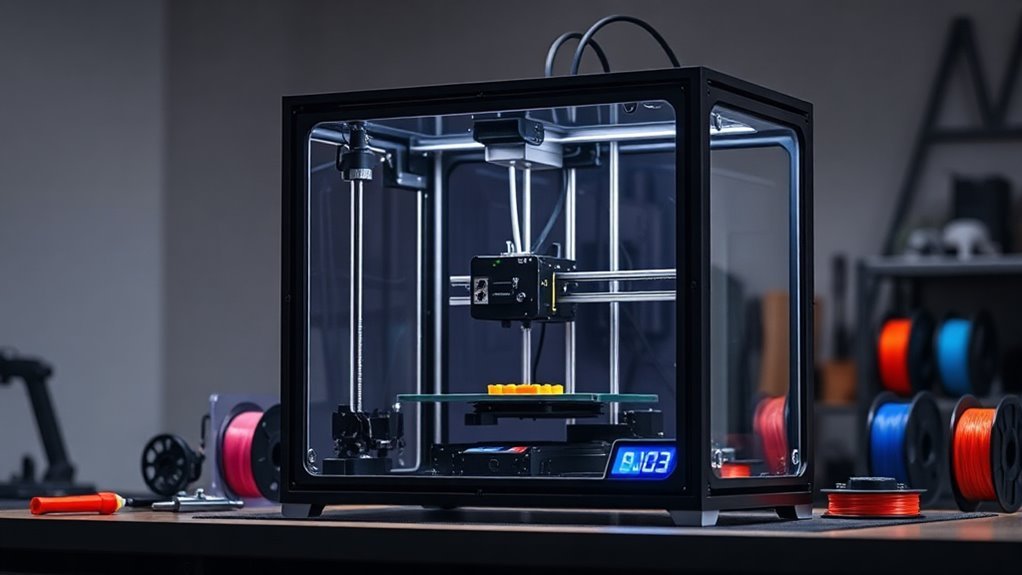
When choosing a 3D printer with a 400x400x400 build volume, you’ll want to ponder several key factors to get the best results. Think about print speed, frame stability, and the type of extruder that suits your projects.
Also, check what materials the printer supports to make certain it matches your needs. It’s all about finding the right balance for what you want to create.
Build Volume Importance
Although a 400×400×400 mm build volume opens up possibilities for printing large single-piece objects or multiple parts at once, you need to weigh several factors before choosing such a 3D printer.
Large prints can take longer and face challenges like warping and poor layer adhesion due to thermal gradients, so reliable bed heating and enclosure control are essential.
You’ll also want a stiff frame and robust motion system to keep dimensional accuracy and avoid layer shifts over wide spans and tall heights.
Preparing and leveling the entire 400×400 mm bed surface carefully is vital for consistent first layers, especially when batch printing.
Additionally, material choices and extrusion capacity matter more since high flow rates and long print times affect surface quality and mechanical strength.
Print Speed Capabilities
Handling a large 400×400×400 mm build volume means print speed becomes a key factor to balance. While CoreXY systems can reach travel speeds near 700 mm/s, you’ll typically print at 150–500 mm/s to maintain quality.
Faster speeds demand rigid components like precision linear rails and high-torque stepper drivers to prevent ringing and layer misalignment. Your hotend and extrusion system must handle high volumetric flow rates—direct-drive dual-gear extruders and high-flow hotends are essential for reliable extrusion beyond 200 mm/s.
Rapid-heating beds help reduce warm-up, but maintaining stable temperatures during high-speed printing is vital to avoid under-extrusion and adhesion issues. Finally, slicer settings and firmware motion planning often dictate your usable speeds more than the printer’s maximum specs.
Frame and Stability
Ensuring frame rigidity and stability is essential for a 400×400×400 mm 3D printer, as taller prints magnify any slight flex or vibration. You want a rigid all-metal frame with die-cast parts to reduce wobble.
Linear rails or supported guideways on the X and Y axes offer better stiffness and repeatability across the wide 400 mm travel compared to unsupported V-wheels or rods. Dual Z-axis leadscrews or synchronized dual-motor Z drives prevent gantry tilt, ensuring consistent layers on tall prints.
A heavy, low-center-of-gravity base combined with a well-braced gantry minimizes resonance, improving first-layer adhesion at higher speeds. Reinforced corners, cross-braces, and anti-vibration mounts maintain dimensional accuracy during long prints and continuous operation, which is critical for large-format reliability.
Extruder Type Options
A sturdy frame sets the foundation, but your printer’s extruder plays a key role in handling large 400×400×400 mm prints. Direct-drive extruders, mounted close to the hotend, give you tighter control over flexible filaments and reduce retraction needs. This makes them ideal for big prints with soft materials.
Bowden setups lower moving mass for faster speeds but demand more tuning and struggle with very soft filaments like TPU. So, they’re a bit trickier when you’re working with flexible stuff.
If you want multi-color or soluble support printing, dual- or multi-extrusion systems add versatility. Just keep in mind they increase weight and calibration challenges.
For high-temperature materials, opt for all-metal hotend-compatible extruders to avoid PTFE degradation. And finally, geared or dual-gear extruders boost filament grip and feeding force, helping prevent slippage during long, high-flow prints common with large build volumes.
Material Compatibility Range
When choosing a 3D printer with a 400x400x400 mm build volume, you’ll want to verify its compatibility with the range of materials you plan to use. Check the hotend and bed maximum temperatures—ideally, the hotend should reach ≥260°C and the bed 100–120°C to handle high-temp filaments like Nylon and Polycarbonate.
Consider whether the extruder is direct-drive or Bowden; direct-drive with strong feeders is better for flexible filaments like TPU. It’s also important to ensure the hotend and nozzle materials are wear-resistant if you plan to print abrasive filaments such as carbon-fiber composites.
Also, confirm the printer supports proper build surfaces and enclosures to maintain ideal adhesion and environmental conditions. Finally, look for firmware and slicer capabilities that accommodate advanced material profiles and dual-extrusion if you use soluble supports.
Automation and Calibration
Material compatibility matters, but automation and calibration take your large-format 3D printing to the next level by guaranteeing consistent results across the entire 400×400×400 mm build area. A comprehensive automatic bed leveling system with 64 or more probe points compensates for plate warp and frame variances, guaranteeing first-layer accuracy.
Automatic Z-offset probing eliminates manual shimming by measuring nozzle-to-bed distance at each print start, reducing failed layers. Mesh bed compensation saved per filament profile adjusts for material-specific bed changes, optimizing adhesion.
Built-in filament runout detection and power-loss recovery prevent print failures during long jobs, saving time and material. Together, these features guarantee reliability and precision.
Focusing on automation and calibration means you’ll spend less time troubleshooting and more time producing high-quality large-volume prints. It just makes the whole printing process smoother and more efficient.
Connectivity and Management
Getting your 3D printer connected and managed efficiently can make a huge difference, especially with large 400×400×400 mm build volumes. Look for printers with WLAN or Ethernet connectivity supporting standard protocols like HTTP, FTP, or SMB to transfer files directly and manage jobs remotely.
Also, check if the printer offers multi-printer group control and queueing. This way, you can run batch production or a small print farm easily without much hassle.
Make sure it supports print resume, remote monitoring with camera support, and remote pause or cancel to save time and material. These features really come in handy when you can’t be right next to the printer all the time.
Compatibility with popular slicers and integrations like OctoPrint allows automated slicing and logging. This helps keep everything streamlined and efficient.
Finally, tri-color or long-range status indicators and email or push notifications help you track builds without constant physical checks. It’s a neat way to stay updated without interrupting your workflow.
Frequently Asked Questions
How Long Does It Take to Print a Large Model?
It usually takes several hours to days to print a large model, depending on complexity, layer height, and print speed.
You’ll want to monitor it closely to guarantee quality and avoid failures during long prints.
Staying attentive helps catch any issues early on, so your print comes out just right.
What Materials Are Compatible With These 3D Printers?
You’ll glide through PLA’s smooth ease, ABS’s toughness, and PETG’s glossy strength. These printers handle flexible TPU and even specialty filaments like carbon fiber blends,
letting you craft vivid, durable masterpieces with every print. It’s like having a whole workshop in one machine!
Are These Printers Suitable for Beginners?
Yes, these printers can suit beginners if you choose models with user-friendly interfaces and reliable support. You’ll want to pick ones with straightforward setup, clear instructions, and strong community resources to help you learn quickly.
It’s really about finding the right fit for you. Look for printers that don’t overwhelm you with complicated features right off the bat. That way, you can get up and running without too much hassle.
What Is the Average Maintenance Cost for Large Volume 3D Printers?
You’ll typically spend around $200 to $500 yearly on maintenance for large volume 3D printers. Costs include replacement parts, filament, and occasional repairs.
But staying proactive with upkeep helps you avoid costly downtime. It’s definitely worth setting aside a budget to keep things running smoothly.
Can These Printers Be Upgraded With Additional Features?
You know what they say, “You can’t teach an old dog new tricks”—but luckily, you can upgrade many large 3D printers with extra features like improved nozzles, better bed surfaces, or enhanced firmware.
These upgrades can seriously boost performance and versatility. So, even older models can keep up with the latest tech.
Conclusion
Choosing the right 3D printer with a 400x400x400 build volume can feel like finding a needle in a haystack, but it doesn’t have to be. Whether you lean towards the Creality Ender 5 Max’s reliability or the Snapmaker Artisan’s dual extrusion versatility, your perfect match is out there.
Keep your needs and budget in mind, and you’ll soon be turning your big ideas into tangible creations. These large build volume 3D printers open up new possibilities for prototyping, creating large models, or even small batch manufacturing.
So, if you’re ready to invest in a 3D printer with a spacious 400x400x400 build volume, think about what features matter most to you. Whether it’s print quality, ease of use, or multi-material capability, there’s a perfect 3D printer waiting to bring your projects to life. The future is yours to build!