Peru Guide /Legal Stuff /Extension of a Migraciones deadline

Threatened Wildlife of Peru Coin Series

Numismatic series “Fauna Silvestre Amenazada del Perú”

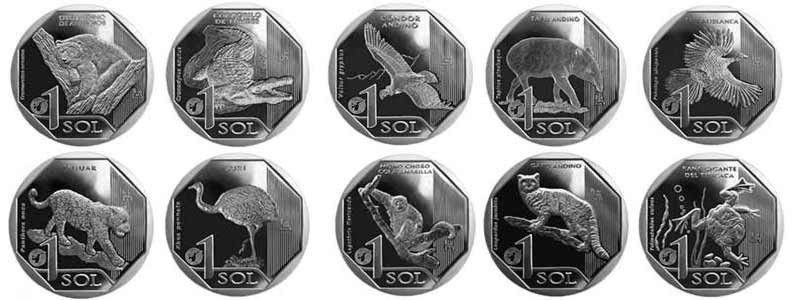
The numismatic series “Fauna Silvestre Amenazada del Perú” (Threatened Wildlife of Peru) was issued by the Peruvian Central Reserve Bank (BCRP) to continue with the lovely numismatic culture and to raise awareness for the importance of species and environment protection with one of the most commonly used coins in the country, the S/ 1 coin.

On the front of each of the 10 different Threatened Wildlife coins one native animal in Peru threatened with extinction is depicted; the back shows the Peruvian Coat of Arms surrounded by the writing Banco Central de Reserva del Perú (Central Reserve Bank of Peru) and the year of issue.

All coins in the series have the denomination of One Sol (S/ 1). They are legal tender. The coins circulate simultaneously with all other S/ 1 coins and can be used in any transaction in Peru. 10 million units from each motive have been minted.

Specifications

  • Value: One Sol (S/ 1)
  • Date of issue: between 2017 and 2019
  • Diameter: 25.5 mm
  • Mass: 7.32g
  • Material: Alpaca (copper alloy with nickel and zinc)
  • Mintage: 10 million coins of each motive
  • Front image: native animal threatened with extinction and the logo of the National Mint on a background of vertical lines.
  • Back image: Peruvian Coat of Arms
  • Legal tender: Yes

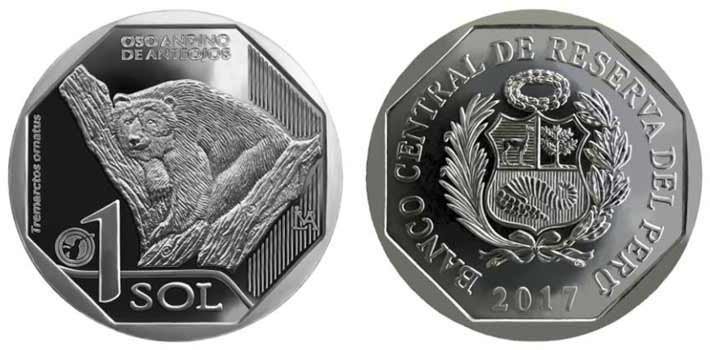
1st Threatened Wildlife coin - Andean Spectacled Bear (Oso Andino de Anteojos)

The first coin of the Threatened Wildlife numismatic series was issued on July 18, 2017. It features the Andean spectacled bear (tremarctos ornatus), also known as the Andean bear, Andean short-faced bear or in Peru Jukumari.

The front of the new S/ 1 coin shows a spectacled bear laying on a tree. As only bear native to South America, the spectacled bear mainly lives in the Andes Mountains of Ecuador, Colombia, Bolivia and Peru in humid and cooler areas. The mid-sized Andean bear has a blackish-brownish fur and distinctive whitish-beige to light brown spectacle-like markings around the eyes and across the face and chest. The usually shy and solitary Andean spectacled bear spends much of its time climbing trees and feeding on vegetation such as cactus, palm nuts and leaves, bamboo, orchids and fruits; only about 5% of their diet is meat.

With only 18,000 spectacled bears left on our planet, from which about a third live in Peru, the Andean short-faced bear is considered vulnerable according to the IUCN (International Union for Conservation of Nature) Red List of Threatened Species. Principal threats include habitat loss because of agriculture, illegal logging, mining, oil exploration and road development, and poaching.

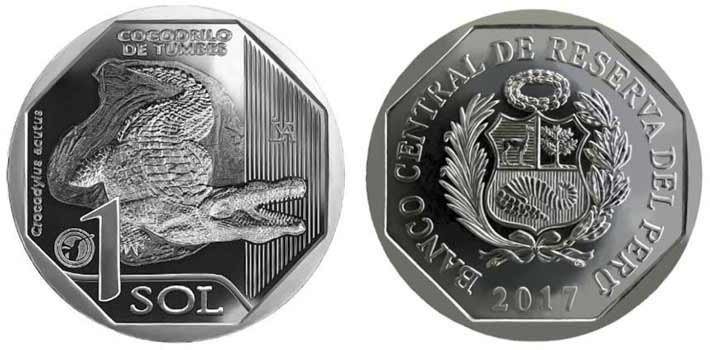
2nd Threatened Wildlife coin - Tumbes crocodile (crocodrilo de Tumbes)

The second coin of the Threatened Wildlife numismatic series was issued on November 8, 2017. It features the Tumbes crocodile, also known as American crocodile or crocodylus acutus.

We can find the American crocodile in the Neotropica inhabiting the shores of the Pacific and Atlantic Ocean from northern Mexico and southern Florida down to Venezuela and northern Peru. As the name suggests, in Peru the Tumbes crocodile can be found in the coastal mangroves of Tumbes, mainly in sanctuaries and occasionally in remote areas along the Tumbes river. The grayish-green adults measure on average between 2.90m to 4.10m (9ft6in to 13ft5in) in length weighing up to about 400kg to 500kg (880 lb). They have a triangular, narrow and long head with powerful jaws, short legs and a long powerful tail. Tumbes crocodiles feed on any aquatic or terrestrial animal they encounter.

As only animal of this type living in Peru the Tumbes crocodile is considered vulnerable according to the IUCN (International Union for Conservation of Nature) Red List of Threatened Species. Primary threats include poaching and habitat loss because of coastal developments, including destruction of nesting grounds and the destruction of mangrove swamps.

Peru Newsflash

New lizard species discovered in Peru

There is still so much new to find out about and see in Peru. Just recently Peruvian scientists discovered a...


Peru has the second-worst drivers in the world

For those living and driving in Peru it comes to no surprise. A recent study by Compare the Market, an...


Machu Picchu reopens for the first time after the social outbreak

The Ministry of Culture of Peru decided to re-open Machu Picchu after it was closed on January 21 because of...


Peru extends the state of emergency in 44 districts

The Peruvian government extended the "state of emergency" in 44 districts of the central departments of...

Peru Event Calendar

«◀ April 2025 ▶»
MonTueWedThuFriSatSun
12345
6789101112
1314151617 1819
20212223242526
27282930

Upcoming Events in Peru

Upcoming Events in Peru

Tourist Attractions & Sights in Peru

Machu Picchu


Peruvian Visa Types

Peruvian Digital Nomad Visa


Peruvian Cheese

Queso Rojo de Lluta

Latest Video

Long Reads...

The Mystery of the Nazca Lines in Peru

In the 1920s, when people first flew across southern Peru, they made an astonishing discovery. Stretching below them,…


Francisco Pizarro González (1474-1541)

Francisco Pizarro, a peasant from Spain, was one of the least well-equipped conquerors in history. However, in the name…


The colorful Fabrics and Textiles of Peru

Europe’s first knowledge of Peruvian textiles was acquired following the Spanish invasion of Peru in 1532, when the…


The Jeweled Frog and the Condor

By a quiet pond, at the side of a cloud-topped mountain in Peru, lived a small green frog and his large green family.…


Peruvian Economy

The Peruvian economy is an emerging, social market economy highly dependent on foreign trade and classified as an upper…