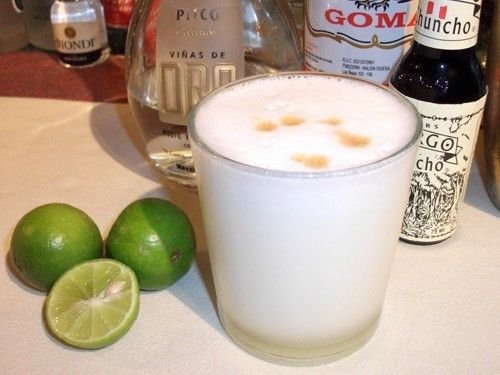
Peru’s national drink and most popular cocktail is surely the famous Pisco Sour. It is the welcome drink in Peru and served for literally any occasion.
Pisco Sour is based on Pisco, a Peruvian grape brandy. Apart from the Pisco, other main ingredients of the Pisco Sour are lime juice obtained from pressing out the small, very acidy Peruvian limes, fresh egg white and Jarabe de Goma, known in the cocktail scene as well as gummy or gum syrup.
This traditional creole dish represents, like no other, the unique fusion of different cultures, traditions and flavors that is so characteristic for today’s Peruvian cuisine.In the 19th century, masses of Chinese immigrants settled along the Peruvian coast to work in the booming agricultural sector. Like the Spanish conquerors, the Basques and African slaves before them, they brought their cooking culture and techniques as well as a few ingredients with them. Merging Peruvian ingredients such as potatoes, ajis and meat with the Chinese way of preparing food (finely slicing ingredients and rapidly stir frying them in a wok), Lomo Saltado was born.The traditional Lomo Saltado is prepared by stir frying sliced beef tenderloin, sirloin or fillet with red onions, tomatoes and aji amarillo adding soy sauce, vinegar and cilantro. Mixed with French fries and served with rice, Lomo Saltado is a great example of how foreign influences and cooking styles not only coexist next to the native, local cuisine, but melt in harmony creating new, enriched Peruvian flavors.And for some variation of this fantastic and beloved dish, the beef can be substituted with chicken breast (Pollo Saltado), pork loin (Lomo Saltado de Cerdo), shrimps (Camerones Saltado) or a mixture of seafood (Saltado de Mariscos). Delicious!Is your mouth already watering? So indulge in our quick and simple to prepare recipe for authentic Peruvian Lomo Saltado.All ingredients can be found easily, no matter where you are in the world; except for the aji amarillo. If you want to stay as authentic as possible and don’t live in Peru, try Latin American food stores around you or online shops. They usually carry aji amarillo in jars or frozen as well as aji amarillo paste that serves its purpose of giving this dish a mild spicy note. If you can’t get it, you can use any other mild yellow, orange or red chili pepper or even an orange bell pepper. The Pisco is optional and can easily be left out; I usually add it to my Lomo Saltado to give the dish this little extra Peruvian flavor.
Some Pisco Sour history
Many stories and myths entwine around the creation of the first Pisco Sour. Many sources claim that it was invented in the 1920s by Victor Vaughen Morris, the owner of the Morris’ Bar in Lima, the place in town for the Peruvian upper class and foreigners, and then refined by Mario Bruiget, a Peruvian bartender working at the Morris Bar, later.
A recipe book from 1903, however, already includes a description of a cocktail extremely similar to Morris’ Pisco Sour recipe that was served many decades earlier around town. And others see in the Pisco Sour just an adaption to the popular Whiskey Sour that was served since the mid-19th century in Latin America.
Pisco Sour - not only popular but part of Peruvian culture
Anyway, while we might never know who invented the first Pisco Sour, Morris surely is the one laying the foundation for its popularity. Today, the Pisco Sour is part of the Peruvian culture and the pride and joy of every Peruvian. Every bar and restaurants serves it and Peruvians drink Pisco Sour whenever there is something to celebrate, when coming together with friends or to welcome strangers and foreigners.
In 2007, the Pisco Sour was even officially declared a part of Peru’s National Cultural Patrimony and is celebrated every year on the first Saturday of February with the “Dia Nacional del Pisco Sour”.
How to make the perfect Pisco Sour
First of all, the key to a great Pisco Sour are the ingredients: Don’t use some cheap booze, but rather a high quality Pisco – a Pisco Aromático, Pisco Acholado or even a usually very expensive Pisco Mosto Verde. Best choose the small Peruvian limes – if there are none around, use the most acidy limes you can find – and press them out shortly before preparing the Pisco Sour. Most recipes ask for Jarabe de Goma. In the cocktail scene, it is as well known as gummy or gum syrup. Here, as well choose quality over price. It can be substituted with white cane sugar syrup or even white granulated sugar. The egg white should be fresher than fresh.
The proportions of the ingredients are variable. Usually, a ratio of 3:1:1, 3:2:1 or even 4:1:1 is used. Our recipe below for a smoother and easy drinkable version of a perfect Pisco Sour is well tested and based on a mix of 3:2:1 (3 parts Pisco, 2 parts syrup and 1 part lime juice).
When prepared in the right way, the Pisco Sour has a fine balance between the quite strong Pisco (alcohol percentage of between 38% and 48%), the intense lime juice and the sweetness of the sugar syrup. So go easy on the Pisco and the syrup. Pisco Sour is usually served in three sizes: Single, Double or “Catedral” (Cathedral).