Tres Leches

Peruvian Three Milks

Peru’s celebrated cuisine is not only about famous chefs, outstanding dishes or the abundance of fresh fruits and vegetables, but as well about the often-forgotten sweet little temptations. One of these in the country highly popular sweet treats is Tres Leches, meaning Three Milks.

Tres Leches is a light and airy sponge cake soaked with a milk syrup made of three different types of milk – sweetened condensed milk, evaporated milk and whole milk (or heavy cream) – which is topped with whipped cream and cinnamon.

This absolutely delicious and addicting combination is usually eaten as cake or dessert, but to be honest works well around the clock and surely is a great soul food.

While Tres Leches isn’t originally from Peru, but rather is assumed to have been created first in Nicaragua or Mexico, and from there spread across Central, North and South America, the sweet, moist and rich cake today is “peruvianized” and can be found on every menu.

And the good thing: it’s incredibly easy to make with our recipe below not matter where you are in the world.

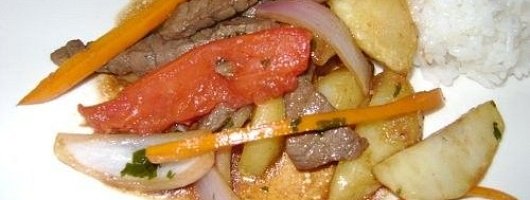
This traditional creole dish represents, like no other, the unique fusion of different cultures, traditions and flavors that is so characteristic for today’s Peruvian cuisine.In the 19th century, masses of Chinese immigrants settled along the Peruvian coast to work in the booming agricultural sector. Like the Spanish conquerors, the Basques and African slaves before them, they brought their cooking culture and techniques as well as a few ingredients with them. Merging Peruvian ingredients such as potatoes, ajis and meat with the Chinese way of preparing food (finely slicing ingredients and rapidly stir frying them in a wok), Lomo Saltado was born.The traditional Lomo Saltado is prepared by stir frying sliced beef tenderloin, sirloin or fillet with red onions, tomatoes and aji amarillo adding soy sauce, vinegar and cilantro. Mixed with French fries and served with rice, Lomo Saltado is a great example of how foreign influences and cooking styles not only coexist next to the native, local cuisine, but melt in harmony creating new, enriched Peruvian flavors.And for some variation of this fantastic and beloved dish, the beef can be substituted with chicken breast (Pollo Saltado), pork loin (Lomo Saltado de Cerdo), shrimps (Camerones Saltado) or a mixture of seafood (Saltado de Mariscos). Delicious!Is your mouth already watering? So indulge in our quick and simple to prepare recipe for authentic Peruvian Lomo Saltado.All ingredients can be found easily, no matter where you are in the world; except for the aji amarillo. If you want to stay as authentic as possible and don’t live in Peru, try Latin American food stores around you or online shops. They usually carry aji amarillo in jars or frozen as well as aji amarillo paste that serves its purpose of giving this dish a mild spicy note. If you can’t get it, you can use any other mild yellow, orange or red chili pepper or even an orange bell pepper. The Pisco is optional and can easily be left out; I usually add it to my Lomo Saltado to give the dish this little extra Peruvian flavor.

Preparation:

  1. Preheat oven to 175°C (350°F). Lightly grease a 33cm x 22.5cm (13” x 9”) glass baking dish or another “presentable” square or rectangular baking pan with a high edge or if you prefer single portions small ramekins or something similar.
  2. Sift the flour and baking powder together and set aside. Separate the eggs.
  3. Preparing the cake: add the salt to the egg whites and beat until stiff. Then gradually add the sugar and whisk until it is completely dissolved. Add the egg yolks and a teaspoon of vanilla extract. Continue to beat until foamy. Very carefully fold in the flour-baking powder mixture, alternating with the milk until the batter is smooth.
  4. Pour the batter into the prepared baking dish. Bake for 30 minutes (or until a toothpick inserted in the center comes out clean) and remove from oven. Then loosen the edges with a knife and pierce the cake several times with a fork or skewer. Allow the cake to cool in the baking dish completely.
  5. Preparing the milk syrup: thoroughly combine the sweetened condensed milk, the evaporated milk, the whole milk and the rum.
  6. Soaking the cake: Leave the cake in the baking dish and pour some of the milk mixture slowly and evenly over it until soaked (you won’t need more than half of the milk syrup). Cover with cling film and refrigerate the cake and the rest of the liquid. After an hour soak the cake again with the syrup and keep covered for at least 3 hours (best overnight) in the fridge. Refrigerate the rest of the syrup as well.
  7. Finishing touches: To finish the Tres Leches whip the cream with the sugar and vanilla extract until stiff. Spread the cream generously over the top of the cake and sprinkle with cinnamon. Keep refrigerated until serving. Serve cut into small squares together with the rest of the syrup – if you, like my family and friends, prefer to have lots of extra delicious milk syrup with your Tres Leches, best prepare 1.5 or even 2 times the quantity.
  8. Indulge and enjoy!

Peru Newsflash

New lizard species discovered in Peru

There is still so much new to find out about and see in Peru. Just recently Peruvian scientists discovered a...


Peru has the second-worst drivers in the world

For those living and driving in Peru it comes to no surprise. A recent study by Compare the Market, an...


Machu Picchu reopens for the first time after the social outbreak

The Ministry of Culture of Peru decided to re-open Machu Picchu after it was closed on January 21 because of...


Peru extends the state of emergency in 44 districts

The Peruvian government extended the "state of emergency" in 44 districts of the central departments of...

Peru Event Calendar

«◀ April 2025 ▶»
MonTueWedThuFriSatSun
12345
6789101112
1314151617 1819
20212223242526
27282930

Upcoming Events in Peru

Upcoming Events in Peru

Tourist Attractions & Sights in Peru

Machu Picchu


Peruvian Visa Types

Peruvian Digital Nomad Visa


Peruvian Cheese

Queso Rojo de Lluta

Latest Video

Long Reads...

The Mystery of the Nazca Lines in Peru

In the 1920s, when people first flew across southern Peru, they made an astonishing discovery. Stretching below them,…


Francisco Pizarro González (1474-1541)

Francisco Pizarro, a peasant from Spain, was one of the least well-equipped conquerors in history. However, in the name…


The colorful Fabrics and Textiles of Peru

Europe’s first knowledge of Peruvian textiles was acquired following the Spanish invasion of Peru in 1532, when the…


The Jeweled Frog and the Condor

By a quiet pond, at the side of a cloud-topped mountain in Peru, lived a small green frog and his large green family.…


Peruvian Economy

The Peruvian economy is an emerging, social market economy highly dependent on foreign trade and classified as an upper…