For those living and driving in Peru it comes to no surprise. A recent study by Compare the Market, an Australian car insurance company, came to the conclusion that Peru has the second-worst drivers in the world.
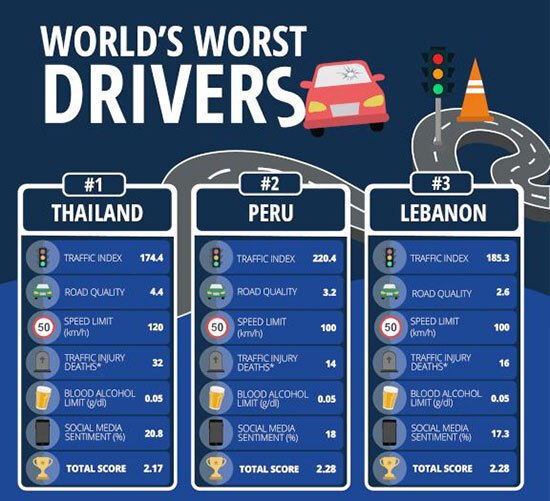
To find out which countries have the best and worst drivers, the car insurance experts chose 50 countries worldwide comparing how good they are to drive in. To do this, 6 different factors were compared:
- Traffic Index: A composite index of time consumed in traffic due to job commute, estimation of time consumption dissatisfaction, CO2 consumption estimation in traffic and overall inefficiencies in the traffic system. Low values get a high score. High values get a low score.
- Road Quality: Response to the survey question “In your country, what is the quality of road infrastructure?” High values get a high score. Low values get a low score.
- Speed Limit: The maximum speed limit within the country. Low values get a high score. High values get a low score. High values get a high score. Low values get a low score.
- Traffic Injury Deaths: Estimated road traffic death rate, per 100,000 people, in 2019. Low values get a high score. High values get a low score.
- Blood Alcohol Limit: The maximum allowable blood alcohol limit whilst driving. Measured in g/dl. Low values get a high score. High values get a low score.
- Social Media Sentiment: The percentage of social media posts that were positive about “driving” in the last year. High values get a high score. Low values get a low score.
And while the world’s best drivers can be found in Japan, the Netherlands and Norway, on the other end of the spectrum we find the world’s worst drivers in Thailand, Peru and Lebanon.
This traditional creole dish represents, like no other, the unique fusion of different cultures, traditions and flavors that is so characteristic for today’s Peruvian cuisine.In the 19th century, masses of Chinese immigrants settled along the Peruvian coast to work in the booming agricultural sector. Like the Spanish conquerors, the Basques and African slaves before them, they brought their cooking culture and techniques as well as a few ingredients with them. Merging Peruvian ingredients such as potatoes, ajis and meat with the Chinese way of preparing food (finely slicing ingredients and rapidly stir frying them in a wok), Lomo Saltado was born.The traditional Lomo Saltado is prepared by stir frying sliced beef tenderloin, sirloin or fillet with red onions, tomatoes and aji amarillo adding soy sauce, vinegar and cilantro. Mixed with French fries and served with rice, Lomo Saltado is a great example of how foreign influences and cooking styles not only coexist next to the native, local cuisine, but melt in harmony creating new, enriched Peruvian flavors.And for some variation of this fantastic and beloved dish, the beef can be substituted with chicken breast (Pollo Saltado), pork loin (Lomo Saltado de Cerdo), shrimps (Camerones Saltado) or a mixture of seafood (Saltado de Mariscos). Delicious!Is your mouth already watering? So indulge in our quick and simple to prepare recipe for authentic Peruvian Lomo Saltado.All ingredients can be found easily, no matter where you are in the world; except for the aji amarillo. If you want to stay as authentic as possible and don’t live in Peru, try Latin American food stores around you or online shops. They usually carry aji amarillo in jars or frozen as well as aji amarillo paste that serves its purpose of giving this dish a mild spicy note. If you can’t get it, you can use any other mild yellow, orange or red chili pepper or even an orange bell pepper. The Pisco is optional and can easily be left out; I usually add it to my Lomo Saltado to give the dish this little extra Peruvian flavor.
Peru not only has come in second-last place but got the highest traffic index score (220.4), and fourth-poorest levels of road quality.
To make matters even worse, TomTom just recently published their Traffic Index 2022 measuring cities around the world by their travel time, fuel costs and CO2 emissions. The Peruvian capital ranked 8th worldwide with a travel time per 10km (6mi) of 27min 10s, an increase of 2 minutes compared to last year. On the American continent Lima even is placed first before Bogota with a travel time per 10km of 26min 20s and Mexico City with 25min 40s.
So, if you are brave enought to drive in Lima or Peru, the only thing we can do for you is our article “Driving in Lima – Not for the faint-hearted; Peruvian combination of “demolition derby” and a “game of chicken”. Have fun!