Europe’s first knowledge of Peruvian textiles was acquired following the Spanish invasion of Peru in 1532, when the conquistadores included a few fabrics in shipments of gold and silver they sent back to Spain.
None of these early pieces shipped to Europe is known to be preserved, but different European archives still yield detailed descriptions of these products of Peruvian looms, which were the first of their kind to reach Europe. The early Spanish chroniclers, amazed at finding such fine textiles, mentioned in their reports the unusual nature of these cloths, the richness of their colors and the superior quality of their dyes.
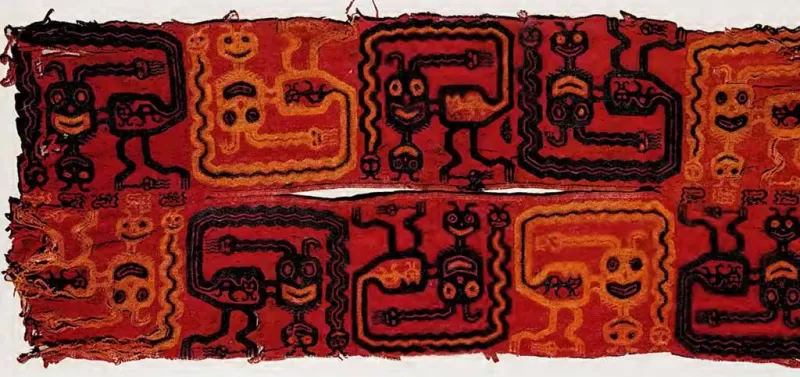
Fabrics from Peru, among them many that were made centuries earlier than those admired by the Spanish invaders, have found their way into European and other collections during the past few decades. Although many show designs that seem strange to European eyes, there are among these textiles, produced far from European influences, examples of great elegance and beauty.
The ancient Peruvians left no written records and, as a result, today’s knowledge of their culture has been derived almost exclusively from the artifacts and structures which have survived the ravages of time and the destructive tendencies of men. Since textile fibers are among the least durable of materials, these have been preserved only under the most favorable circumstances. In Peru, in the coastal area’s conditions prevailed which were more or less parallel to those of ancient Egypt. Rainfall was almost unknown and mainly due to burial practices, numerous fabrics were left undisturbed in protected locations for long periods of time.
Beginning less than a century ago, scientific excavations of parts of the cemeteries and areas of ancient habitation have made it possible to reconstruct a tentative sequence for pre-Columbian cultural development. This indicates that for some 4,000 years prior to the Spanish conquest, the inhabitants of the western coastal and highland regions of South America produced woven textiles. The earliest so far recovered are of cotton and bast fibers. Later, textiles were made mainly of cotton and wool with some bast fibers and hair used for special purposes.
Cotton in white and several shades of brown is known to have been cultivated in the coastal valleys. Wool came from the native camelids of the highlands, the Llama, Alpaca, Vicuña and Guanaco. No metal threads are known to have been used and there is no evidence to show that either silk or linen (flax) was known. Sheep’s wool was only introduced by the Spaniards upon their arrival in Peru.
Spinning and weaving were highly developed, making it possible to produce fabrics of various textures. These ranged from cloths of great finesse to coarse, heavy pieces for utilitarian purposes, and from open, lace-like types to others of rug-like firmness. The weaving techniques included most of those known to present-day craftsmen, as well as a large number which are not in current use. Of the standard weaves, only satin appears to have been absent. Pile weaves and twill were used sparingly.
Favored types were tapestry, wrap-face stripes in plain and pattern weaves, brocades and damasks, gauzes and double cloths, all of which occur in a number of distinctive forms. In addition to patterning produced during weaving, added bands, borders tassels and fringes were used. Feathers, small plaques of gold and silver, as well as embroidery, served for ornamentation. Patterns were produced also by the tie-die methods and painting.
Many of the weaving practices of ancient Peru cannot be duplicated on today’s looms. The Peruvians made most of their cloths with four selvages, frequently weaving first from one end of the wrap and then the other. They built up one unit of a pattern quite independent of the other units, and put wefts in diagonally or in curves, if they wished. This was possible, since their looms were not equipped with a reed and fixed beater as are modern or European style looms.
All of these types of weaving and ornamentation and numerous other textile making techniques, such as twining, knotting, netting, looping and braiding or plaiting, were known and used in Peru. Long before the Spanish conquest, technical and aesthetic competence had developed to a high level and more important to the reconstruction of the picture of the cultural growth of these people, there were marked local and temporal preferences for certain techniques, designs and colors.
The first scientific excavations, especially those of parts of the cemeteries of Pachacamac, not far from Lima, made it possible to begin mapping out a sequence for Peruvian cultural development. Subsequent work at Pachacamac, at Ancon, and in the Lima valley of the central coastal region, on the Paracas peninsula, in Nazca, Ica, Chincha, and Cañete valleys to the south, and the Chancay, Supe, Chicama, Santa and Moche valley, to the north, among others, has shown a number of fairly distinct styles.
Three of these are generally considered being pan-Peruvian. The earliest of the three was Chavín, a northern style, which is believed to have penetrated far enough to the south to have influenced Paracas designs such as are shown in many of the famous embroidered Peruvian textiles. The second of these was the Tiahuanaco style. This, believed to have had its origin in the southern highlands, spread to the coast where though modifications a distinct Coast Tiahuanaco variant developed. In textiles, this style is seen in many fine Peruvian tapestries, some of which appear quite modern in design.
Later, Inca influence spread over much of Peru, leaving its mark but never completely supplanting the older styles. Inca textiles probably are best known by large poncho-shirts in tapestry with designs consisting of many small squares, and bags with small llama figures. Numerous other styles, some paralleling the above, some intervening, are equally distinctive. Of these, most are believed to have had limited geographical distribution and are known as local styles.