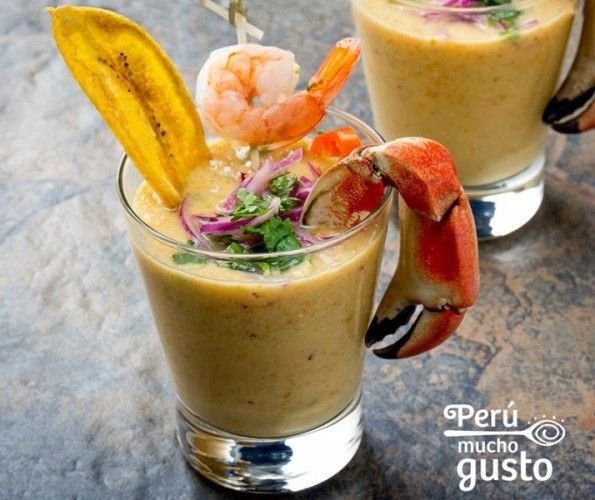
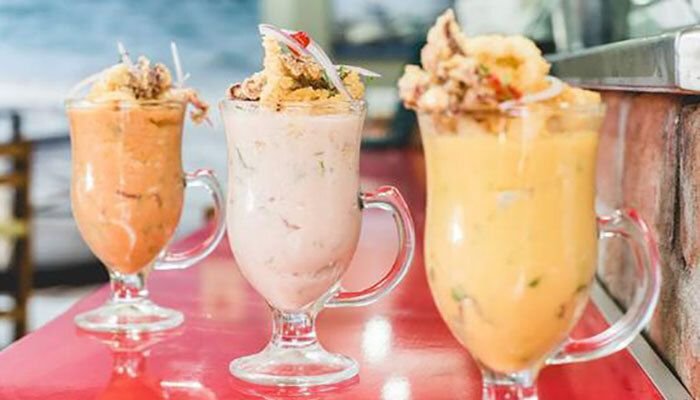
In the original sense, Leche de Tigre (meaning Tiger’s Milk), is the marinating liquid left on the plate after having finished a Ceviche, Peru’s famous appetizer which impresses with its simplicity, freshness, and Peruvian flavor.
Since forever, this liquid infused by all the flavors and healthy nutrients of the fish, the aji, the onion and lime juice, is spooned after the meal to enjoy even the last drop of Peru’s national dish, to boost the libido (here supposedly the tiger comes into play) or to ease the discomfort of a hangover supposedly bringing the dead back to life.
However – depending on how you look at it – clever entrepreneurs or creative minds, further developed the original Leche de Tigre, so the simple leftover marinating liquid of Ceviche, promoting it as stand-alone drink: first as hip savory, in most cases non-alcoholic (some bartenders would add a shot of Pisco) cocktail and later, adding other ingredients, as sort of a healthy, true Peruvian smoothie everyone should consume to add some more vitamins and minerals to their diet.
Even though some people say that Leche de Tigre is just a liquified Ceviche with less fish and lots of things that don’t belong into Peru’s famous appetizer, today, Leche de Tigre is highly popular. It is made at home or served in (seafood) restaurants as an apéritif or starter and in bars as a cocktail. And while everyone has his or her own “secret” recipe, main elements include the classic Ceviche ingredients: fish, lime juice, aji and onion. Additionally, in most recipes, fish stock, celery, garlic, ginger, cilantro, and sometimes evaporated milk is added. All the ingredients are blended, poured into a simple or fancy glass, nicely decorated or not, and then served as an apéritif, starter, or cocktail.
Making Peruvian Leche de Tigre is simple and a matter of minutes. Below find a basic (!) recipe which gives you a good introduction and can be adjusted to taste, for example by adding other seafood.
This traditional creole dish represents, like no other, the unique fusion of different cultures, traditions and flavors that is so characteristic for today’s Peruvian cuisine.In the 19th century, masses of Chinese immigrants settled along the Peruvian coast to work in the booming agricultural sector. Like the Spanish conquerors, the Basques and African slaves before them, they brought their cooking culture and techniques as well as a few ingredients with them. Merging Peruvian ingredients such as potatoes, ajis and meat with the Chinese way of preparing food (finely slicing ingredients and rapidly stir frying them in a wok), Lomo Saltado was born.The traditional Lomo Saltado is prepared by stir frying sliced beef tenderloin, sirloin or fillet with red onions, tomatoes and aji amarillo adding soy sauce, vinegar and cilantro. Mixed with French fries and served with rice, Lomo Saltado is a great example of how foreign influences and cooking styles not only coexist next to the native, local cuisine, but melt in harmony creating new, enriched Peruvian flavors.And for some variation of this fantastic and beloved dish, the beef can be substituted with chicken breast (Pollo Saltado), pork loin (Lomo Saltado de Cerdo), shrimps (Camerones Saltado) or a mixture of seafood (Saltado de Mariscos). Delicious!Is your mouth already watering? So indulge in our quick and simple to prepare recipe for authentic Peruvian Lomo Saltado.All ingredients can be found easily, no matter where you are in the world; except for the aji amarillo. If you want to stay as authentic as possible and don’t live in Peru, try Latin American food stores around you or online shops. They usually carry aji amarillo in jars or frozen as well as aji amarillo paste that serves its purpose of giving this dish a mild spicy note. If you can’t get it, you can use any other mild yellow, orange or red chili pepper or even an orange bell pepper. The Pisco is optional and can easily be left out; I usually add it to my Lomo Saltado to give the dish this little extra Peruvian flavor.